
Affiliate disclosure: This page contains affiliate links. As an Amazon Associate, we earn from qualifying purchases at no extra cost to you. Learn more.
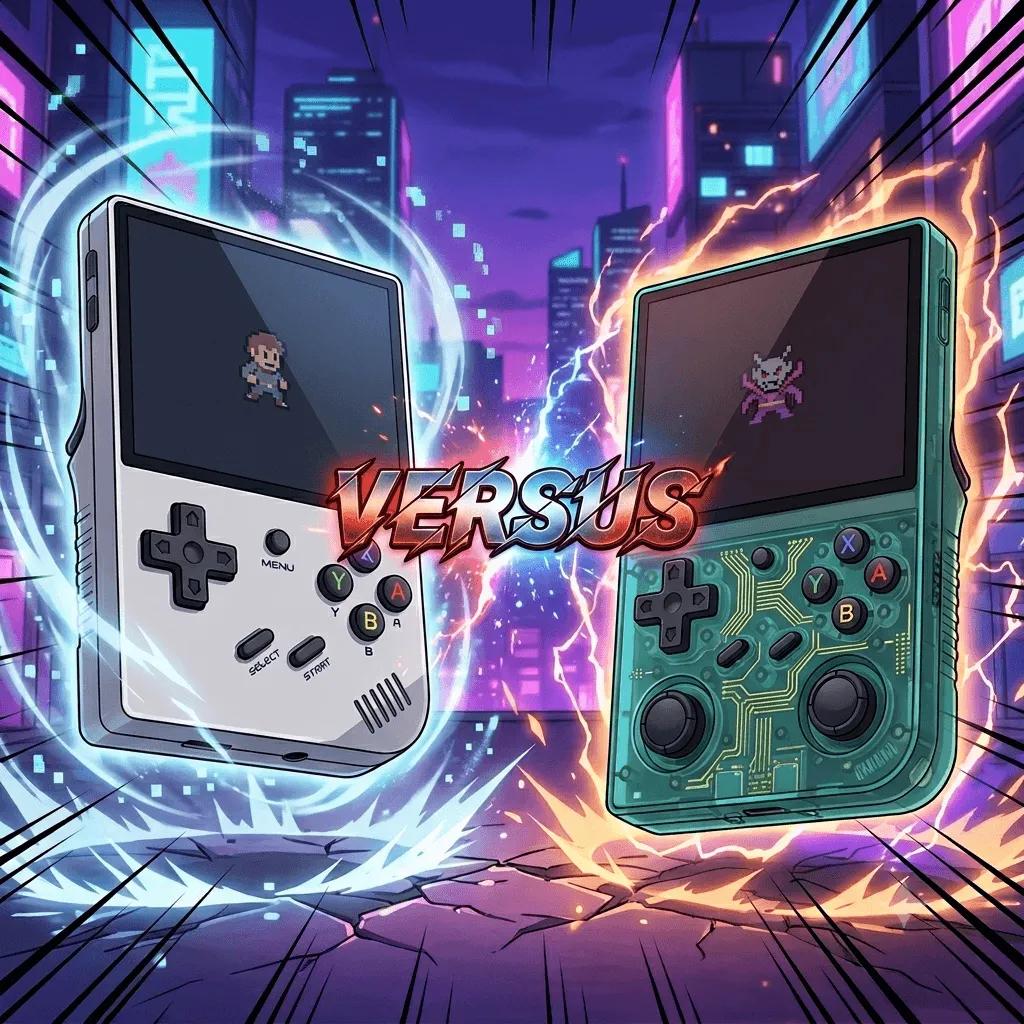
The Anbernic RG35XX Plus and RG35XX Pro are the two most recommended budget handhelds in the retro gaming community — and they share nearly identical internals. Same H700 chip, same RAM, same 3.5-inch 640x480 IPS screen, same custom firmware support. The difference is form factor: horizontal versus vertical. That single difference affects comfort, pocketability, and which games feel best to play on each device.
Specs Compared
| RG35XX Plus | RG35XX Pro | |
|---|---|---|
| Price | $70 | $65 |
| Form Factor | Horizontal | Vertical |
| Screen | 3.5" IPS 640x480 | 3.5" IPS 640x480 |
| Chipset | Allwinner H700 | Allwinner H700 |
| RAM | 1GB LPDDR4 | 1GB LPDDR4 |
| Analog Sticks | 2 (dual) | 1 (single) |
| Shoulder Buttons | L1, L2, R1, R2 | L1, L2, R1, R2 |
| Battery | 3,300mAh | 3,300mAh |
| WiFi / Bluetooth | Yes / Yes | Yes / Yes |
| HDMI | Yes | Yes |
| Rumble Motor | Yes | Yes |
| Weight | ~165g | ~155g |
The key hardware difference: the Plus has two analog sticks. The Pro has one. Everything else is functionally identical.
Form Factor
The RG35XX Plus uses a horizontal layout inspired by the original Game Boy. Your hands grip the sides with thumbs resting naturally on the D-pad and face buttons. The dual analog sticks sit below the D-pad and buttons respectively, mirroring a controller layout. It's wider than the Pro but flatter — it slides into a jacket pocket but not a jeans pocket.
The RG35XX Pro uses a vertical layout inspired by the Game Boy Color or Game Boy Pocket. You hold it with both hands centered, D-pad under the left thumb, buttons under the right. The single analog stick is below the D-pad. It's taller and narrower than the Plus — more pocketable, especially in jeans or shorts.
Neither form factor is objectively better. It comes down to which systems you play most and where you plan to carry it.
Comfort by System
Game Boy, Game Boy Color, Game Boy Advance: The vertical Pro feels more natural for these systems. The original Game Boy family used a vertical layout, and the Pro replicates that hand position. GBA on the Plus is also comfortable, but the wider grip can feel less intuitive for side-scrolling GBA games.
NES and SNES: The horizontal Plus has the edge here. SNES especially benefits from the wider layout — shoulder button access is more natural when your hands are spread apart rather than stacked.
PS1: The Plus wins for PS1. Many PS1 games use all four shoulder buttons, and the horizontal layout makes L1/L2/R1/R2 access more comfortable during extended play. Games that need an analog stick (Ape Escape, for example) are only fully playable on the Plus with its dual sticks.
N64: The Plus is the only option here. N64 games require an analog stick for camera control and movement. The Pro's single stick makes most N64 games playable but compromised — you can't control the camera and move simultaneously without awkward button remapping.
Dreamcast: Same as N64. The second stick on the Plus matters for 3D Dreamcast games. The Pro handles 2D Dreamcast games fine.
Genesis and Master System: Both are equally comfortable. These systems use D-pad and three or six buttons — no analog sticks needed.
Custom Firmware
Both devices have identical custom firmware support. KNULLI, muOS, and Batocera all work on both. The firmware experience is the same regardless of which device you choose.
For first-time users, we recommend KNULLI for its balance of ease-of-use and features. muOS is slightly more performance-focused and has a dedicated following for its speed and minimalist interface. See our muOS vs KNULLI vs Onion OS comparison for a deeper dive.
Battery Life
Both have 3,300mAh batteries and identical power consumption due to the shared H700 chipset. Real-world battery life is essentially the same: 5 to 7 hours for GBA and NES, 4 to 5 hours for PS1 and N64, and 3 to 4 hours for Dreamcast. Screen brightness has the biggest impact on battery life — both panels are the same, so the numbers are interchangeable.
Build Quality
Both devices share Anbernic's standard H700-series build quality. Plastic shells with a matte finish, responsive D-pads, clicky shoulder buttons. Neither feels cheap, neither feels premium — they feel like exactly what they are: well-built $65-$70 devices.
The D-pads are slightly different due to the form factor. Some users prefer the Plus's wider-set D-pad for fighting game quarter-circle motions. Others prefer the Pro's compact D-pad for precise platformer inputs. Both are among Anbernic's better D-pad implementations.
Pocketability
The Pro wins pocketability. Its narrower vertical profile slides into a jeans pocket more easily than the Plus's wider horizontal body. If you're buying a handheld specifically for daily carry — something you grab on the way out the door — the Pro's shape is more practical.
The Plus fits in jacket pockets and backpack side pockets without issue, but it's a conscious carry rather than a slip-it-in-and-forget-it carry.
Price
The Pro is $5 cheaper at $65 versus the Plus at $70. The $5 difference reflects the second analog stick on the Plus. If you know you'll only play GBA, SNES, and PS1 (without analog-dependent games), the Pro saves you $5 with no functional trade-off. If there's any chance you'll want N64, 3D Dreamcast, or analog-dependent PS1 games, the $5 for the second stick is the best value upgrade in budget handhelds.
The Verdict
Buy the RG35XX Plus if you want the most versatile budget handheld. The second analog stick opens up N64 and 3D Dreamcast, the horizontal layout is more comfortable for PS1 and SNES, and the $5 premium is negligible.
Buy the RG35XX Pro if pocketability is your top priority and you primarily play GBA, Game Boy, NES, and SNES. The vertical form factor is more natural for handheld-era games, it's lighter, and it's $5 cheaper.
Both are excellent. Neither is wrong.
Related reading
 ComparisonComparisonComparison