
Affiliate disclosure: This review contains affiliate links. As an Amazon Associate, we earn from qualifying purchases at no extra cost to you. Learn more.
The Anbernic RG Vita Pro is a handheld that wears its inspiration as its literal name. It looks like a PlayStation Vita, it's called the Vita, and the unavoidable question is whether it can actually play Vita games. The short answer: not reliably. The longer answer involves a surprisingly capable PSP machine, a beautiful screen, and a pricing problem.
Design and Build
The PS Vita silhouette is immediately recognizable — curved edges, symmetrical stick layout, a glass front panel that stretches edge to edge. Anbernic committed fully to the aesthetic and the result is one of their most visually striking handhelds.
Build quality is a step above the base RG Vita. The Pro gets a glossy glass front panel similar to the Retroid Pocket Mini V2, which looks premium but attracts fingerprints constantly. The plastic shell has Anbernic's typical light, grainy texture that resists smudging on the back and sides. At roughly 235 grams, it's light enough for extended sessions without wrist fatigue.
Ergonomics are genuinely good for a flat-slab handheld. The body is wide enough that your palms wrap around it naturally, and the sticks fall under your thumbs without stretching. It's more comfortable than the TrimUI Smart Pro S and roughly on par with the Mangmi Air X.
Controls
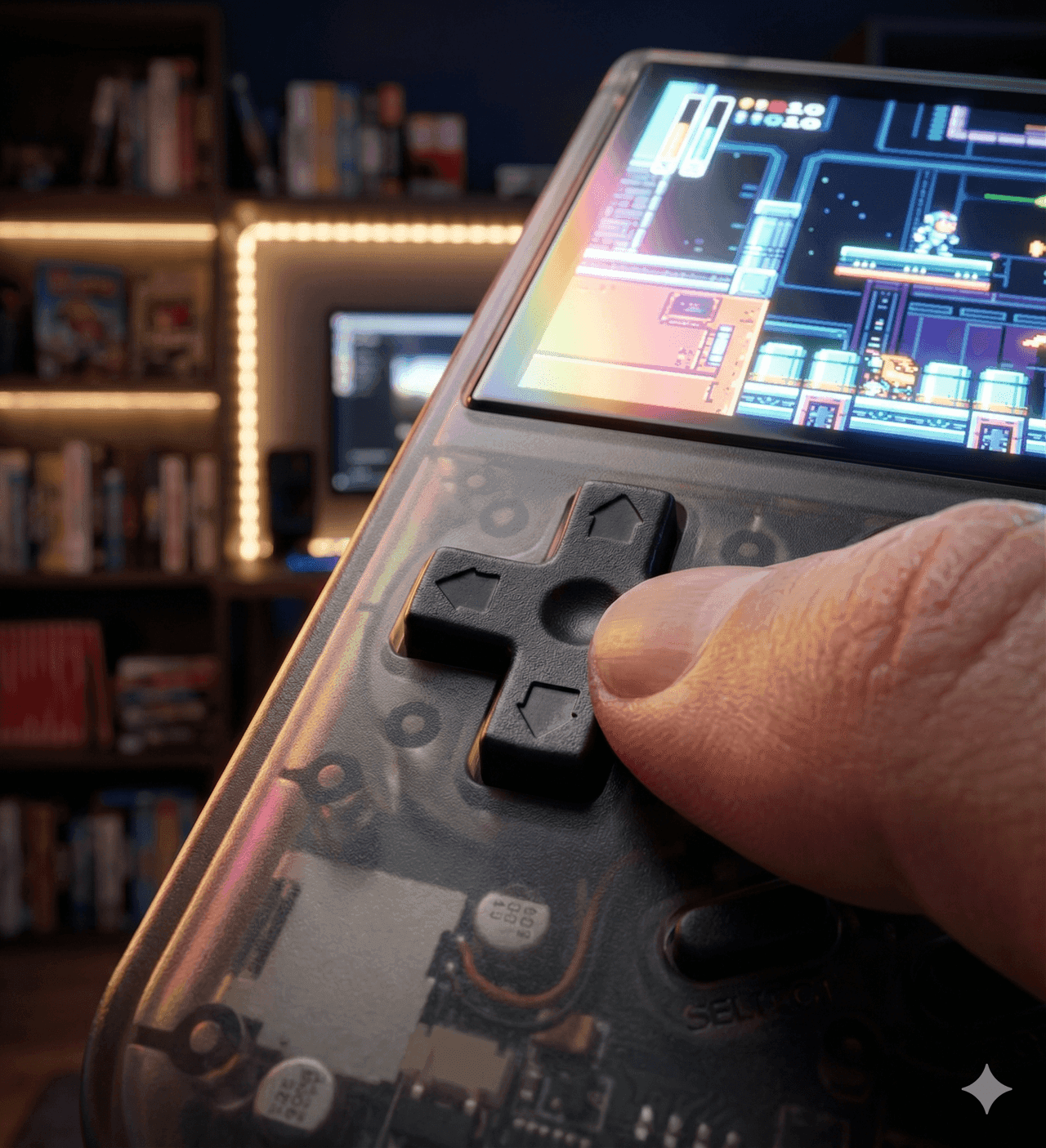
The hall-effect sticks have good range of motion and smooth travel. The D-pad is a standard Anbernic membrane style — accurate, with a satisfying click. Face buttons are responsive with a glossy finish.
The shoulder buttons are the biggest miss. L1 and R1 are fine — clicky digital switches that sit at a comfortable height. But L2 and R2 are also digital switches. No analog travel. On a device called "Pro" that costs $150, the absence of analog triggers feels like a genuine oversight. Racing games, shooting games, and anything designed around variable trigger input loses a dimension of control.
Display
The 5.5-inch 1080p IPS panel is the highlight of the hardware. Colors are vibrant, viewing angles are wide, and brightness is adequate for indoor use and light outdoor play. It's not OLED, so you won't get the inky blacks of a Retroid Pocket Mini or Steam Deck OLED, but for an IPS panel at this price, it's excellent.
The resolution matters for emulation. At 1920x1080, you get clean integer scaling for PSP games at 3x or 4x resolution — and the results are genuinely impressive. PSP titles that looked muddy on the original hardware become crisp and detailed at higher internal resolutions. This screen makes the RG Vita Pro one of the best dedicated PSP devices you can buy.
Software
The dual-boot setup is a genuine differentiator. You get Android 14 with full Google Play Store access and a Linux partition with EmulationStation as the frontend.
The Android side works well. It's a clean build without excessive bloatware, and you can install any emulator from the Play Store. PPSSPP, AetherSX2, Dolphin — everything runs as expected on Android. The out-of-box emulator setup is decent but not perfect; you'll want to install your preferred apps and configure controls yourself.
The Linux side is rougher. Anbernic's stock Linux build has quirks — odd default mappings in some emulators, inconsistent settings, and a general lack of polish. The good news is that Anbernic seeded review units to the GammaOS, KNULLI, and ROCKNIX teams before launch. Custom firmware options are available from day one, and they transform the Linux experience into something much more refined. If you plan to use the Linux partition, install a community firmware immediately.
Emulation Performance
8-bit and 16-bit (NES, SNES, Genesis, Game Boy): Perfect across the board on both Android and Linux. No issues.
PS1: Flawless. Enhanced resolution looks fantastic on the 1080p screen.
N64: Strong. Most games run at full speed. Goldeneye and Conker's have the usual minor issues that exist across all N64 emulators.
Dreamcast and Saturn: Dreamcast is excellent. Saturn is game-dependent but generally good. Panzer Dragoon Saga runs well; Guardian Heroes is perfect.
PSP: This is where the RG Vita Pro earns its keep. The Rockchip RK3576 handles PPSSPP at 3x resolution for most games and 4x for lighter titles. God of War: Chains of Olympus at 4x resolution on this screen is a showcase experience. Monster Hunter Freedom Unite, Crisis Core, and Persona 3 Portable all run smoothly at 3x. This is the best dedicated PSP handheld under $200.
PS2 and GameCube: Possible for lighter titles. Persona 4, Final Fantasy X, and Kingdom Hearts run at native resolution with some frame drops. God of War and Shadow of the Colossus require settings compromises. This is not a reliable PS2 machine — it handles the easy titles and struggles with the demanding ones.
PS Vita: The elephant in the room. Vita3K is still in early development, and performance on the RK3576 is inconsistent at best. Some 2D Vita titles are playable with patience. Anything 3D is a no-go. Do not buy this device expecting to play Vita games.
Battery Life
The 5,000mAh battery delivers roughly 4 to 5 hours of PSP emulation at moderate brightness, and 5 to 7 hours for lighter 2D systems. PS2 emulation drains it faster — expect 3 to 4 hours. Charging via USB-C takes about 2.5 hours. Respectable numbers across the board.
The Competition
At $150, the RG Vita Pro sits in a crowded price bracket. The Retroid Pocket 5 at $149 offers a Snapdragon 865, OLED screen, and better raw emulation performance for PS2 and GameCube. The Retroid Pocket Mini at $149 gives you a pocketable form factor with comparable PSP performance. The Mangmi Air X at $89 handles PSP and Dreamcast well at a much lower price.
The RG Vita Pro's advantages are its screen size (5.5 inches vs. the RP5's 5.0 inches), the dual-boot Linux option, and the PS Vita aesthetic. If those matter to you, the Pro makes sense. If raw emulation power per dollar is the priority, Retroid has the edge.
Who Should Buy This
The RG Vita Pro makes the most sense if you primarily want a PSP upscaling machine with a big, beautiful screen. It excels at that specific job better than almost anything in its price range. It's also a solid pick if you value the dual-boot flexibility and plan to run custom firmware on the Linux side.
It's a harder sell if you want reliable PS2 or GameCube emulation (get a Retroid Pocket 6 or Steam Deck), if you expect PS Vita emulation (not ready yet on any handheld), or if you're on a tight budget (the Mangmi Air X does 80% of what this does for 60% of the price).
If PSP is the draw, pair this review with our best handhelds for PSP emulation guide, the best PSP games list, and the PPSSPP setup guide to get the most out of it.
The Verdict3.8 / 5
The RG Vita Pro is a dedicated PSP upscaling machine in a beautiful shell. If that's what you want, it delivers. But the lack of analog triggers, the irony of not emulating its namesake well, and strong competition at the price point keep it from being an easy recommendation.
Related reading
 ReviewReviewReview