
Affiliate disclosure: This review contains affiliate links. As an Amazon Associate, we earn from qualifying purchases at no extra cost to you. Learn more.
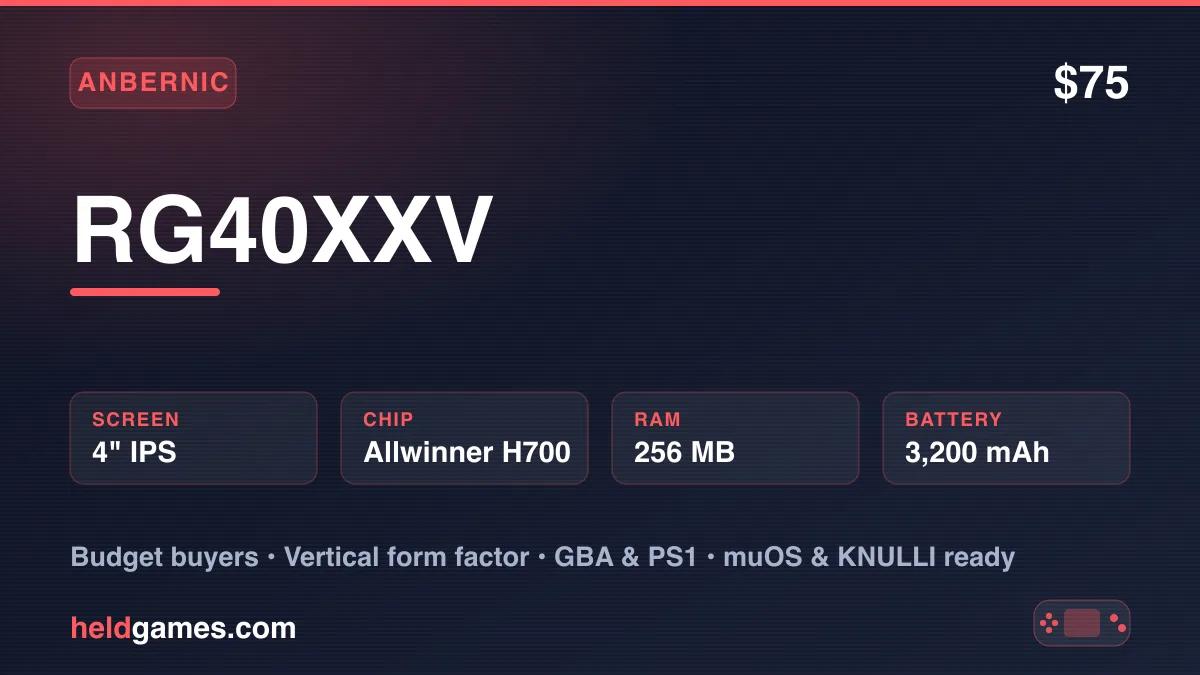
Think of the Anbernic RG40XXV as the RG35XX that hit the gym. It shares the same Allwinner H700 chip and vertical DNA as Anbernic's iconic budget handhelds, but brings a larger 4" IPS display, dual analog sticks, and a beefier battery to the table. At around $75, it's competing hard for the crown of best budget vertical handheld — and it makes a compelling case.
✓ Pros
- • Gorgeous 4" IPS display at native 640×480
- • Dual analog sticks unlock N64, PSP, and DS
- • Excellent build quality — feels premium for the price
- • muOS and KNULLI are best-in-class community firmware options
- • Strong GBA, SNES, and PS1 emulation right out of the box
- • 7–9 hours of real-world battery life
✗ Cons
- • H700 chip hits a hard ceiling — no PS2, GameCube, or Saturn
- • Stock firmware is functional but uninspiring
- • Analog sticks are small nubs — adequate but not comfortable for long 3D sessions
- • Larger screen means lower pixel density than the RG35XX
Design and Build Quality
Pick up the RG40XXV and you'll immediately recognize the Anbernic DNA. The matte plastic shell is the same thoughtful, textured design as the RG35XX — scaled up to accommodate the larger screen without feeling bloated. It's a touch wider and taller, but remains genuinely pocketable.
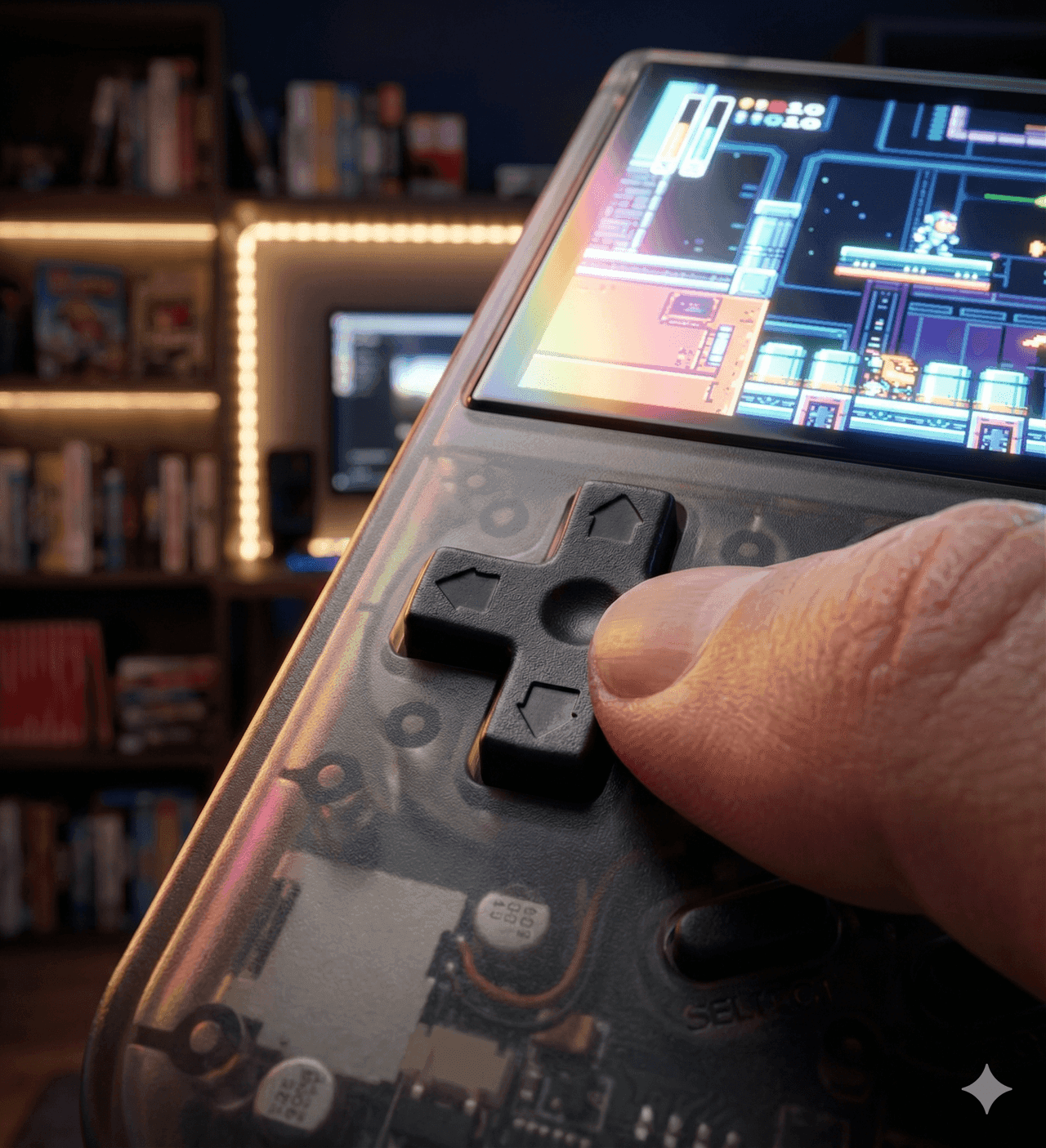
The face buttons have the same satisfying tactile click that Anbernic fans expect. The D-pad is a standout at any price point: 8-directional inputs register cleanly with zero mushiness, making it a joy for fighting games and precision platformers. Shoulder buttons — L, R, L2, and R2 — click crisply and are well-positioned for both small and large hands.
At 168g, the RG40XXV is only slightly heavier than the RG35XX (155g). The difference is barely perceptible in practice.
Display
The 4" IPS panel is the headline upgrade here. At 640×480, it shares the same resolution as the RG35XX's 3.5" screen — which means pixel density drops slightly (185 PPI vs. 211 PPI). In practice, this isn't a problem. Retro game art was designed for low-resolution displays and looks fantastic at 640×480. The larger canvas actually makes it easier to spot detail in complex sprite-heavy titles.
Brightness and color accuracy are excellent. Blacks are deep, colors pop without oversaturation, and backlight bleed is minimal even at maximum brightness. Outdoor visibility is reasonable — not great in direct sunlight, but usable in shade. GBA games render at their native resolution without any scaling artifacts.
Technical Specifications
| Screen | 4" IPS, 640×480 resolution |
| Processor | Allwinner H700 (quad-core, 1.5GHz) |
| RAM | 256MB DDR3 |
| Storage | MicroSD (user-supplied) |
| Battery | 3,200mAh — ~7-9 hours |
| OS | Linux (muOS or KNULLI recommended) |
| Connectivity | USB-C, 3.5mm audio, HDMI out |
| Dimensions | 86 × 152 × 18mm |
| Weight | 168g |
D-Pad and Buttons
The controls deserve their own section because they're genuinely one of the best things about this device. The D-pad is a cut above most handhelds at this price — precise, tactile, and fatigue-free for extended sessions. Street Fighter II, Castlevania: Symphony of the Night, and Mega Man X all feel exactly right.
The analog sticks are the weakest link. They're small nubs with a short throw distance — they work, and they unlock a whole tier of systems, but don't expect the comfort of a DualSense. For turn-based games, platformers, or anything with modest analog requirements, they're perfectly adequate. For extended 3D gaming sessions, you'll notice the limitation.
Face buttons (A/B/X/Y) are well-spaced and use the same satisfying short-travel mechanism as the rest of the Anbernic lineup. Start, Select, and the menu button are positioned sensibly and easy to reach without repositioning your grip.
Battery Life
The 3,200mAh battery is a meaningful upgrade over the RG35XX's 2,600mAh cell. Real-world testing yields:
- GBA / SNES / NES — 8–9 hours
- PS1 / N64 — 7–8 hours
- PSP — ~6 hours with display at full brightness
USB-C charging is standard and the device tops off in roughly 2.5 hours. It also supports pass-through play while charging, which is a small but appreciated touch.
Stock Firmware Experience
Out of the box, the RG40XXV runs a barebones Linux-based firmware. It's functional — games scan correctly, the emulator cores work, and you can be up and running quickly. But the UI is dated and navigation feels clunky compared to what the community has built.
For a first taste or for anyone who wants to keep things simple, stock is fine. But most users will want to move on quickly.
muOS and KNULLI Compatibility
The RG40XXV's H700 chip has first-class support in both major community firmware options:
muOS is the go-to recommendation for most users (setup guide here). It's fast, clean, and themeable with an active community constantly releasing improvements. Navigation is intuitive, scraping for boxart works well, and setup takes about 20 minutes. If you're not sure which to pick, start here.
KNULLI is the power-user option. Built on a RetroArch foundation, it gives you granular control over every emulation setting, shader, and configuration. It's slightly more complex to set up but offers more flexibility for tinkering. Great for users who want to squeeze every frame out of demanding titles.
Both support installation via a simple SD card swap — no soldering or firmware flashing required.
Emulation Performance by Tier
The H700 chip is a known quantity. Here's exactly what to expect:
Tier 1 — Excellent (full speed, no caveats): NES, Game Boy, Game Boy Color, Game Boy Advance, SNES, Sega Genesis, Neo Geo, Arcade (MAME), PlayStation 1. Every game in these libraries runs flawlessly at full speed. GBA and PS1 are the showcases — the hardware was practically built for them.
Tier 2 — Decent (most games work, some caveats):
- N64 — The majority of the library is playable. Mario 64, Ocarina of Time, Majora's Mask, and most platformers run well. Demanding titles like Conker's Bad Fur Day and Perfect Dark struggle.
- PSP — 2D PSP titles and simpler 3D games (Castlevania: The Dracula X Chronicles, Mega Man Powered Up) run well. Demanding 3D titles like God of War: Chains of Olympus are inconsistent.
- Nintendo DS — Works well for most titles using muOS or KNULLI's dual-screen layout options.
Tier 3 — Not viable: PS2, GameCube, Saturn, Dreamcast (marginal). The H700 simply doesn't have the horsepower. Don't buy this device expecting to play PS2 titles.
RG40XXV vs RG35XX — Is It Worth the Upgrade?
This is the central question for anyone already eyeing the RG35XX. Here's the honest breakdown:
| RG40XXV | RG35XX | |
|---|---|---|
| Screen | 4" IPS | 3.5" IPS |
| Resolution | 640×480 | 640×480 |
| Chip | H700 | H700 |
| Analog Sticks | Yes (dual) | No |
| Battery | 3,200mAh | 2,600mAh |
| Price | ~$75 | ~$55 |
The $20 premium buys you a larger screen, dual analog sticks, and 23% more battery. If you want to play any N64 or PSP games — or if you simply prefer the feel of a bigger handheld — the RG40XXV is the clear choice.
If you're a pure 2D gamer focused on GBA, SNES, NES, and PS1, the RG35XX is still an extraordinary value and the larger screen won't matter to you. The RG35XX's higher pixel density also gives it a slight edge for pixel-art games where sharpness is everything.
Bottom line: The RG40XXV is the step up, not a sidegrade. But the RG35XX remains the better pure value if analog sticks aren't on your checklist.
Who Is This For?
The RG40XXV is the right device if you:
- Want the best budget vertical handheld in the $70–80 range
- Care about N64 or PSP emulation alongside a GBA/SNES/PS1 library
- Prefer a larger screen for extended sessions
- Want to run muOS or KNULLI on proven, well-supported hardware
- Are upgrading from a RG35XX and want analog sticks without jumping to a $150+ device
It's not the right device if you want PS2, GameCube, or demanding modern emulation — for that, look at the Retroid Pocket 4 Pro or Anbernic RG556. Curious how it stacks against the mid-range? See our Retroid Pocket 5 vs RG40XXV comparison, or browse the full field in the best handhelds under $100 guide.
Final Verdict
The Anbernic RG40XXV earns its place as one of the best budget vertical handhelds you can buy in 2026. The 4" display is a genuine improvement, the controls are class-leading for the price, and muOS/KNULLI support makes it a pleasure to own long-term. The H700 chip's ceiling is real — you won't be playing PS2 here — but for everything from NES through PS1, with solid N64 and PSP coverage on the side, it delivers.
At $75, it's an easy recommendation for anyone entering the retro handheld hobby or looking to step up from the base RG35XX.
Related reading
 ReviewReviewReview