
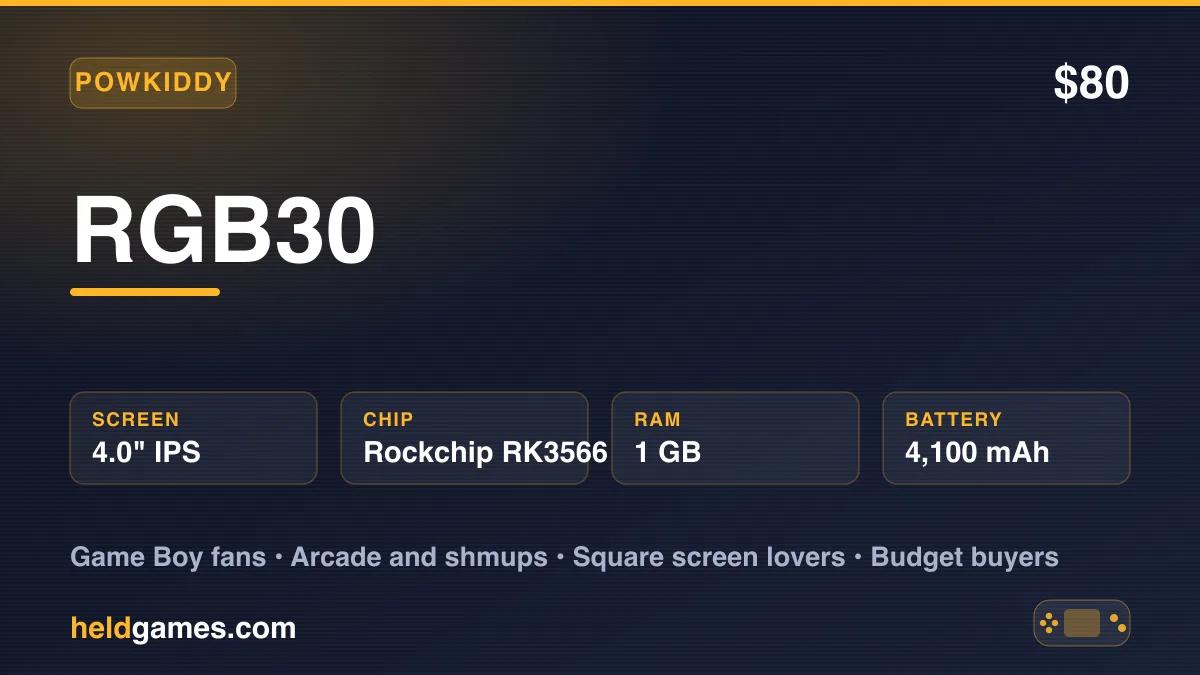
The Powkiddy RGB30 is one of the most distinctive budget handhelds on the market. Almost every other device chases a 16:9 or 4:3 screen. The RGB30 uses a 4 inch square panel at a true 1:1 aspect ratio instead. That single choice defines the whole device. It is built for systems that were never widescreen, and for those systems it shines.
✓ Pros
- • 4 inch 1:1 square screen is perfect for Game Boy, arcade, and vertical shooters
- • Sharp 720x720 IPS panel with excellent color
- • RK3566 chip handles everything through PS1 with ease
- • Strong battery life for the size
- • Open source Linux firmware with a huge emulator library
- • Wi-Fi and Bluetooth for box art, RetroAchievements, and controllers
✗ Cons
- • Square screen letterboxes most 4:3 and all 16:9 content
- • Plastic shell and analog sticks feel budget
- • Sticks are not hall effect, so drift is possible over time
- • N64, Dreamcast, and PSP are playable but not flawless
- • No GameCube or PS2 support
Build and Design
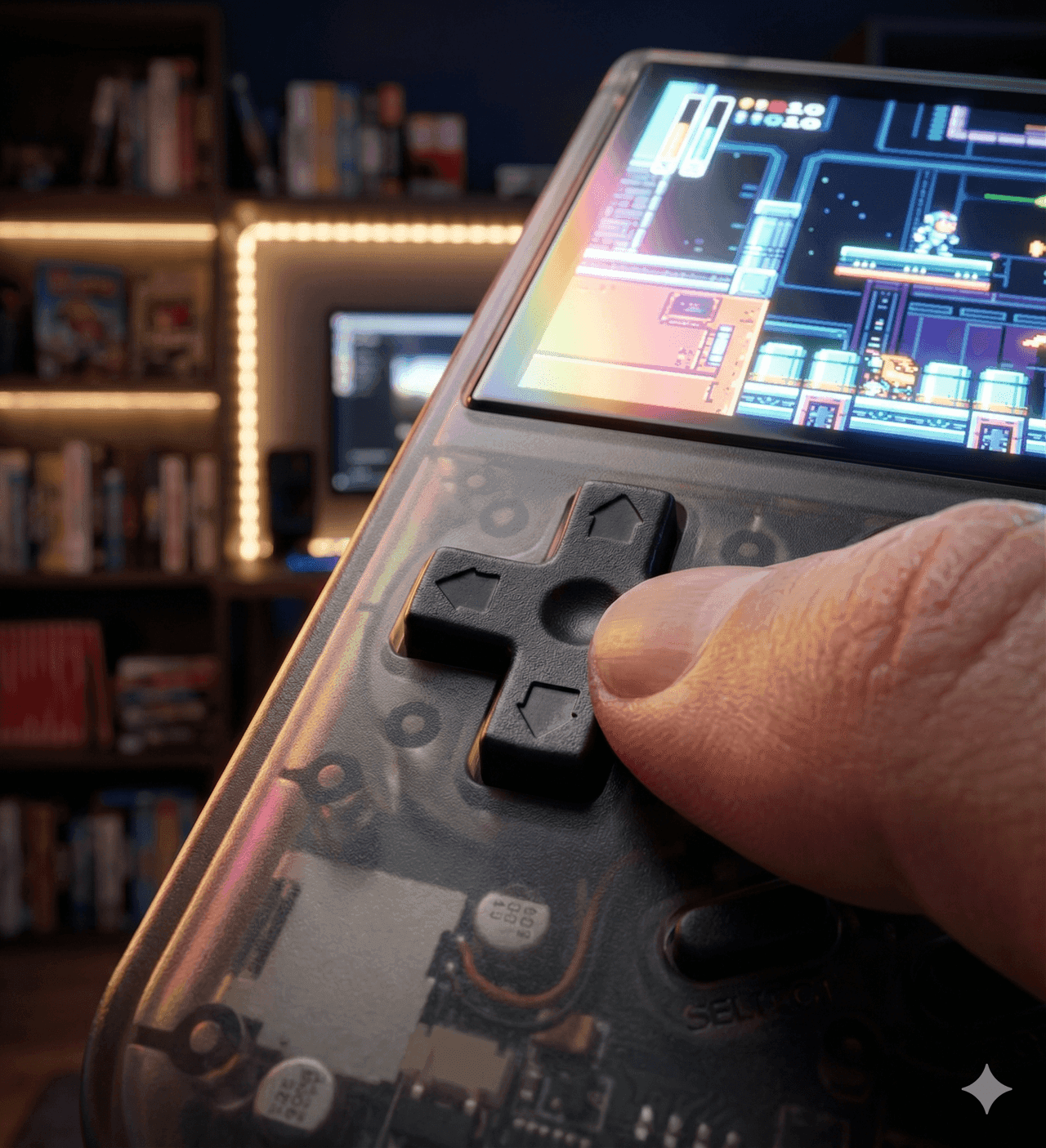
The RGB30 is a tall, chunky little device. The square screen forces a body shape that is unusual at first, but it gives the controls room to breathe. The D-pad and face buttons sit high on the front and never feel cramped. The dual analog sticks land below them in a comfortable layout.
The shell is thin plastic. It does not feel premium, and the analog sticks in particular feel cheap next to the rest of the device. These are not hall effect sticks, so they can develop drift down the line. For a device at this price, that is an expected trade. Nothing about the build is bad. It just reminds you what you paid.
The button feel is good. The D-pad is accurate for fighting games and platformers, and the face buttons have a clean click. Shoulder buttons are present and usable.
Display
The screen is the entire reason this device exists. It is a 4 inch IPS panel at 720x720 with a 1:1 aspect ratio. For systems built around square or tall displays, nothing else in this price range comes close.
Game Boy and Game Boy Color fill the panel almost perfectly. Vertical arcade shooters look incredible. Neo Geo, CPS, and classic MAME titles get a large, sharp presentation. Pico-8 games look like they were made for this screen.
The trade is obvious. Standard 4:3 content like SNES or Genesis runs with letterbox bars top and bottom. Widescreen content gets even smaller. If your library is mostly horizontal console games, the square screen works against you. If you love handhelds, arcade boards, and shooters, it is a joy.
Technical Specifications
| Screen | 4.0 inch IPS, 720x720, 1:1 aspect ratio |
| Processor | Rockchip RK3566, quad-core ARM Cortex-A55 @ 1.8GHz |
| GPU | ARM Mali-G52 |
| RAM | 1GB LPDDR4 |
| Storage | Dual microSD (one for OS, one for games) |
| Battery | 4,100 mAh, around 8 hours |
| OS | Open source Linux (ships with JELOS or ROCKNIX builds) |
| Connectivity | Wi-Fi 5, Bluetooth, mini HDMI out, USB-C, 3.5mm |
| Weight | around 200g |
Emulation Performance
The RK3566 is a capable budget chip. It clears the entire 8-bit and 16-bit era without breaking a sweat, and it handles PS1 perfectly. Here is how it holds up by system.
- NES, Game Boy, GBC, GBA: Perfect. This is the device's home turf.
- SNES: Flawless, including special chip titles.
- Genesis, Master System, PC Engine: Perfect.
- Arcade, CPS, Neo Geo, MAME: Excellent for the classic boards. Vertical games look fantastic.
- PS1: Perfect. Full speed across the library.
- Nintendo DS: Runs, but two screens on a square panel means stretched or stacked layouts that are a compromise.
- N64: Playable. Many games run well. Some need tweaks and a few never feel right.
- Dreamcast: Playable. The bulk of the library runs, though demanding titles can struggle.
- PSP: Playable. Lighter 3D is good. Heavy 3D is inconsistent.
- GameCube, PS2, Wii: Not supported. The chip cannot handle these.
The honest framing is simple. Buy the RGB30 for everything up to and including PS1. Treat N64, Dreamcast, and PSP as a bonus, not a guarantee.
Battery Life
The 4,100 mAh battery is generous for a device this size. Expect around 8 hours on lighter systems and less when you push N64 or PSP. That is strong endurance for the price. The USB-C port charges in roughly 2 hours and supports play while charging, so a small power bank keeps long trips going.
Firmware and Software
The RGB30 runs open source Linux firmware rather than a locked stock system. Most units ship on a JELOS or ROCKNIX build, and the community supports several options including Batocera. These firmwares give you a clean game launcher, automatic box art scraping, RetroAchievements, and per-system settings.
Setup takes a bit of patience. You add your own legally owned games to the second card and let the system scrape art. Once configured, it behaves like a tidy retro console. Wi-Fi makes box art and achievements painless.
Powkiddy RGB30 vs Anbernic RG35XX
The closest budget rival we cover is the Anbernic RG35XX. The two devices take opposite approaches.
The RG35XX is a small vertical handheld with a 3.5 inch 4:3 screen and the Allwinner H700 chip. It tops out around PS1, has no analog sticks, and leans on a polished firmware ecosystem. It is cheaper and more pocketable.
The RGB30 has the bigger, sharper square screen, dual analog sticks, Wi-Fi, HDMI out, and a higher ceiling that reaches into N64, Dreamcast, and PSP. It costs more and is far less pocketable.
If you want a tiny PS1 machine for your pocket, the RG35XX wins. If you want the best screen for Game Boy and arcade games plus a little more power, the RGB30 wins. Our full Powkiddy RGB30 vs Anbernic RG35XX breakdown digs into the details.
Who Is This For?
The Powkiddy RGB30 is a great fit for:
- Game Boy and arcade fans who want a screen shaped for those systems
- Shmup players who care about vertical games
- Pico-8 creators and players who want a native, square canvas
- Collectors who already own a widescreen handheld and want a specialist second device
It is a poor fit for anyone whose library is mostly 16:9 console games, or who needs GameCube and PS2.
Final Verdict
The Powkiddy RGB30 is a specialist, and it is excellent at the thing it specializes in. The 1:1 screen is a genuine reason to own it if you love the systems it was built for. The budget shell and stick quality are the cost of admission, and N64 through PSP performance is a bonus rather than the point.
Buy it for the screen and for everything up to PS1. On those terms, it is one of the most charming budget handhelds you can own.
Related reading
 ReviewReviewReview