
Affiliate disclosure: This review contains affiliate links. As an Amazon Associate, we earn from qualifying purchases at no extra cost to you. Learn more.
The Retroid Pocket Mini solves a problem the retro handheld market has had for years: you could have pocketable or powerful, but not both. Budget standbys like the Miyoo Mini Plus top out at PS1 and lack analog sticks. The full-size RP5 is powerful but too large for a jeans pocket. The Mini slots perfectly between them — a genuinely pocketable device running the same Snapdragon 865 chip as the RP5, with a 3.7" OLED screen that makes every system from NES to PS2 look better than it ever did on original hardware.
✓ Pros
- • OLED screen with deep blacks and vivid color — best display in its size class
- • Snapdragon 865 handles PS2, GameCube, and PSP with ease
- • Genuinely pocketable — fits in a jeans pocket without bulk
- • Full Android OS — install any emulator, streaming app, or sideloaded APK
- • Premium build quality for the price point
- • Hall-effect analog sticks — no drift
✗ Cons
- • 3.7" screen is noticeably smaller than the RP5's 5.5"
- • Battery life shorter than larger devices due to compact size
- • Android setup curve for first-time users
- • PS3 and Switch emulation remains limited on this chip
Build Quality and Design
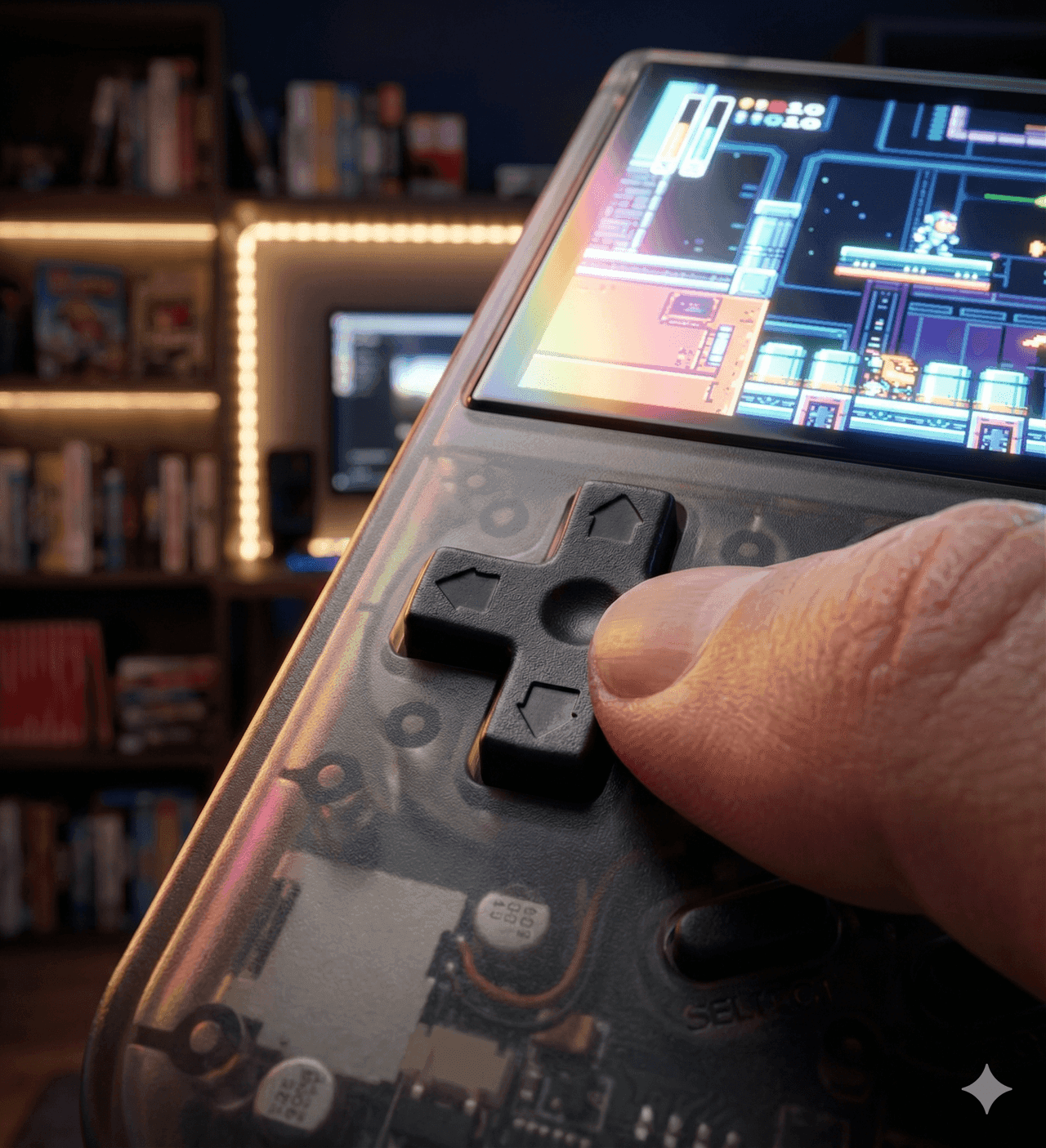
Pick up the Retroid Pocket Mini and the first thing you notice is that it doesn't feel like a $149 device. The shell has a tight matte finish, every seam is flush, and the buttons click with a satisfying firmness that cheap handhelds can't match. Retroid put real effort into the physical controls — the D-pad is accurate and responsive, the ABXY buttons have a clean tactile break, and the analog sticks sit in a layout that immediately feels natural.
The form factor is the headline. At roughly the footprint of a large smartphone and slim enough to slide into a front pocket, the Mini is the best compact retro handheld for everyday carry. You won't think twice about dropping it in a bag or a pocket the way you would with a larger device. The shoulder buttons and triggers have proper travel and don't feel mushy — a common failure point on handhelds this size.
The hall-effect analog sticks deserve a mention. Traditional potentiometer sticks develop drift over time; hall-effect sticks use magnets and essentially never drift. At $149, getting hall-effect sticks is a meaningful build quality win.
Display
The 3.7" OLED panel is the feature that separates the Mini from every other compact handheld on the market. OLED technology produces true blacks by turning pixels off entirely, which means the contrast ratio is effectively infinite. Dark games — Castlevania: Symphony of the Night, Metroid, any horror title — look genuinely dramatic on this screen in a way that IPS panels simply cannot match.
Colors are vivid without being oversaturated, and the pixel density at this screen size means retro pixel art is sharp and clean. GBA games look stunning. PS1 3D games rendered at higher internal resolutions look better than most people have ever seen them. The OLED also responds better in varied lighting conditions than budget IPS panels — blacks stay black, colors stay saturated.
The 3.7" size is a real trade-off compared to the RP5's 5.5" screen. Emulating systems designed for a TV means some details are small. But for the target use case — pocketable, on-the-go retro gaming — the size is exactly right.
Technical Specifications
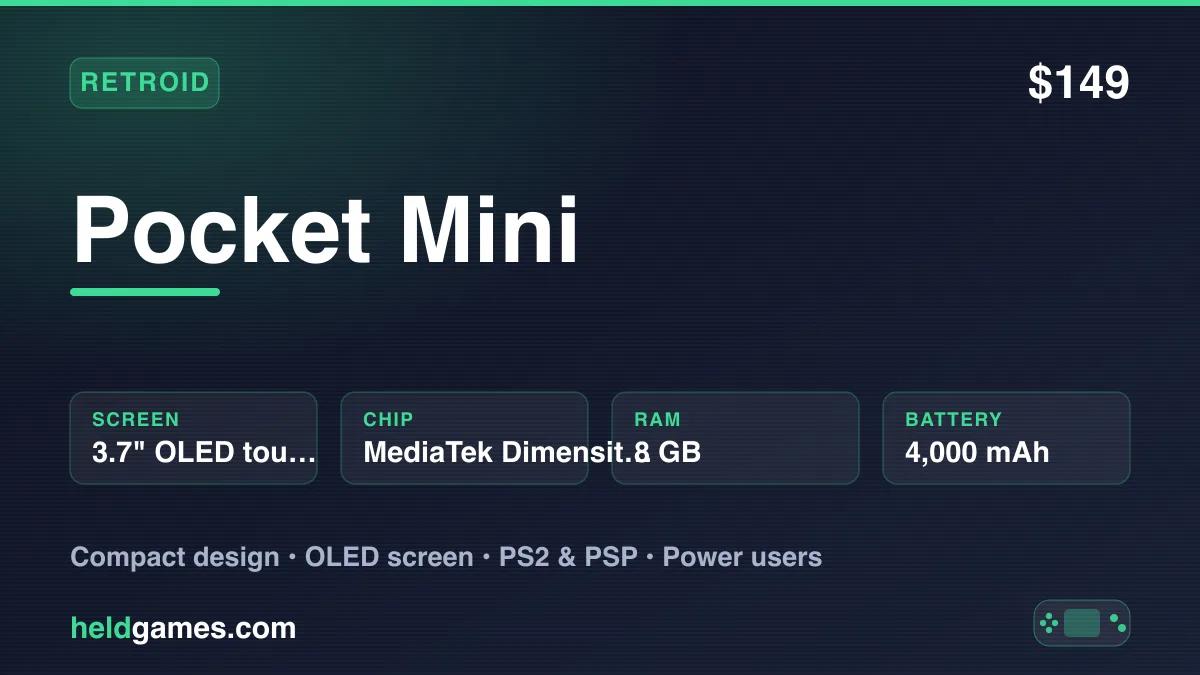
| Screen | 3.7" OLED touchscreen, 960×640 resolution |
| Processor | Qualcomm Snapdragon 865 (octa-core, Adreno 650 GPU) |
| RAM | 8GB LPDDR4X |
| Storage | 128GB UFS + MicroSD slot |
| Battery | 4,000mAh — ~4-6 hours (system dependent) |
| OS | Android 13 |
| Connectivity | USB-C (DP out), Wi-Fi 6, Bluetooth 5.2, 3.5mm |
| Dimensions | 155 × 70 × 18mm |
| Weight | 215g |
Emulation Performance
The Snapdragon 865 is a serious mobile processor, and the Mini's emulation ceiling matches the full-size RP5 exactly. This is one of the best compact retro handhelds for anyone who wants to go beyond 16-bit systems:
- NES / Game Boy / GBC / GBA — Trivial. Perfect performance on every title.
- SNES — Flawless, including demanding SA-1 and SuperFX titles.
- PS1 — Perfect. Every game runs without compromise.
- N64 — Excellent. Near-full library compatibility.
- Dreamcast — Very good. The vast majority of titles run at full speed.
- PSP — Perfect. Every title including demanding 3D games like God of War and Monster Hunter.
- GameCube — Excellent via Dolphin. Most of the library runs at full speed; a few demanding titles need minor settings tweaks.
- PS2 — Very good. Most titles run well; open-world and late-era PS2 games may need per-game configuration.
- Wii — Good on most titles; some demanding games need resolution compromises.
- DS / 3DS — Excellent on both systems.
- PS3 / Switch — Not recommended. These systems push beyond what the Snapdragon 865 can handle reliably.
Android and the Retroid Launcher
The Mini runs full Android 13, which means you're not locked into a curated firmware experience. You can install any emulator — standalone Dolphin, PPSSPP, PCSX2, DuckStation, RetroArch — and configure each to your exact preferences. You can also install streaming apps like Xbox Game Pass or GeForce NOW, turning the Mini into a cloud gaming device with a proper controller.
Retroid ships a clean custom launcher that makes the experience feel more console-like: games are organized by system, artwork is scraped automatically, and everything is accessible without navigating Android's app drawer. First-time Android handheld users can use the launcher as their primary interface and never feel lost. More experienced users can drop into full Android for granular control.
The Retroid app store provides curated emulator builds optimized for Retroid hardware. It's not the only way to install apps, but it's the fastest path to a working setup out of the box. Getting the Mini fully configured takes an hour or two, not a weekend.
Battery Life
The 4,000mAh battery delivers roughly 4-6 hours of play time depending on the system being emulated. Lighter systems like GBA or SNES push toward the high end; demanding systems like GameCube or PS2 drain the battery faster. That's a reasonable trade-off for a device this compact — fitting a large battery in a pocketable shell requires compromises.
The USB-C port supports charging while playing, so a small power bank extends sessions indefinitely on long trips. The Mini also charges quickly enough that a 30-minute top-up before leaving the house adds meaningful play time.
Retroid Pocket Mini vs Retroid Pocket 5
Both devices run the same Snapdragon 865 chip, so the emulation ceiling is identical. The differences are entirely about form factor and screen size.
The RP5 has a 5.5" OLED display — significantly larger, better for extended home sessions, and easier to read fine text on demanding 3D games. It's the better choice if the device mostly stays on a desk or in a bag.
The Mini's 3.7" OLED wins on portability and display quality per inch. True blacks and vibrant OLED color make a real difference for the systems that matter most in this class. If everyday carry is the priority — the device that's always in your pocket — the Mini is the right call. If you want the bigger screen and don't mind the larger footprint, the RP5 is worth the step up.
Retroid Pocket Mini vs Budget Handhelds
The closest size competitor is the Miyoo Mini Plus, which is similarly pocketable at roughly $65. We break this matchup down fully in our Pocket Mini vs Miyoo Mini Plus comparison. The gap in capability is enormous. The Miyoo Mini Plus tops out at PS1 and lacks analog sticks entirely — it's an excellent device for NES through PS1, but it cannot run PSP, GameCube, or PS2 at all. The Mini costs more than twice as much and delivers vastly more emulation range.
Anbernic's budget vertical handhelds (RG35XX and similar) occupy the same price category as the Miyoo Mini Plus with similar limitations. They're excellent value for retro gaming up to PS1, but the Snapdragon 865 in the Mini puts it in a completely different performance tier.
If your library stops at PS1, the Miyoo Mini Plus is the smarter buy. If you want PSP, GameCube, PS2, and the full modern emulation stack in a pocketable device, the Mini has no real competition at $149.
Who Is This For?
The Retroid Pocket Mini is the best compact retro handheld for:
- Commuters and travelers who want serious emulation in a device that fits in any pocket
- RP5 owners who want a second device for on-the-go use without carrying the larger device
- Upgraders from budget handhelds who've hit the PS1 ceiling and want more without going full-size
- Anyone who wants OLED in a compact handheld — there's nothing else at this price and size with a comparable screen
It's not the right fit for users who primarily game at a desk or TV, where the larger screen of the RP5 or a docked device would be a better experience.
Final Verdict
The Retroid Pocket Mini is one of the best compact retro handhelds released in 2024 and arguably the best overall value in the pocketable Android handheld category. The OLED screen is genuinely class-leading for its size, the Snapdragon 865 handles everything through PS2 and GameCube without compromise, and the build quality punches above the price point. The shorter battery life and smaller screen are real trade-offs, but they're the inevitable cost of fitting this much hardware into a pocketable form factor.
If you want the full modern emulation library in something that actually fits in your pocket, buy the Mini. For more devices in this size class, see our best micro and pocket handhelds guide, and for what this chip can really do, the best handhelds for PS2 emulation guide ranks it against the field.
Related reading
 ReviewReviewReview