
Affiliate disclosure: This page contains affiliate links. As an Amazon Associate, we earn from qualifying purchases at no extra cost to you. Learn more.
Price note, October 2026. Android handheld prices have moved repeatedly through 2026 because of the DRAM and flash shortage driven by AI datacenter demand. We cover the pattern in the RAM shortage and handheld prices. Every figure below is as of October 2026 — check the live listing before you buy.
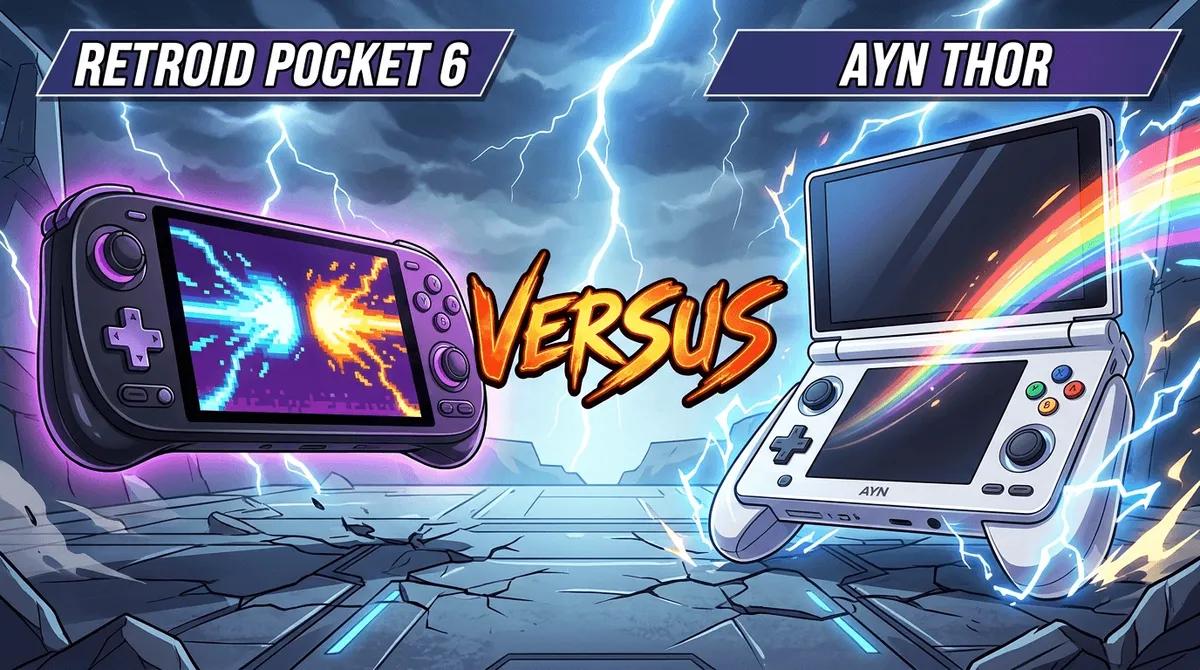
The Retroid Pocket 6 and AYN Thor are the two flagship Android emulation handhelds of 2026, and for once, comparing them is genuinely interesting. They share the same Snapdragon 8 Gen 2 processor, the same 6,000mAh battery, and the same Android 13 OS. On paper, the hardware story is nearly identical. In practice, they are completely different devices serving different buyers.
The Retroid Pocket 6 is the evolution of a proven form factor — a powerful single-screen Android handheld that handles everything from NES to PS2 without compromise, at $244. The AYN Thor is something genuinely new: a clamshell dual-screen device with a 6" AMOLED on top and a 3.92" AMOLED touchscreen on the bottom. It's the definitive device for DS and 3DS emulation, and unlike anything else on the market.
Choosing between them is less about which is "better" and more about what your personal game library actually needs.
Quick Verdict
| Retroid Pocket 6 | AYN Thor (Base) | |
|---|---|---|
| Form Factor | Traditional landscape | Clamshell dual-screen |
| Screen(s) | 5.5" AMOLED, 1080p, 120Hz | 6" + 3.92" dual AMOLED |
| Processor | Snapdragon 8 Gen 2 | Snapdragon 8 Gen 2 |
| RAM | 8GB LPDDR5x | 8GB LPDDR5x |
| Battery | 6,000mAh | 6,000mAh |
| Price | $244–$279 | From $329 |
| Best For | All-around emulation | DS/3DS emulation |
Design & Ergonomics
The RP6 wins this category out of the box.
The Retroid Pocket 6 is a traditional landscape handheld with a 5.5" AMOLED screen and proper ergonomic grips. It's comfortable for long sessions without accessories, and the Model A / Model B layout choice (D-pad on top vs. joystick on top) lets you configure the control scheme that suits your library. Hall-effect sticks and analog L2/R2 triggers are standard. Pick it up and start playing.
The AYN Thor is a clamshell — a flat device that folds open to reveal two screens. The build quality is premium (metal-reinforced hinge, solid construction throughout) but the grip situation is a real tradeoff: the Thor has no dedicated grips. Extended sessions will have the device's corners pressing into your palms. A grip accessory is effectively mandatory for hour-plus play. That's an additional cost and an additional step that the RP6 doesn't require.
If comfort matters to you and you don't want to think about accessories, the RP6 is the easier choice.
Winner: Retroid Pocket 6 — comfortable by default, no grip accessory required.
Display
The answer here depends entirely on what you're playing.
For single-screen games — everything except DS and 3DS — the RP6's 5.5" AMOLED at 120Hz is outstanding. Vivid colors, true blacks, ~400ppi pixel density. It's the best screen in this price bracket for traditional gaming.
The AYN Thor has two screens: a 6" top AMOLED at 120Hz (slightly larger than the RP6's panel) and a 3.92" bottom AMOLED touchscreen at 60Hz. Both use the same panel technology. For single-screen games, you're gaming on the top panel, which is comparable to and slightly larger than the RP6's display. For DS and 3DS games, both screens are in use simultaneously — and there is no single-screen device that can replicate this.
Winner: Tie for single-screen games. AYN Thor by a wide margin for DS/3DS.
Performance
This one is simple: they're the same.
Both devices run the Snapdragon 8 Gen 2 with 8GB LPDDR5x RAM and active cooling fans. Emulation performance across your personal game library is identical:
- NES through PS1: Trivial on both
- N64 / Dreamcast / PSP: Flawless on both
- GameCube / Wii: Excellent on both — demanding titles like F-Zero GX run cleanly
- PS2: Excellent on both — upscaled, smooth on mainstream titles
Any benchmark difference between the two devices falls within measurement noise. If raw emulation performance is your deciding factor, flip a coin.
Winner: Tie.
DS & 3DS Emulation
This is the entire reason the AYN Thor exists, and it's where the comparison stops being close.
Playing DS games on a single-screen handheld requires a compromise: display one screen at a time, squeeze both screens side by side with reduced sizes, or use an awkward layout that makes games harder to read and interact with. None of these replicate how the games were designed to be played.
On the AYN Thor, DS emulation via DraStic or RetroArch works exactly as the original hardware did. The top game screen appears on the top AMOLED. The bottom interaction screen appears on the bottom touchscreen. You tap, drag, and interact using your finger as you would with the original stylus. There are no layout compromises. Games that depend on touchscreen interaction — which is a significant share of the DS library — play correctly rather than awkwardly.
3DS emulation via Azahar follows the same logic. Both screens in use, touchscreen functional, most of the library at full speed.
The RP6 can run DS and 3DS games via emulators — the hardware is capable — but the experience on a single screen is a meaningful step below what the Thor delivers.
Winner: AYN Thor — not close.
Software & Setup
Both devices run Android 13 and require manual emulator setup — neither is plug-and-play.
The Retroid Pocket 6 uses Retroid's custom launcher, which is among the more approachable Android handheld interfaces available. Installing emulators, organizing libraries, and configuring frontends like Daijishō or ES-DE is a few hours of work for a new user.
The AYN Thor runs AYN's dual-screen AOSP launcher, which adds a configuration layer that single-screen devices don't have. Assigning apps to screens, managing the dual-screen home layout, and configuring emulators to take advantage of both panels requires additional time and familiarity. The Thor Control Center — a real-time overlay for FPS, temps, and quick settings — is genuinely useful and something the RP6 doesn't have an equivalent to.
Neither device is appropriate for someone approaching emulation for the first time. The Thor is the harder of the two to get running cleanly.
Winner: Retroid Pocket 6 — lower setup overhead.
Battery Life
Both devices have 6,000mAh batteries powering the same Snapdragon 8 Gen 2 chip. Real-world battery life is comparable across equivalent workloads:
- NES / SNES / GBA: ~12 hours on both
- PS1 / N64: ~8–10 hours on both
- PS2 / GameCube: ~5–6 hours on both
The Thor drives two AMOLED panels simultaneously for DS/3DS sessions, which does draw slightly more power than the RP6's single screen. For DS gaming specifically, the practical difference is minor — DS emulation is not a demanding workload for the 8 Gen 2.
Winner: Tie — negligible real-world difference.
Value
At $244, the Retroid Pocket 6 is $85 cheaper than the AYN Thor Base, which rose from $299 to $329 over two price increases. Both are well-built devices at their respective price points, but the gap is no longer the $50 it was in April.
The RP6's lower price makes it the straightforward choice for buyers who don't have a strong DS/3DS use case. The Thor's $329 is still justifiable for buyers who specifically want dual-screen emulation, because that capability is not available elsewhere at any price. But $85 is a harder premium to wave through than $50 was, and late-batch Thors also ship with slower UFS 3.1 storage instead of UFS 4.0.
Note: the AYN Thor Lite, now $259, is not a genuine alternative to the RP6. The Lite uses a Snapdragon 865 rather than the 8 Gen 2, which is a significant capability downgrade. The Lite model is not recommended. If you're considering the Thor, the Base at $329 is the minimum.
Winner: Retroid Pocket 6 — $85 cheaper, more comfortable, lower setup overhead.
The Final Call
Choose the Retroid Pocket 6 if:
- Your library is primarily NES through PS2/GameCube/PSP — the RP6 handles all of it flawlessly
- You want the best all-around Android emulation handheld at around $244
- Comfort out of the box matters — you don't want to buy accessories just to play comfortably
- You prefer a lower setup overhead and more approachable launcher experience
Choose the AYN Thor if:
- DS and 3DS games are a meaningful part of your personal library and you want the authentic dual-screen experience
- You're an experienced Android emulation user comfortable with manual configuration
- The dual-screen utility panel — monitoring, walkthroughs, multitasking — appeals to you
- You're willing to pay $329 and invest in a grip accessory for the setup that the dual-screen form factor delivers
You cannot make a bad choice between these two. They're the best Android emulation handhelds available in 2026. The decision is really about your library: if DS and 3DS are priorities, the Thor is worth the extra $85 and the setup work. If they're not, the RP6 is the better buy, and more clearly so than when we first ran this comparison.
Related reading
 ComparisonComparisonComparison