
Affiliate disclosure: This review contains affiliate links. As an Amazon Associate, we earn from qualifying purchases at no extra cost to you. Learn more.
The Retroid Pocket 6 is the device you buy when you have decided that budget hardware is not enough and you want the ceiling raised. At $249, it lands squarely in the bracket where Android handhelds have historically over-promised and under-delivered. The RP6 does not do that. Retroid dropped a Snapdragon 8 Gen 2 into a handheld that costs less than a pair of running shoes, wrapped it in a 5.5" 120Hz AMOLED screen, and backed it with a 6,000mAh battery. That chip was in flagship phones just two years ago. The result is the benchmark device for the $200 to $250 Android handheld bracket in 2026.
The Short Version
Buy it if you want the whole sixth console generation handled properly. GameCube, PS2, Wii and PSP all run well, the AMOLED is the best screen at this price, and the 6,000mAh battery outlasts everything nearby.
Skip it if your library stops at PS1, in which case an Anbernic RG40XXV does the job for a third of the money. Skip it too if you want something that works out of the box, because Android setup takes a few hours.
Want the 4:3 screen instead? The Retroid Pocket Nova uses the same silicon in a retro shaped panel for $20 less.
✓ Pros
- • Snapdragon 8 Gen 2 handles PS2, GameCube, and Wii without compromise
- • 5.5" 120Hz AMOLED — 400ppi, true blacks, stunning color accuracy
- • 6,000mAh battery — best-in-class endurance for the price
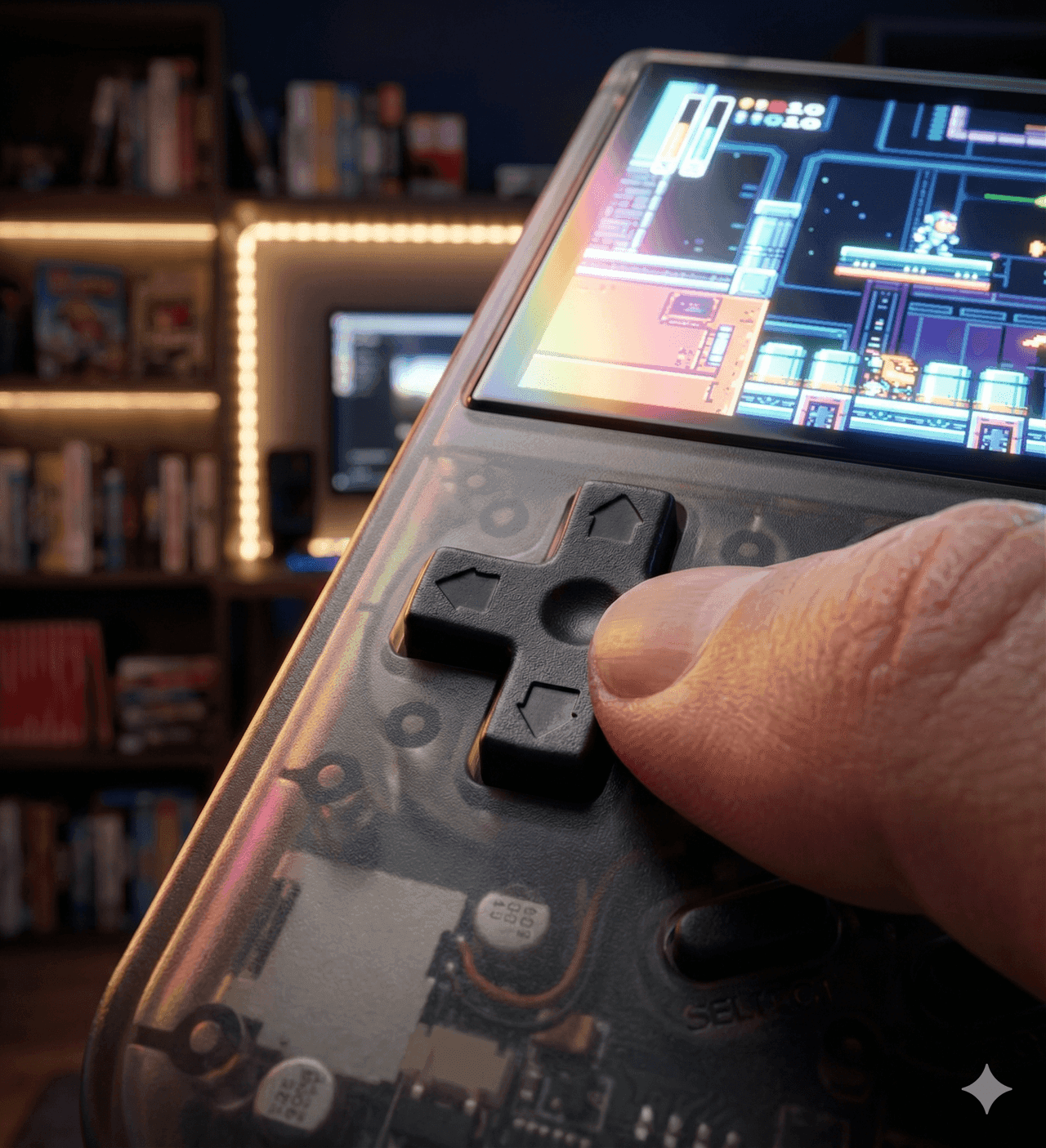
- • Model A / Model B layout choice — D-pad on top or joystick on top
- • 3D Hall-effect analog sticks — drift-free by design
- • Analog L2/R2 triggers with proper throw
- • Wi-Fi 7 for fast file transfers and streaming
- • Strong value at $229–249 for the hardware on offer
✗ Cons
- • Design is generic — functional but unremarkable compared to earlier Retroid devices
- • Android setup has a real learning curve — not plug-and-play
- • Speakers are average for a device at this price
- • No fingerprint sensor
- • 12GB RAM model discontinued — base 8GB/128GB is the only option now
Specs
Technical Specifications
| Screen | 5.5" AMOLED, 1080p, 120Hz, ~400ppi |
| Processor | Snapdragon 8 Gen 2 (1×3.2GHz + 4×2.8GHz + 3×2.0GHz) |
| GPU | Adreno 740 @ 680MHz |
| RAM | 8GB LPDDR5x |
| Storage | 128GB or 256GB UFS 3.1 + microSD slot |
| Battery | 6,000mAh |
| OS | Android 13 |
| Cooling | Active (fan) |
| Controls | 3D Hall-effect sticks, analog L2/R2, Model A or B layout |
| Connectivity | Wi-Fi 7, Bluetooth 5.3, USB-C |
Build Quality and Ergonomics
The RP6 is built well. The shell is solid plastic with flush seams, no flex, and nothing that creaks. It sits comfortably across two hands in extended sessions, with the grip width and trigger depth you'd expect from a full-size handheld. The active cooling fan keeps thermals in check even under sustained PS2 and GameCube loads — you'll hear it faintly under load, but it never becomes intrusive.
The main honest criticism here is aesthetic: the RP6 is generic. Earlier Retroid devices had design character — the Pocket 2's retro curves, the Pocket 4 Pro's distinctive branding. The RP6 looks like a competent Android handheld shaped by a committee. It doesn't look bad, it just doesn't look like anything in particular. If you're buying for feel and function, this is a non-issue. If you care about the device looking as interesting as it performs, temper your expectations.
Model A vs Model B
Retroid offers two control layouts:
- Model A — D-pad on top, left analog stick below. Matches the original PlayStation layout. Better for 2D games, fighting games, and retro titles where the D-pad does primary work.
- Model B — Left analog stick on top, D-pad below. Matches the Xbox/Switch layout. More comfortable for 3D games where the analog stick carries the load.
Neither layout is objectively correct. If your library skews heavily toward 2D retro games — SNES, GBA, PS1 2D titles — Model A is the natural fit. If you're primarily running GameCube, PS2, and PSP, Model B puts your thumb where it spends most of its time. Retroid making this a choice rather than a mandate is a small but meaningful thing.
The Hall-effect analog sticks warrant a specific callout. Traditional potentiometer sticks develop positional drift as the resistive material wears — it's not a defect, it's physics. Hall-effect sticks measure position using magnets and are essentially immune to drift. The RP6 makes these standard. Combined with analog L2/R2 triggers that have real travel, the physical controls are the best Retroid has shipped.
Display: The 5.5" AMOLED Advantage
At 5.5" with a 1080p AMOLED panel at 120Hz, the RP6's screen is the best display in its price class.
AMOLED technology produces light at the pixel level. Black pixels emit zero light — not a dimmed backlight, actual zero emission. The contrast ratio is effectively infinite. For retro gaming, which spans dark action games, horror titles, and the entire Castlevania catalog, the visual difference between AMOLED and IPS is immediate. Dark scenes read as dramatic rather than grey.
The 120Hz refresh rate matters more than it might seem for a gaming-focused display. Menus scroll smoothly, fast-paced games like F-Zero GX and Burnout 3 feel genuinely fluid, and even the Android launcher itself benefits from the higher refresh when navigating. At ~400ppi the pixel density is high enough that individual pixels are not visible at normal viewing distance. Retro pixel art looks clean; upscaled 3D content looks polished.
Color accuracy is excellent. Retroid has calibrated the RP6's panel well out of the box — GBA games in particular benefit, revealing the color depth that the original hardware's washed-out screen obscured. The display alone would justify a significant portion of the $249 price.
Android Setup: Not Plug-and-Play
Running full Android 13 is the RP6's strategic advantage and its biggest friction point for new users.
The flexibility is real. You can install RetroArch, standalone Dolphin, AetherSX2/PCSX2, PPSSPP, DuckStation, or any emulator directly. You can install Daijishō or ES-DE as a game-library frontend to organize your personal collection by system with automatic box art scraping. You can run streaming apps — Xbox Game Pass, GeForce NOW, Steam Link, Moonlight — turning the RP6 into a capable cloud gaming device when you're on a good network.
None of this is automatic. Getting from an out-of-box RP6 to a working emulation setup requires time: installing emulators, configuring each one, pointing them at your game files, setting up a frontend. A comfortable baseline setup takes a few hours. Advanced configuration — per-game settings, shader profiles, custom controller mappings — takes longer.
Daijishō and ES-DE are both excellent choices for organizing a large collection. Daijishō has a more polished visual design; ES-DE is simpler to configure and has broader system support out of the box. Either one transforms the Android experience into something that feels deliberate rather than cobbled together.
If you want a device you can hand to someone with no context and have them playing retro games in five minutes, the RP6 is not that device. If you're willing to invest the setup time, the result is more capable and flexible than any fixed-firmware device in this price range.
Emulation Performance
The Snapdragon 8 Gen 2 is a genuinely fast mobile processor — the same chip that powered flagship phones in 2023-2024. In a retro handheld context, this is significant overkill for classic systems and exactly right for the demanding sixth-generation targets.
Here's how your personal library of games you own will run:
- NES / Game Boy / GBC / GBA — Trivial. Every title, full speed, with resolution upscaling and run-ahead latency reduction available for the systems that benefit from it.
- SNES — Flawless, including the most demanding SA-1 and SuperFX titles.
- PS1 — Perfect. Every game, upscaled, no configuration required.
- N64 — Excellent. Near-complete library compatibility, upscaled to high resolution.
- Dreamcast — Flawless. Full library at full speed.
- PSP — Perfect. Every title at high resolution with excellent performance headroom.
- GameCube — Excellent. Dolphin handles demanding titles like F-Zero GX at 2x resolution without compromise. The vast majority of the library runs perfectly.
- Wii — Excellent. Most of the library runs without issue; a small number of the most demanding titles need minor resolution adjustments.
- PS2 — Excellent. Most titles run at 60fps with upscaling. Burnout 3: Takedown is silky. Sly Cooper runs clean. Metal Gear Solid 3 performs well with standard settings. Open-world late-era PS2 titles may need per-game tuning, but the baseline is strong.
Some Switch game compatibility exists via current Android-based emulators, but this is not the RP6's strength and not what you're buying it for. The device's value is firmly in the retro era — everything through the sixth console generation, handled confidently.
Battery Life
The 6,000mAh battery is the largest you'll find in a device at this price, and it shows in practice:
- NES / SNES / GBA — ~12–13 hours
- PS1 / N64 — ~9–10 hours
- PSP / Dreamcast — ~8–9 hours
- GameCube / PS2 — ~5–6 hours
- Wii (demanding titles) — ~4–5 hours
For classic gaming through the fifth generation, battery life is a non-issue — you'll be done with a session long before the RP6 is. Even under GameCube and PS2 loads, five-plus hours covers most realistic portable gaming scenarios. The active cooling fan has a minor impact on battery under sustained heavy loads, but nothing dramatic.
USB-C supports charging while playing. The device charges quickly enough that a 30-minute top-up adds several hours of lighter-load gaming.
Comparing the Competition
vs Retroid Pocket 5
The Retroid Pocket 5 remains the strongest argument against the RP6. Same control quality, an excellent 5" OLED, and a Snapdragon 865 that already covers most libraries for $30 less. Our full Pocket 6 vs Pocket 5 breakdown settles which side of the line you fall on.
vs Retroid Pocket G2
The Retroid Pocket G2 is the more affordable option in the same Retroid lineup, targeting the $150–175 range. It handles PS2 and GameCube but with less headroom — demanding titles that run flawlessly on the RP6 may need compromises on the G2. If your library doesn't push the ceiling, the G2 is a reasonable save. If you want to run everything the sixth generation has to offer without configuration overhead, the RP6's performance margin is worth the price difference.
vs AYANEO KONKR Pocket Fit
The AYANEO KONKR Pocket Fit offers more raw processing power than the RP6, but at a substantially higher price and with an LCD panel rather than AMOLED. The RP6 beats it on screen quality and value; the KONKR edges ahead on peak performance for the most demanding emulation targets. For the vast majority of retro gaming, the RP6 is the better use of money.
vs AYN Thor
The AYN Thor takes a different approach entirely with its dual-screen design, targeting a different form factor entirely. For a full side-by-side breakdown, see our Retroid Pocket 6 vs AYN Thor comparison.
Who Is This For?
The Retroid Pocket 6 is the right device for:
- Retro gamers who want the full sixth-generation library without compromise — GameCube, PS2, Wii, and PSP at full quality, handled confidently
- Android enthusiasts who want flexibility — any emulator, any frontend, streaming apps, sideloading — alongside proper handheld ergonomics
- Buyers who've hit the ceiling on mid-range hardware and want a device that doesn't require per-game workarounds for the systems they care about
- Anyone who values display quality — the 5.5" 120Hz AMOLED is a meaningful step above the IPS panels in competing devices at this price
It's not the right fit for users who want something truly pocketable (see the Retroid Pocket Mini), buyers whose library stops at PS1 (an Anbernic RG40XXV handles that for $75), or anyone unwilling to invest setup time in Android. For where the RP6 lands in the wider field, see the best handhelds for PS2 emulation and best handhelds for GameCube emulation.
Frequently Asked Questions
Is the Retroid Pocket 6 worth it in 2026?
Yes, if you want the full sixth generation library. The Snapdragon 8 Gen 2 clears GameCube, PS2, Wii and PSP without per game workarounds, and nothing else near $249 pairs that with a 1080p 120Hz AMOLED. If your library stops at PS1, you are paying for headroom you will not use.
Can the Retroid Pocket 6 run PS2 games?
Yes, and well. Most titles hit 60fps with upscaling. Open world late era PS2 games are the ones that need per game tuning, which is true of every Android handheld in this class.
Can it run Switch games?
Some, through current Android emulators, but that is not what you are buying it for. The RP6's value is everything through the sixth console generation.
Should I get Model A or Model B?
Model A puts the D-pad on top, matching the PlayStation layout, and suits 2D and retro libraries. Model B puts the analog stick on top, matching Xbox and Switch, and suits GameCube, PS2 and PSP. Neither is better. Pick the one matching where your thumb spends most of its time.
Retroid Pocket 6 or Retroid Pocket 5?
The Pocket 5 is $30 cheaper with a Snapdragon 865 that already covers most libraries. The Pocket 6 buys you PS2 and Wii headroom plus the bigger battery. Our Pocket 6 vs Pocket 5 breakdown settles it properly.
Retroid Pocket 6 or Retroid Pocket Nova?
Same chip, same speed. The Nova has a 4:3 AMOLED that fills the screen for retro systems. The Pocket 6 has a larger 16:9 AMOLED and a bigger battery. Pick on screen shape, not performance. See our Nova vs Pocket 6 comparison.
Does the Retroid Pocket 6 get stick drift?
No. It uses 3D Hall-effect sticks, which sense position with magnets rather than wearing contacts, so they do not develop the drift that traditional sticks do.
How long does the battery last?
Roughly 12 hours on 2D systems, 8 to 9 on PSP and Dreamcast, and 5 to 6 under GameCube and PS2 loads. The full breakdown is in the battery section above.
Final Verdict
The Retroid Pocket 6 earns its 4.5/5 by doing the hard thing: actually delivering on a premium spec sheet at a price that has historically meant disappointment. The Snapdragon 8 Gen 2 handles everything through the sixth console generation cleanly. The AMOLED screen is the best display in this price class. The 6,000mAh battery outlasts the competition. The Model A/B layout choice and Hall-effect sticks show that Retroid paid attention to what enthusiasts actually wanted.
The design won't win awards and the Android setup curve is real. But for a buyer who wants the benchmark Android handheld under $250 in 2026, the RP6 is the answer.
Related reading
 ReviewReviewReview