
Affiliate disclosure: This page contains affiliate links. As an Amazon Associate, we earn from qualifying purchases at no extra cost to you. Learn more.
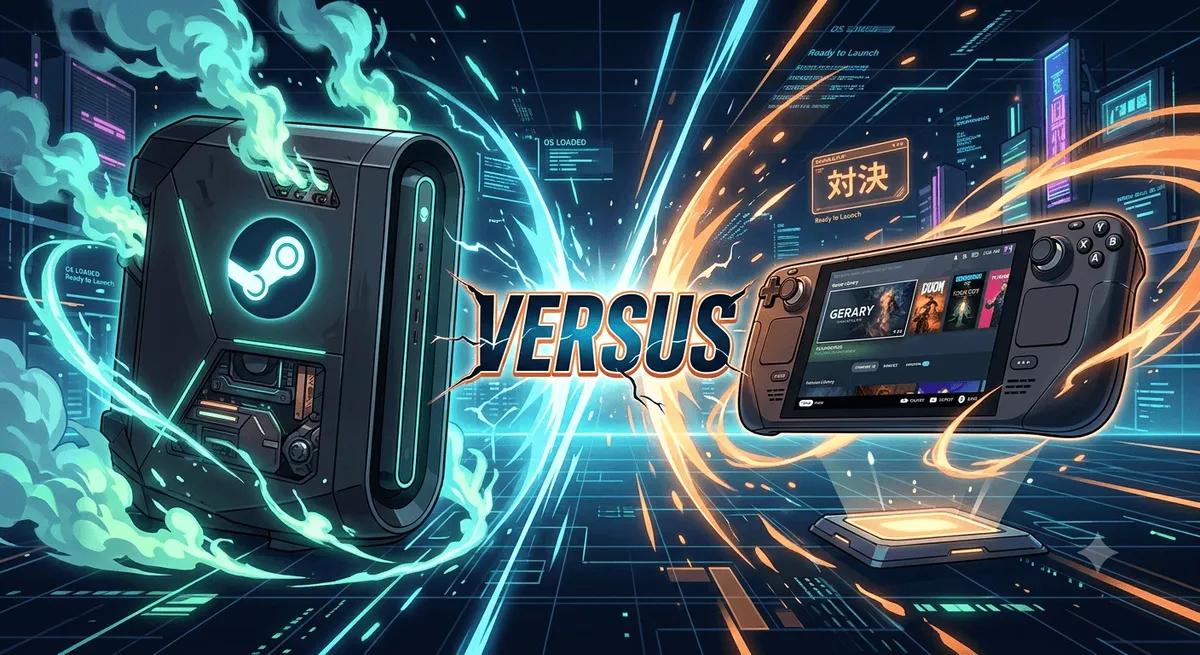
Valve now sells two SteamOS devices that matter to retro and emulation gamers: the portable Steam Deck OLED and the living-room Steam Machine, which started shipping at the end of June 2026. They run the same operating system and the same emulation stack. They are built for completely different jobs.
The short version: the Steam Deck is a handheld you take everywhere. The Steam Machine is a powerful box that lives under your TV. This comparison breaks down which one deserves your money in 2026, now that Valve has confirmed final pricing for both.
Affiliate disclosure: This page contains affiliate links. As an Amazon Associate, we earn from qualifying purchases at no extra cost to you. Learn more.
Quick Verdict
| Steam Machine | Steam Deck OLED | |
|---|---|---|
| Form factor | Living-room console | Handheld |
| Price | $1,049 (512GB) to $1,349 (2TB) | $789 (512GB) to $949 (1TB) |
| Availability | Invitation queue, shipping now | In stock |
| CPU | AMD Zen 4, 6c/12t, ~4.8GHz | AMD Zen 2, 4 cores |
| GPU | RDNA 3, 28 CUs, 8GB GDDR6 | RDNA 2, 8 CUs (shared) |
| RAM | 16GB DDR5 (upgradeable SODIMM) | 16GB LPDDR5 (soldered) |
| Performance | ~6x Steam Deck | Baseline |
| Screen | None (use your TV/monitor) | 7.4" OLED, 90Hz |
| Portable? | No | Yes |
| Best for | High-end emulation on the TV | Emulation anywhere |
They're Not Really Competitors
This is the most important thing to understand before comparing specs: the Steam Machine and Steam Deck aren't trying to be the same product.
The Steam Deck is a portable. Its entire reason to exist is that you can play it on the couch, in bed, on a flight, or docked to a TV. Its hardware is constrained by battery life and the need to fit in your hands.
The Steam Machine has no such constraints. It's plugged into the wall and connected to a display, so Valve gave it a desktop-class CPU, a much larger GPU, dedicated graphics memory, and active cooling. The result is roughly 6x the Steam Deck's performance.
So the real question isn't "which is better." It's "which job do you need done?"
Performance & Emulation
This is where the gap is enormous, and where it matters most for our audience.
Steam Deck OLED uses a 2022-era AMD "Van Gogh" APU: a 4-core Zen 2 CPU and an 8-CU RDNA 2 GPU sharing 16GB of LPDDR5. It's brilliant for everything through PS2, GameCube, and Wii. But its older CPU is the ceiling for demanding targets. PS3 emulation is inconsistent, and demanding Switch titles need real tuning.
Steam Machine pairs a 6-core/12-thread Zen 4 CPU (up to ~4.8GHz) with a 28-CU RDNA 3 GPU and 8GB of dedicated GDDR6. That's a generational leap in exactly the areas emulation cares about: single-thread CPU speed and GPU throughput. RPCS3 (PS3), demanding Dolphin and Wii U workloads, and Switch emulation that make the Deck sweat all run far more comfortably here.
| Emulation target | Steam Deck OLED | Steam Machine |
|---|---|---|
| NES → PS1, N64, PSP, Dreamcast | Flawless | Flawless |
| PS2 / GameCube / Wii | Excellent | Excellent |
| PS3 (RPCS3) | Inconsistent, needs tuning | Much stronger |
| Switch | Hit-or-miss | Strong |
If your goal is "one device that plays everything through PS3 on the big screen," the Steam Machine is the more capable tool by a wide margin.
Software: Identical (And That's the Point)
Both devices run SteamOS 3. Both support EmuDeck, the one-click installer that configures RetroArch, Dolphin, PCSX2, RPCS3, PPSSPP, and more. Both put your Steam library, Proton compatibility, and cloud saves front and center.
Practically, this means:
- If you can set up emulation on a Steam Deck, you can set up a Steam Machine. The workflow is identical.
- Your Steam library and cloud saves sync across both, so owning one doesn't lock you out of the other.
- The Steam Machine's upgradeable SODIMM RAM is a repairability win the soldered-RAM Steam Deck can't match.
Price: Now Confirmed
The speculation phase is over. Valve locked in final pricing on June 23, 2026, and it came in higher than the leaks suggested: $1,049 for the 512GB model and $1,349 for the 2TB model, with a 2TB bundle that includes the new Steam Controller at $1,428.
Valve says the jump over the rumored ~$950 comes down to the 2026 memory market, where AI data center demand has pushed DDR5 prices up dramatically. Notably, Valve confirmed it is not subsidizing the hardware. The Steam Machine is priced like a PC, not like a console sold at a loss.
The Steam Deck OLED sits at $789 (512GB) to $949 (1TB) after Valve's May 2026 price hike. So the gap between a top-end Deck and an entry Steam Machine is now exactly $100. The deciding factor at these prices isn't the dollar amount. It's whether you value portability or power.
Availability: The Invitation Queue
You cannot simply add a Steam Machine to your cart. Valve launched it through a reservation lottery to keep scalpers out. Registration closed June 25, purchase invitations started going out June 29, and each invitation gives you 72 hours to buy. The first units shipped June 29-30, and Valve says it expects to work through the full reservation queue by the end of 2026.
If you didn't register in time, watch Valve's official Steam Machine page for the next availability window. The Steam Deck OLED, by contrast, is in stock today.
Which Should You Buy?
Buy the Steam Deck OLED if...
- You want to play anywhere. That's the entire point, and the Steam Machine can't do it.
- Your emulation ceiling is PS2 / GameCube / Wii, which the Deck handles beautifully.
- You want a gorgeous OLED screen and console-like sleep/wake in your hands.
- You want a device you can actually buy today, without a queue.
- See our full Steam Deck OLED review.
Buy the Steam Machine if...
- You primarily play on a TV or monitor and want a clean, plug-and-play SteamOS box.
- You want to push past the Deck's ceiling into PS3 and demanding Switch emulation.
- You'd otherwise build or buy a mini-PC emulation station and prefer Valve's first-party SteamOS support.
- You're patient enough for the invitation queue.
- See our full Steam Machine breakdown for every confirmed spec.
Honestly? Many people will want both. The Deck for portable play, the Machine for the living room, with a shared Steam library tying them together. If you can only pick one, let your default play location decide: hands or TV.
Don't Forget the Alternatives
At these prices, it's worth remembering you have options outside Valve's ecosystem:
- For portable power with more emulation muscle than the Deck, a Windows handheld like the ROG Ally X is worth a look. See our best PC gaming handhelds guide.
- For a living-room emulation box, a Batocera mini-PC competes directly with the Steam Machine, often for less.
- For budget retro play, a sub-$100 Anbernic still covers the entire 8/16/32-bit canon. See our budget handheld guide.
Updated July 19, 2026 with Valve's confirmed pricing and launch details. The Steam Machine began shipping June 29, 2026.
Related reading
 GuideGuideGuide