

Affiliate disclosure: This guide contains affiliate links. As an Amazon Associate, we earn from qualifying purchases at no extra cost to you. Learn more.
2026-08-20 · News and analysis
Affiliate disclosure: This guide contains affiliate links. As an Amazon Associate, we earn from qualifying purchases at no extra cost to you. Learn more.
Buying a handheld used to be simple. You read the spec sheet, you ordered the device, and the device matched the spec sheet.
That assumption is breaking down in 2026, and the Anbernic RG34XX SP is the clearest example. The same model number has now shipped with three different memory configurations, each one worse than the last, without a name change to tell you which you are getting.
What Actually Happened
The timeline, as best as it can be established.
May 2025. The RG34XX SP launches advertising 2 GB of LPDDR4.
January 2026. Anbernic cuts the RAM to 1 GB. This was noticed at the time and Anbernic said the change had no practical impact under its Linux firmware, which is a defensible position for a device running lightweight emulation.
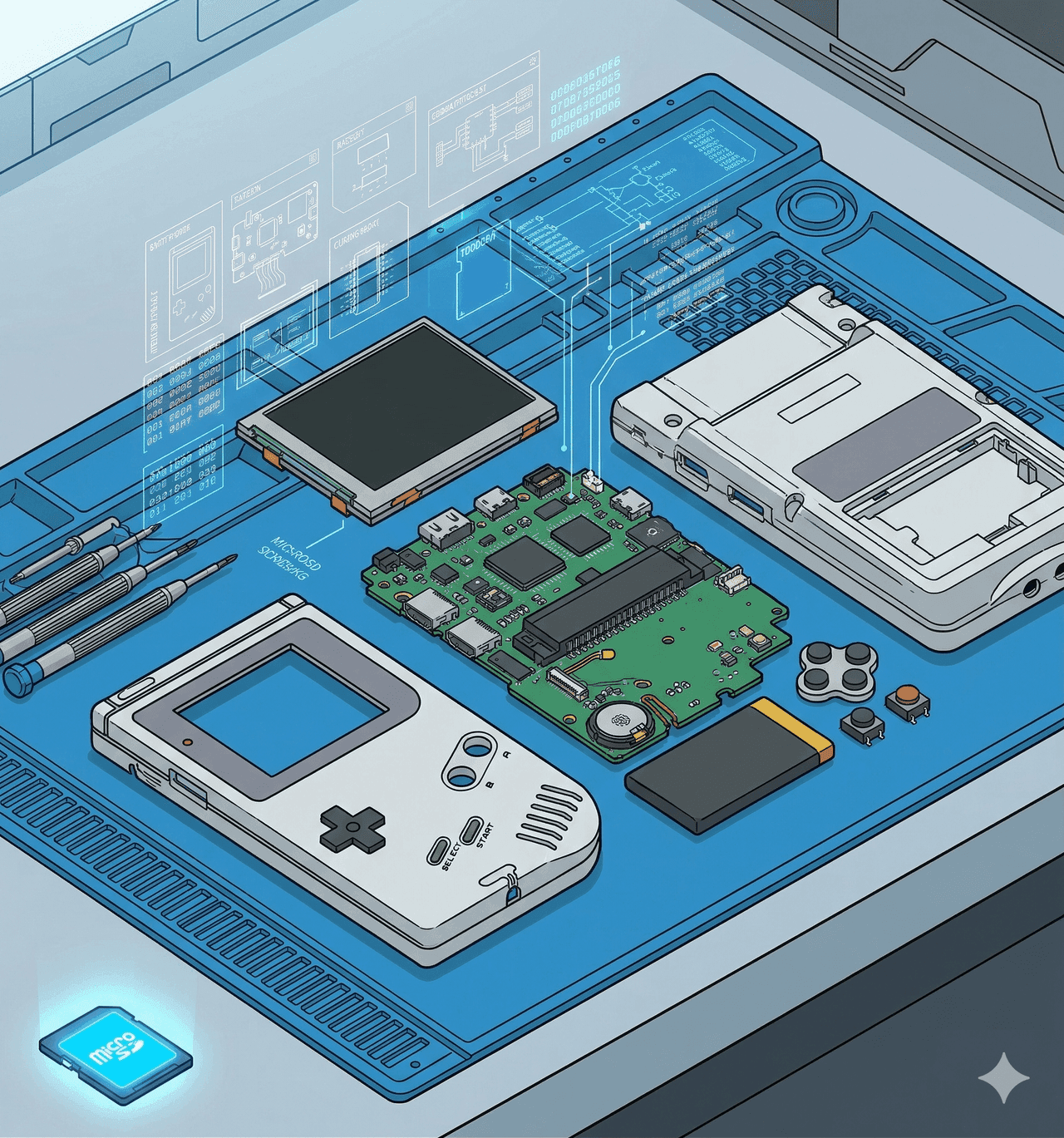
2026. Units start appearing with 512 MB. A teardown identified the chip as a Samsung K4E4E324EE, which is 512 MB of LPDDR3.
That last step is two downgrades at once. The capacity dropped again, and the memory type went backwards from LPDDR4 to the older and slower LPDDR3.
What Anbernic Said
Anbernic's response was that the current standard memory capacity is 1 GB, and that a customer receiving a 512 MB unit represents an unexpected error. The company recommended that affected buyers contact its after-sales team, which would prioritise a replacement.
That is a reasonable response to the capacity question. If 512 MB units genuinely escaped by mistake, offering priority replacements is the right remedy.
The gap in the response is the memory type. Anbernic addressed the capacity drop and did not address the shift from LPDDR4 to LPDDR3, which affects every unit carrying the older memory regardless of capacity. LPDDR4 is faster and more power efficient. A device on LPDDR3 is a slower device, and that has not been acknowledged.
Why This Is Happening
None of this is happening in a vacuum, and it is worth being fair about the pressure vendors are under.
DRAM and NAND contract prices rose roughly 90 to 95 percent in the first quarter of 2026 alone, driven mostly by AI datacenter demand consuming the same supply that consumer devices depend on. Every handheld maker has responded somehow. Retroid raised prices repeatedly and discontinued the Pocket G2. AYANEO halted the Next 2. Valve pushed the Steam Deck OLED from $549 to $789.
We track the whole picture in 2026 gaming price hikes and the RAM shortage and handheld prices.
Anbernic's approach has been to hold prices and trim components instead. That is a legitimate strategy in a brutal market. The problem is not the trimming. The problem is doing it silently under an unchanged model number, so a buyer comparing reviews written in 2025 against a device shipping in 2026 has no way to know they are different products.
How to Check What You Have
If you own an RG34XX SP, or any recent Anbernic device, you can verify the memory yourself.
On stock Anbernic firmware. Look for a system information or device info screen in the settings menu. Reported RAM is usually listed there.
On custom firmware. muOS, KNULLI, and other Linux firmwares expose this directly. Open a terminal or the built in system info tool and check available memory. A device reporting roughly 450 to 500 MB of usable RAM has 512 MB installed. A device reporting roughly 900 MB to 1 GB has 1 GB.
Remember that reported free memory is always lower than installed memory, because the operating system reserves some. Do not panic at a number slightly under the round figure.
If you find 512 MB. Contact Anbernic's after-sales service and reference the company's own statement that 1 GB is the current standard and that 512 MB units are an error. Anbernic has said it will prioritise replacements.
Does It Actually Matter?
Honestly, it depends on what you play.
For 8-bit and 16-bit systems, GBA, and most 2D games, 512 MB is enough and you may never notice. Those workloads are tiny and the H700 handles them regardless.
For the demanding end of the H700's range, it matters. PS1 with heavier settings, PSP, Dreamcast, and N64 all benefit from headroom, and the LPDDR3 speed reduction compounds the capacity reduction. If you bought the device specifically to push those systems, you have less machine than you paid for.
The larger issue is trust. When a model number stops guaranteeing a specification, every review on the internet becomes less reliable, including ours. We note current versus launch memory in our RG34XX SP review for exactly this reason.
What This Means for Buying Right Now
A few practical rules for the current market.
Check the listing's stated RAM, not the model's reputation. Reviews from 2025 may describe hardware that no longer ships.
Prefer devices where memory is not the constraint. The new Anbernic RG SP ships with 1 GB and was specified that way from the start, so there is no gap between what was announced and what arrives.
Consider Android devices for demanding emulation. Something like the KONKR Pocket Advance at 3 GB or 4 GB has real headroom, and Android devices have been less prone to silent revisions.
Buy from sellers with easy returns. If the device that arrives does not match the listing, you want that to be a simple problem to solve.
Frequently Asked Questions
How much RAM does the Anbernic RG34XX SP have?
It depends when you bought it. It launched in May 2025 with 2 GB of LPDDR4, was cut to 1 GB in January 2026, and some units have since been found with 512 MB of LPDDR3.
What did Anbernic say about the 512 MB units?
Anbernic said 1 GB is the current standard capacity and that receiving a 512 MB unit is an unexpected error. It directed affected customers to after-sales service for a priority replacement. It did not address the change from LPDDR4 to LPDDR3.
Is LPDDR3 worse than LPDDR4?
Yes. LPDDR4 is faster and more power efficient. A device using LPDDR3 will perform worse, most noticeably on demanding emulation.
How do I check how much RAM my Anbernic has?
Check the system information screen in the settings menu on stock firmware, or use the system info tool on muOS or KNULLI. Reported free memory is always somewhat lower than installed memory.
Does 512 MB of RAM ruin the device?
Not for 2D systems and GBA, where you will likely never notice. It does matter for PS1 at higher settings, PSP, Dreamcast, and N64.
Why is this happening?
DRAM and NAND prices rose roughly 90 to 95 percent in early 2026 because of AI datacenter demand. Anbernic chose to trim components rather than raise prices. Other vendors raised prices or discontinued products instead.
Related Reading
Related reading
 GuideGuideGuide