
Affiliate disclosure: This guide contains affiliate links. As an Amazon Associate, we earn from qualifying purchases at no extra cost to you. Learn more.
2026-04-11
Affiliate disclosure: This guide contains affiliate links. As an Amazon Associate, we earn from qualifying purchases at no extra cost to you. Learn more.
If you have been researching retro handhelds you have probably encountered two terms: FPGA and emulation. The Analogue Pocket and ModRetro Chromatic use FPGA. Devices from Anbernic, Retroid, Miyoo, and AYN use software emulation. Both approaches play retro games. The difference is how they do it, and for most buyers the practical difference is smaller than the internet suggests.
This guide explains what each technology actually does, where the differences matter, and which approach makes sense for your buying decision.
What Is Software Emulation
Software emulation is what the vast majority of retro handhelds use. A modern processor (ARM, x86, or similar) runs a program that simulates the behavior of older hardware. The emulator reads the original game code and translates the instructions that the original CPU, GPU, and audio chip would have executed into instructions that the modern processor understands.
RetroArch, Dolphin, PPSSPP, DuckStation, and every other emulator on your handheld works this way. The emulator is software running on general-purpose hardware.
Advantages of software emulation:
Software emulation runs on inexpensive, widely available hardware. A $50 device can emulate a dozen retro systems. A $250 device can emulate systems through PS2 and GameCube. The hardware is mass-produced smartphone components. Costs are low and dropping every year.
Software emulators improve continuously. Open source projects like RetroArch receive updates that improve accuracy, performance, and compatibility. A game that runs poorly today may run perfectly after a future update. Your device gets better over time without hardware changes.
Software emulation supports features the original hardware never had. Save states, rewind, fast forward, run-ahead latency reduction, shader filters, resolution upscaling, and widescreen patches are all possible because the emulator controls the execution environment.
Limitations of software emulation:
Emulation is an approximation. The emulator simulates what the original hardware did based on documentation and reverse engineering. Edge cases exist where the simulation does not perfectly match the original behavior. For the vast majority of games this is undetectable. For some games, particularly those that relied on timing quirks of original hardware, minor differences can appear.
Emulation introduces latency. The process of reading original instructions, translating them, and rendering output on modern hardware adds a small delay compared to original hardware. Modern techniques like run-ahead reduce this to negligible levels on capable hardware but it is technically present.
What Is FPGA
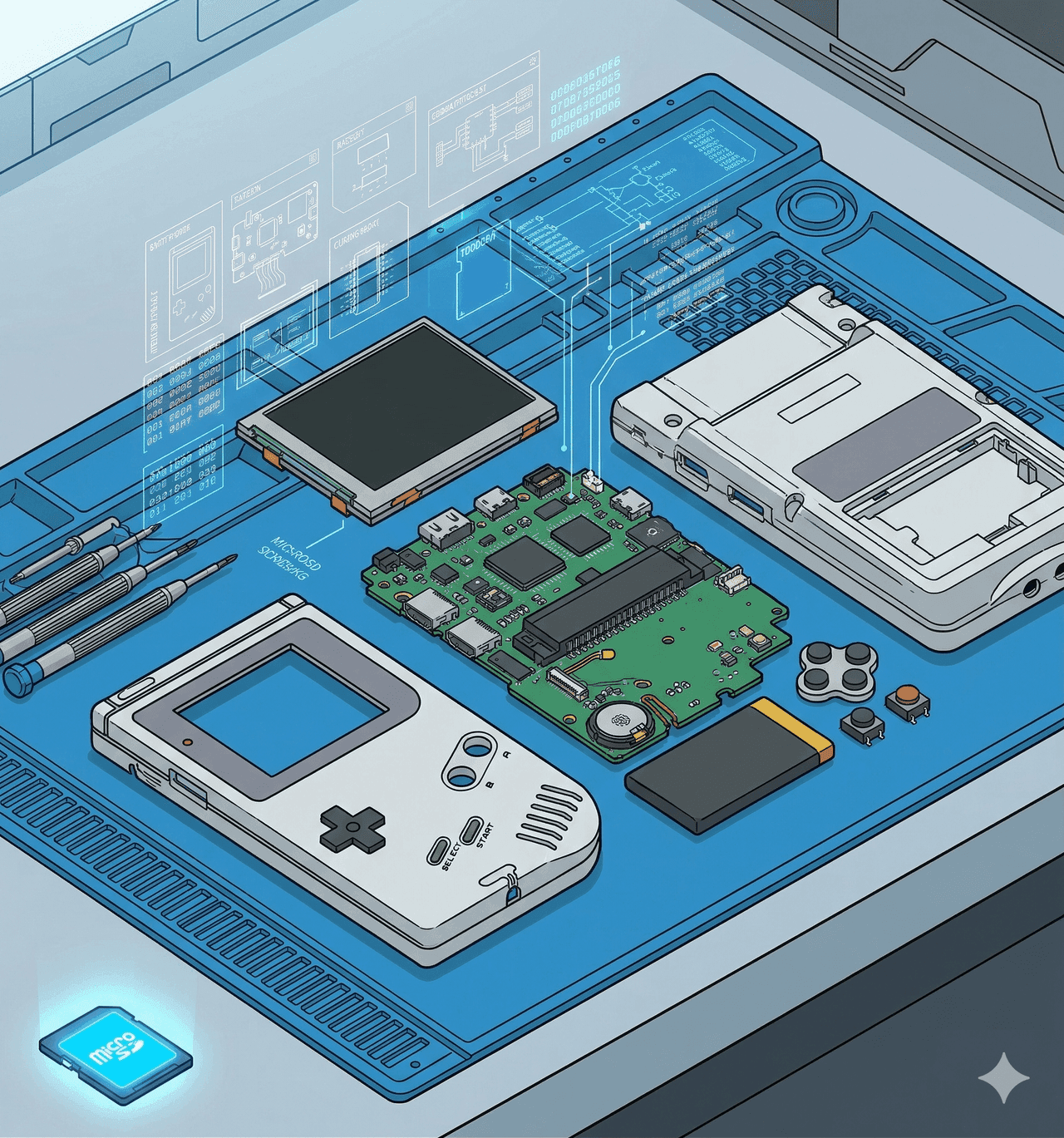
FPGA stands for Field Programmable Gate Array. It is a chip whose internal logic circuits can be reconfigured to behave like different hardware. Instead of running software that simulates an old CPU, an FPGA device reconfigures its physical circuits to become that CPU.
When you load a Game Boy core on an Analogue Pocket, the FPGA chip is reconfigured at the circuit level to function as a Game Boy processor, display controller, and audio chip. The game code runs on hardware that behaves identically to the original silicon, not on a translator layer.
Advantages of FPGA:
Cycle accuracy. A well-implemented FPGA core replicates the original hardware behavior at every clock cycle. Games that depend on precise timing, obscure hardware quirks, or undocumented behavior work correctly because the hardware behaves identically to the original.
Minimal latency. Because the game code runs on circuits that mimic the original hardware rather than being translated through software layers, input-to-display latency matches or closely approaches original hardware levels.
Cartridge support. FPGA devices like the Analogue Pocket can read original cartridges directly. Insert a Game Boy cartridge and play it on modern hardware with a modern display. The game runs from the original ROM chip on the cartridge.
Limitations of FPGA:
Cost. FPGA chips capable of replicating retro gaming hardware are expensive. The Analogue Pocket costs $219. The ModRetro Chromatic costs more. Budget FPGA devices do not exist in the way that budget emulation devices do.
System coverage. Each retro system needs a separate FPGA core developed for it. Core development is complex and time-consuming. The Analogue Pocket supports Game Boy, GBC, GBA, Game Gear, Neo Geo Pocket, and Atari Lynx through official and community cores. It does not support N64, PS1, PS2, or any system beyond the fourth generation in a practical way. FPGA cores for more complex systems are theoretically possible but require larger and more expensive FPGA chips.
Fewer modern features. FPGA devices generally do not offer the same feature set as software emulation. Save states, rewind, fast forward, and resolution upscaling are not standard on most FPGA implementations. Some FPGA cores add these features but they are not universal.
Limited device selection. Only a handful of FPGA handhelds exist. The Analogue Pocket and ModRetro Chromatic are the primary options in 2026. Compared to dozens of software emulation handhelds at every price point, the FPGA market is tiny.
When Does the Difference Matter
For the vast majority of retro gaming, software emulation is indistinguishable from original hardware. Modern emulators for NES, SNES, Game Boy, GBA, Genesis, and PS1 are extremely accurate. Games look correct, sound correct, and play correctly. The average player will not notice any difference between a well-configured emulator and original hardware.
The difference matters in specific scenarios.
Speedrunning and competitive play. Frame-perfect tricks and glitches that depend on exact hardware timing may behave differently on software emulation. Speedrunners who need original hardware behavior benefit from FPGA.
Obscure and unlicensed titles. Games that used nonstandard hardware behavior, including some unlicensed cartridges and homebrew, may not work correctly in emulators that do not account for their specific quirks. FPGA replicates the hardware regardless.
Cartridge collections. If you own a large collection of original cartridges and want to play them on modern hardware with a modern screen, FPGA devices with cartridge slots are the only option. Software emulation requires ROM files rather than physical cartridges.
Input latency sensitivity. Players who are sensitive to input latency and play fast-paced action or fighting games may prefer FPGA's lower latency. The difference is measured in milliseconds and is below the perception threshold for most players.
Which Should You Choose
If you have a cartridge collection and want to play those physical cartridges on modern hardware, the Analogue Pocket is the answer. It is the only handheld that reads original Game Boy, GBC, and GBA cartridges natively with near-perfect accuracy.
If you want the broadest system coverage at the best price, software emulation is the clear choice. A $50 Anbernic RG35XX Pro emulates a dozen systems. A $250 Retroid Pocket 6 emulates everything through PS2 and GameCube. No FPGA device matches this range at any price.
If accuracy above all else is your priority and you are focused on fourth-generation systems and earlier, FPGA delivers. If you want to play PS1, N64, Dreamcast, PSP, PS2, or GameCube games on a handheld, software emulation is currently the only option.
Most retro handheld buyers are best served by software emulation. The technology is mature, the devices are affordable, and the gaming experience is excellent. FPGA is a premium option for enthusiasts who value hardware-level accuracy and cartridge compatibility above all else.
FPGA Devices Worth Considering
Analogue Pocket
The Analogue Pocket is the flagship FPGA handheld. It reads Game Boy, GBC, and GBA cartridges natively. Optional adapters add Game Gear, Neo Geo Pocket, and Atari Lynx support. The 3.5 inch 1600x1440 display is one of the sharpest screens on any handheld at any price. Community-developed openFPGA cores add NES, SNES, Genesis, and other systems via ROM files loaded from microSD.
At $219 it is expensive for a device focused primarily on Game Boy-era games. For cartridge collectors and accuracy enthusiasts it is the definitive product.
ModRetro Chromatic
The ModRetro Chromatic plays original Game Boy and Game Boy Color cartridges with FPGA-based hardware emulation. It features a metal chassis, a bright 2.56 inch display, and a premium build quality. The focus is narrower than the Analogue Pocket. It does not support GBA cartridges. It is a dedicated Game Boy machine with exceptional build quality.
Related Guides
Related reading
 Guide
Guide ComparisonGuide