
Affiliate disclosure: This review contains affiliate links. As an Amazon Associate, we earn from qualifying purchases at no extra cost to you. Learn more.
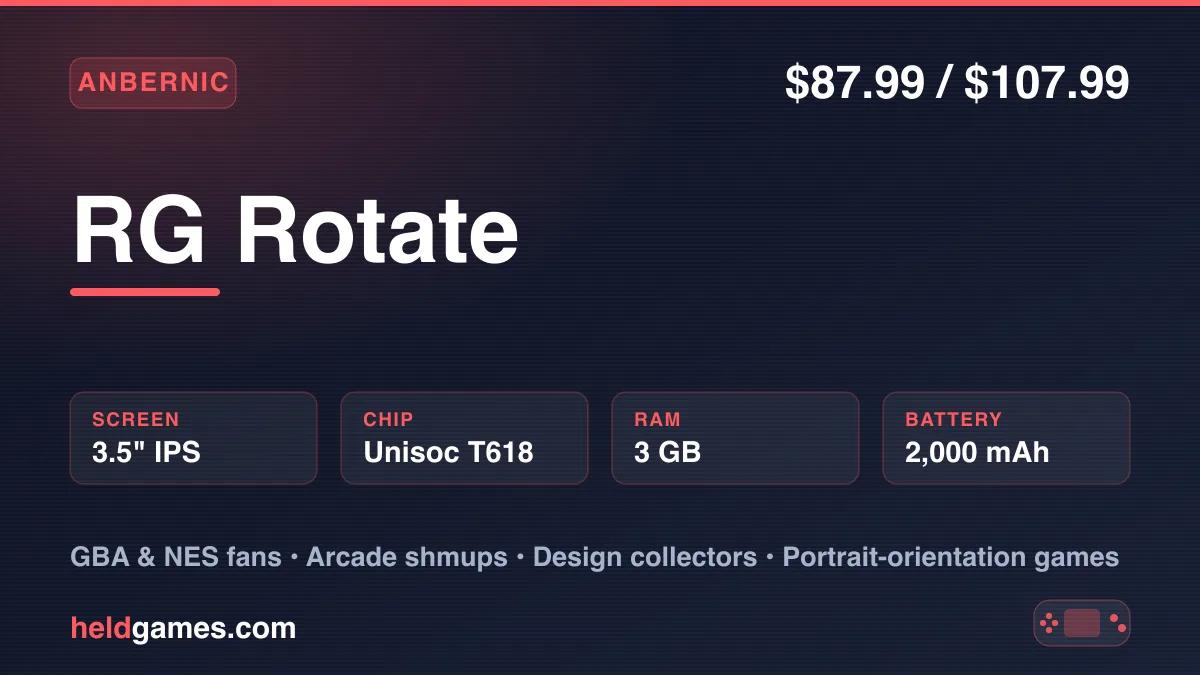
Anbernic ships a lot of handhelds. Most are slabs. The RG Rotate is the rare one that tries something genuinely different. It is built around a square 3.5 inch screen that physically swivels on a metal hinge, so you can twist the panel relative to the controls. It is the first mainstream retro handheld to do this, and it lands at a budget friendly $88.
This is not a flagship. It is a fun, affordable device aimed at retro first players. The Unisoc T618 chip and 3 GB of RAM put it firmly in the budget tier. Where it shines is the square screen and the systems that suit it. GBA, NES, SNES, arcade, and vertical shmups all look great on a 720x720 panel that can rotate to match the game.
What Is the Anbernic RG Rotate?
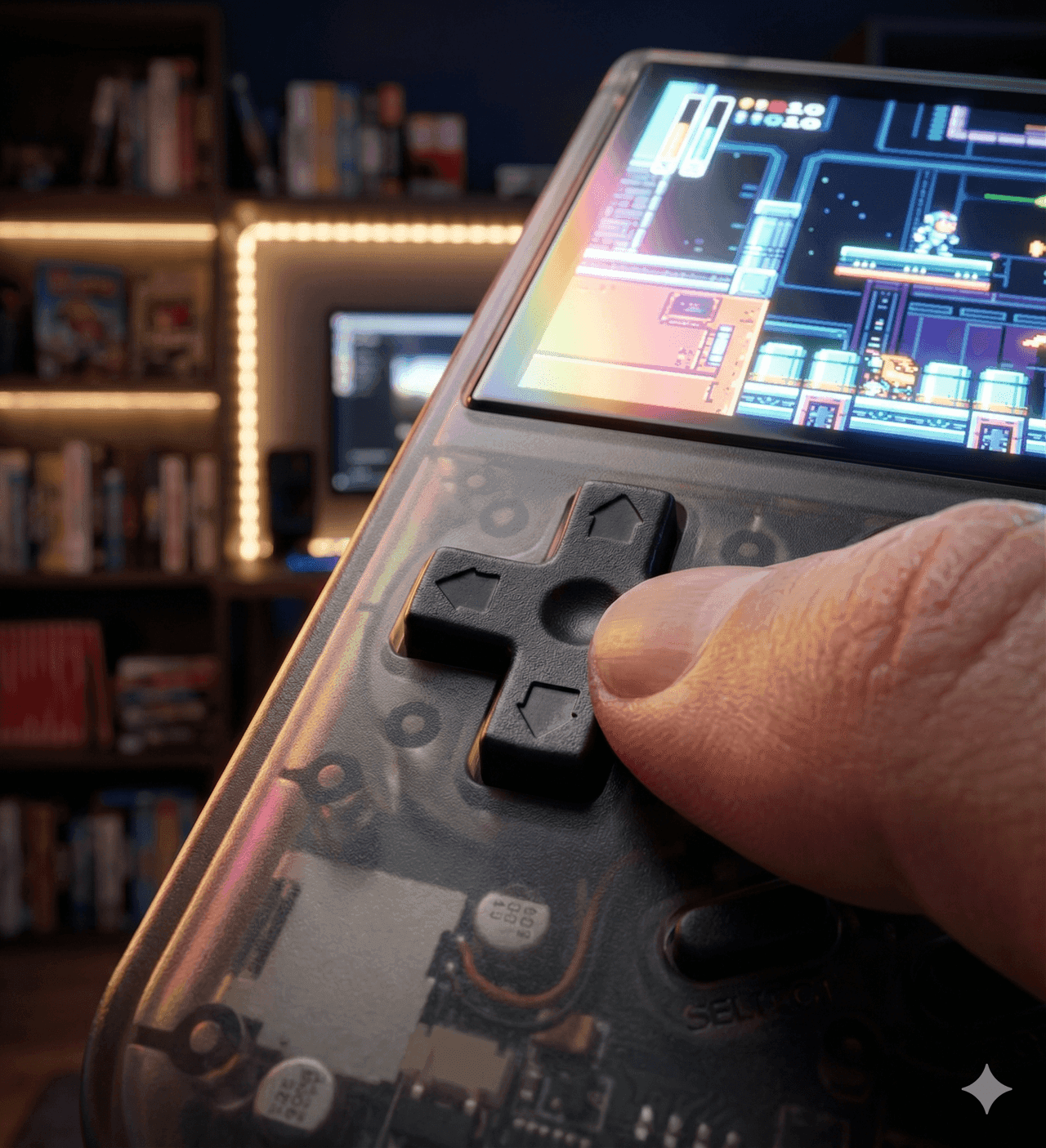
The RG Rotate is an Android retro handheld with a 3.5 inch square IPS display at 720x720, mounted on a thin alloy hinge that lets the screen pivot relative to the control deck. The form factor recalls the old T-Mobile Sidekick. A control slab sits on the bottom, and a swiveling screen sits on top. It runs Android 12, charges over USB C, and ships in two chassis options.
Specs
| Screen | 3.5 inch IPS, 720x720, 1:1 square, 290 PPI |
| Screen mechanism | Rotating alloy hinge (swivel display) |
| Processor | Unisoc Tiger T618, octa core (2x A75 + 6x A55) |
| GPU | Mali G52 MP2 at 850MHz |
| RAM | 3 GB LPDDR4X |
| Storage | 32 GB eMCP, microSD up to 2TB |
| OS | Android 12 |
| Battery | 2000 mAh, roughly 5 hours |
| Charging / audio | USB C, also handles audio out, no 3.5mm jack |
| Connectivity | Wi-Fi 5, Bluetooth 5.0 |
| Controls | Face buttons, D-pad, analog sticks, adjustable height L2 and R2, six axis gyro |
| Chassis | Polar Black (ABS) or Aurora Silver (aluminum) |
The Rotating Screen Is the Whole Point
The defining feature is not the square panel. Anbernic already did a 720x720 square screen on the RG Cube. The defining feature is the hinge. The screen pivots on an ultra thin alloy hinge that Anbernic says passed internal high durability testing.
Why bother? Because a square display is an elegant compromise for retro, and rotating it lets the device match more aspect ratios without letterboxing.
- Game Boy and Game Boy Color fill nearly the entire square panel.
- NES and SNES display almost edge to edge.
- GBA fills the screen with narrow top and bottom bars.
- Vertical arcade shooters like Ikaruga and DoDonPachi run in their native portrait orientation.
- Dual screen DS layouts stack cleanly on a square display.
The buttons stay put while only the screen rotates, so the control ergonomics stay consistent in both orientations.
Design and Build
The RG Rotate comes in two chassis options.
- Polar Black uses an ABS plastic body and is the lighter, cheaper option at $88.
- Aurora Silver uses an aluminum body with a matte finish at $108. This is the premium pick.
Both share the hinge, the control layout, and the port placement. The silhouette is clean and low profile, and it slips into a pocket far more easily than the chunky RG Cube.
Controls and Ergonomics
The control set is solid for a budget device. You get face buttons, a D-pad, dual analog sticks, a six axis gyro, and a vibration motor. The standout is the adjustable height L2 and R2 shoulder triggers, which let you change the trigger travel physically. That is a nice touch you do not usually see at this price.
Emulation Performance
The Unisoc T618 is a proven budget chip. It shows up in many well regarded handhelds, so its limits are well understood. Set expectations at the budget tier and you will be happy.
- NES, SNES, Game Boy through GBA, Genesis, PC Engine. Full speed, no fuss.
- PS1. Full library, full speed.
- Arcade. CPS1, CPS2, Neo Geo, and most MAME run well.
- Nintendo 64. Good. The bulk of the library runs with the right core.
- Dreamcast. Good. Most titles play at full speed via Flycast. See the Flycast Dreamcast setup guide.
- PSP. Playable. Many titles run full speed, with the heaviest needing tuning. Note that PSP output is 16:9, so it wastes space on a 1:1 screen.
- DS. Playable, and the square screen suits stacked dual screen layouts.
- PS2, GameCube, Wii, Switch. Out of reach. The T618 is a budget chip, so do not buy the Rotate for these.
If heavy PS2 and GameCube are your goal, step up to a Snapdragon device like the Retroid Pocket 6.
A Note on the 3 GB of RAM
The 3 GB of RAM is the one spec to keep in mind. It is low for an Android handheld in 2026. For pure retro emulation it is fine, and everything up to PSP runs without trouble. It does limit heavy Android multitasking and the most demanding PSP and DS titles. For a retro first device at $88, it is an acceptable trade.
Battery Life
The 2000 mAh battery is small. Expect roughly 5 hours of mixed retro play, and less for N64 or Android native titles. The hinge and the compact body leave little room for a larger cell. This is a device you top up often, which is the honest trade for the slim swivel design.
Software
The RG Rotate runs full Android 12 with access to the Play Store, so any Android emulator or front end works. We suggest installing a front end like Daijisho or ES DE for Android on top of the stock launcher, then using the RetroArch setup guide to dial in cores. The stock Anbernic launcher remains the weakest part of the Anbernic software story, but on Android it takes only minutes to replace.
Anbernic RG Rotate vs RG Cube
The RG Cube is the closest sibling. Both use a 720x720 square panel, but they target different buyers.
| RG Rotate | RG Cube | |
|---|---|---|
| Screen | 3.5" 720x720, rotating hinge | 3.95" 720x720, fixed |
| Chassis | ABS or aluminum | Plastic |
| Processor | Unisoc T618 | Unisoc T820 |
| RAM | 3 GB | 8 GB |
| Battery | 2000 mAh | 5200 mAh |
| OS | Android 12 | Android 13 |
| Headphone jack | No | Yes |
| Price | $88 / $108 | $170 |
The RG Cube is the more powerful device with a stronger chip, more RAM, and a much bigger battery. The Rotate is cheaper, far more pocketable, and brings the unique swivel screen. If you want power and battery life, pick the RG Cube. If you want novelty and portability on a budget, pick the Rotate.
Who Should Buy the Anbernic RG Rotate
Buy the RG Rotate if you play mostly Game Boy, GBA, NES, SNES, arcade, or vertical shmups; you love the swivel screen idea; you want a cheap, pocketable second device; you value the square display for retro systems.
Skip the RG Rotate if you want PS2 or GameCube (look at the Retroid Pocket 6); you need long battery life away from a charger; a 3.5mm headphone jack is non negotiable; you want the most RAM and power for your money (the RG Cube is stronger).
The RG Rotate is not the most powerful handheld of 2026. It might be the most fun to pick up at this price. For the right buyer, that counts for a lot.
Frequently Asked Questions
How much does the Anbernic RG Rotate cost?
It starts at $88 for the Polar Black ABS model and $108 for the Aurora Silver aluminum model. Both share the same internals.
Does the Anbernic RG Rotate screen actually rotate, or is it just software?
It physically rotates. The screen is mounted on an alloy hinge that pivots relative to the control deck. The panel itself moves, which is different from a software rotation flag.
What can the Anbernic RG Rotate emulate?
Everything from 8 bit and 16 bit systems through PS1, arcade, N64, Dreamcast, and most of PSP and DS. PS2, GameCube, Wii, and Switch are out of reach on the Unisoc T618.
Does the Anbernic RG Rotate have a headphone jack?
No. The Rotate ships without a 3.5mm jack. Audio runs through the USB C port or Bluetooth.
What is the battery life on the Anbernic RG Rotate?
The battery is 2000 mAh, good for roughly 5 hours of mixed retro emulation. Heavier systems like N64 pull it down faster.
Related Reading
- Anbernic RG Cube Review — the fixed screen square display sibling
- Anbernic RG Vita Pro Review — Anbernic's PSP focused widescreen handheld
- Best Retro Handhelds in 2026
- Best Handhelds for DS and 3DS Emulation
- RetroArch Setup Guide
The Verdict4.2 / 5
The Anbernic RG Rotate is a charming budget handheld built around one clever idea, a square screen that physically swivels on a hinge. For GBA, NES, SNES, arcade, and vertical shmups it is a genuine delight, and at $88 it is easy to recommend as a fun second device. Set expectations at the budget tier. The Unisoc T618 and 3 GB of RAM handle everything up to PSP, Dreamcast, and most N64, but PS2 and GameCube are off the table. If you want the novelty and a retro first library, the Rotate is a lot of fun for the money.
Related reading
 ReviewReviewReview