
Affiliate disclosure: This review contains affiliate links. As an Amazon Associate, we earn from qualifying purchases at no extra cost to you. Learn more.
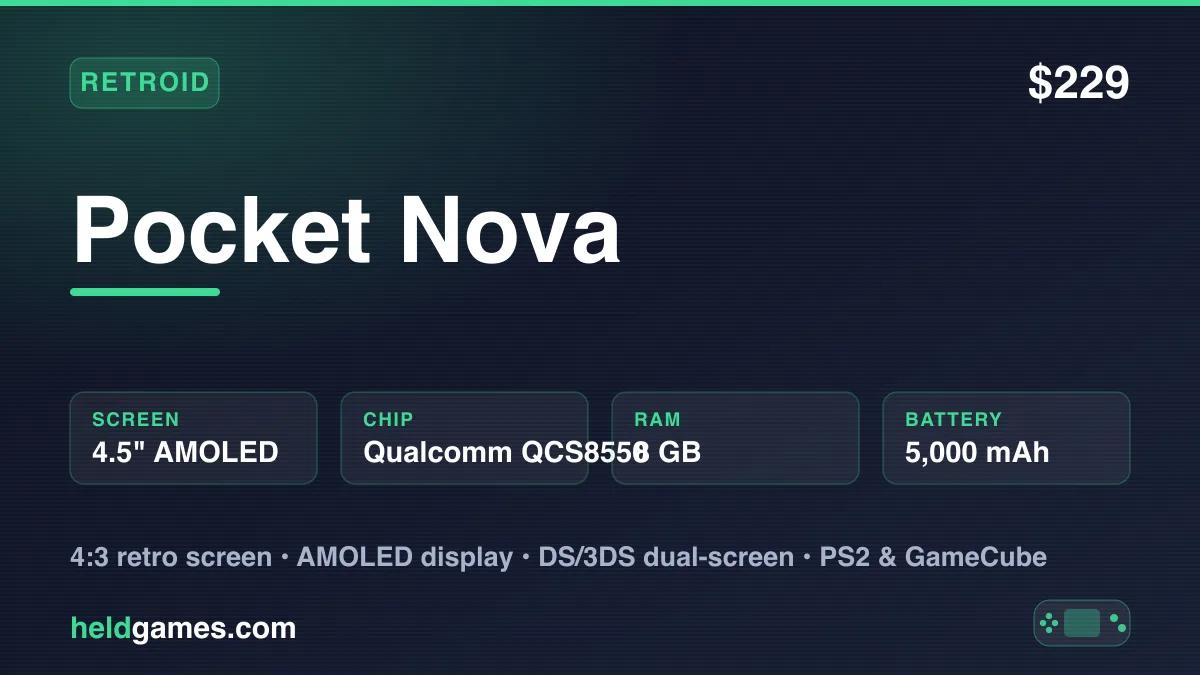
Retroid has made a lot of great 16:9 handhelds. The Pocket Nova is something different. It is built around a 4.5 inch AMOLED in a true 4:3 shape, which is the aspect ratio most of the retro library was actually made for. Pair that screen with the QCS8550, a Snapdragon 8 Gen 2 class chip, and you get a device that fills the glass edge to edge with SNES, GBA, PS1, and GameCube instead of leaving black bars down the sides.
The Nova opened pre-orders on June 26, 2026 and is shipping now, starting at $229. It has become one of the easiest recommendations we make to retro focused buyers, and the reason is entirely the screen.
The Short Version
If your library lives in the 4:3 era, buy this one. The panel shape means SNES, GBA, PS1, N64 and GameCube fill the screen instead of wasting a third of it, and the AMOLED contrast makes pixel art look better than it does on any LCD handheld near this price.
If you play a lot of widescreen 3D, modern Android games, or streaming apps, get the Retroid Pocket 6 instead. Same chip, 16:9 panel, bigger battery.
✓ Pros
- • True 4:3 AMOLED that fills the screen for most retro systems
- • QCS8550 is Snapdragon 8 Gen 2 class, strong PS2 and most of GameCube
- • Adreno 740 GPU has mature emulator driver support
- • Hall-effect sticks and analog triggers
- • Works with the Dual Screen Add-on for DS and 3DS style play
- • Wi-Fi 7, 27W charging, and a 3.5mm jack
- • Starts at $229, undercutting the Pocket 6
✗ Cons
- • 4:3 means black bars on widescreen 3D and modern Android games
- • 5,000 mAh battery is smaller than the Pocket 6's 6,000 mAh
- • 255 g is on the heavier side for the screen size
- • Android setup curve for newcomers
- • No 4:3 benefit for the Switch and PS2 era libraries you might also want
Technical Specifications
| Screen | 4.5 inch AMOLED, 1280x960, 4:3, 120Hz |
| Processor | Qualcomm QCS8550 (Snapdragon 8 Gen 2 class) |
| GPU | Adreno 740 |
| RAM | 8GB or 12GB LPDDR5X |
| Storage | 128GB UFS 3.1 + microSD |
| Battery | 5,000 mAh, 27W wired |
| OS | Android 13 |
| Connectivity | Wi-Fi 7, Bluetooth 5.3, USB-C (DisplayPort), 3.5mm |
| Dimensions | 169.9 x 84.1 x 15.6 mm |
| Weight | 255 g |
| Price | $229 (8GB) / $269 (12GB) |
Build and Design
The Pocket Nova is a horizontal handheld that puts the 4:3 screen front and center. It measures about 169.9 by 84.1 by 15.6 mm and weighs roughly 255 g. That makes it wider than a typical 16:9 device of the same screen size, because a 4:3 panel is taller, and the body grows to match. It is still a comfortable two handed device, just not a slip in your jeans pocket one.
The control layout uses Hall-effect sticks, analog triggers, and a stacked shoulder button arrangement. Front firing stereo speakers sit on the face. Retroid offers the Nova in opaque colors like Black, GameCube, and 16-Bit, plus a premium tier of transparent shells including Ice Blue, Crystal, Watermelon, and Clear Purple.
Hall-effect sticks matter more than the spec sheet suggests. They use magnetic sensors rather than physical contacts, so they do not develop stick drift the way traditional potentiometer sticks do. On a device you plan to keep for years, that is the difference between a handheld that ages well and one that does not.
The 4:3 AMOLED Is the Whole Point
The screen is why this device exists. You get a 4.5 inch AMOLED at 1280 by 960 in a 4:3 aspect ratio, with a 120Hz refresh rate and around 355 PPI.
Here is why that shape matters. The NES, SNES, Genesis, Game Boy, GBA, PS1, N64, and GameCube were all designed for screens close to 4:3. On a 16:9 handheld you either stretch them, which looks wrong, or pillarbox them, which wastes a third of your screen. On the Nova those systems fill the panel. Combine that with AMOLED contrast and you get pixel art with true blacks and punchy color, at a size that feels right for the era. For a deeper look at why this trade matters, see our best AMOLED handhelds guide.
There is a bonus in the resolution too. 1280x960 is exactly 4x the 320x240 of many retro systems, which means integer scaling lands cleanly with no shimmer or uneven pixels. Our integer scaling explainer covers why that matters more than raw pixel count.
The trade is the other direction. Widescreen 3D, modern Android games, and most streaming apps are 16:9, so they letterbox with bars on the top and bottom. If your library is mostly retro, the 4:3 panel is a gift. If you lean modern, a 16:9 device like the Retroid Pocket 6 fits better.
The QCS8550 Chip Explained
The Nova runs a Qualcomm QCS8550. That name might be unfamiliar, so here is the plain version. The QCS8550 is Qualcomm's industrial and IoT variant of the Snapdragon 8 Gen 2. It is the same CPU and the same Adreno 740 GPU, just with the 5G cellular modem stripped out. A handheld does not need a phone modem, so you lose nothing that matters for gaming and you get flagship class silicon.
That is good news for emulation. The Adreno 740 is the same GPU in the Pocket 6 and in 2023 flagship phones, which means Vulkan and the open source Turnip drivers are mature and well tested. Emulators behave predictably instead of fighting the hardware. Paired with up to 12GB of LPDDR5X RAM and active cooling, the Nova has the headroom to push demanding systems and hold a steady frame rate over longer sessions.
The practical takeaway is that the Nova is not a gamble. It shares silicon with a device that has been in the community's hands for over a year, so emulator compatibility is a known quantity rather than something you find out after you buy.
Emulation by System
The Nova runs the same chip and GPU as the Pocket 6, so it lands in the same performance tier across the board.
| System | How it runs | Notes |
|---|---|---|
| NES, SNES, Genesis, GBA | Flawless | The screen's home turf. These fill the 4:3 panel |
| PS1 | Flawless | Upscales cleanly with room to spare |
| Nintendo 64 | Excellent | The big names run great, with the usual fussy exceptions |
| Dreamcast and Saturn | Excellent | Full speed across nearly the whole library |
| PSP | Excellent | Most games run at 2x or 3x resolution |
| GameCube | Very good | Most of the library runs well, heaviest titles need per game tuning |
| PS2 | Good, upscalable | Many games run at 2x, the hardest still need settings work |
| Wii | Mixed to good | Lighter games run well, motion heavy ones depend on the title |
| Nintendo DS and 3DS | Strong | Plus the Dual Screen Add-on trick, covered below |
| Switch | Possible, not the point | Lighter titles only. This is not a Switch machine |
The short version is that the Nova comfortably clears everything through Dreamcast and PSP, runs most of GameCube, and upscales a good chunk of PS2. For the full picture on the hardest of those systems, see our GameCube and Wii emulation guide and our best handhelds for PS2 emulation roundup.
One thing worth setting expectations on. The 4:3 screen is a real advantage through the GameCube era and a real disadvantage after it. PS2, Wii and Switch games are mostly widescreen, so the panel that makes your SNES library sing will letterbox them. Buy the Nova for what is behind the PS2 era, not in front of it.
The Dual Screen Add-on
This is the Nova's most interesting wrinkle. Retroid confirmed the Pocket Nova is compatible with the Dual Screen Add-on first introduced for the Pocket 5 and 6. It is a $69 accessory with a 5.5 inch AMOLED on a click-stop hinge that drives the second screen over DisplayPort through USB-C with passthrough charging. The unit mounts with a device specific back clip, so Nova owners want the Nova fit rather than the clip bundled for older models.
Clip it on and the Nova becomes a modern day Nintendo DS or 3DS, with a proper two screen layout instead of two screens squeezed onto one panel. For the DS and 3DS libraries that depend on a second screen, this is the closest a current handheld gets to the real thing. We cover setup and the best games for it in our Dual Screen Add-on guide, and the wider category in our best handhelds for DS and 3DS emulation roundup.
Android and Software
The Nova runs full Android 13. You install your own emulators, whether that is RetroArch, standalone Dolphin, PPSSPP, Flycast, or a frontend like Daijisho or ES-DE. You can add streaming and cloud gaming apps too. The flexibility is the reward and the setup is the cost.
If you are new to Android handhelds, the Retroid ecosystem is one of the more beginner friendly places to start, with a large community and frequent firmware support. Our Retroid Pocket 6 setup guide covers the same software stack step by step, and almost all of it applies directly to the Nova.
Battery and Charging
The Nova carries a 5,000 mAh battery with 27W wired charging over USB-C. That is a step down from the Pocket 6's 6,000 mAh, which is the one spec where the bigger sibling clearly wins.
In practice expect long sessions on 2D and PSP and shorter ones when you push GameCube and PS2, which is normal for an 8 Gen 2 class chip. AMOLED helps here in a way LCD does not. Because black pixels are genuinely off, a 4:3 game with letterboxing draws less power than the same content on an LCD.
The 27W charging refills quickly, and the returning 3.5mm jack means zero latency wired audio.
How It Compares
Against the Retroid Pocket 6, the choice is screen shape. Same chip family, but the Nova is 4:3 AMOLED for retro and the Pocket 6 is 16:9 AMOLED with a bigger battery for a mixed library. This is the comparison most buyers actually need.
Against the AYANEO Pocket Micro 2, it is size and power. The Nova is bigger with a faster chip and a larger 4:3 screen. The Micro 2 is truly pocketable with a proven Snapdragon 865.
Against the Retroid Pocket Classic, it is shape and tier. The Nova is a horizontal 4:3 flagship. The Classic is a cheaper vertical GBA style device with a slower chip.
Against the Anbernic RG557, it is panel shape again, plus ecosystem. The RG557 is a 16:9 AMOLED alternative at a similar tier.
Who Is This For?
The Retroid Pocket Nova suits:
- Retro players whose library lives in the 4:3 era and want it to fill the screen
- GameCube and PS2 fans who want a flagship class chip without going to the top tier
- DS and 3DS players who want the Dual Screen Add-on experience
- Power users who want full Android with a great AMOLED panel
It is not the right pick for widescreen 3D and modern Android games, for the longest possible battery life, or for anyone who needs a truly pocketable device.
Frequently Asked Questions
Is the Retroid Pocket Nova worth it?
For a retro focused library, yes. The 4:3 AMOLED is the only panel of its kind at this price, and the Snapdragon 8 Gen 2 class chip is genuinely fast rather than just adequate. If your library is mostly widescreen, the Pocket 6 is the better buy for the same money.
Is the Nova better than the Retroid Pocket 6?
They are the same speed. The Nova has the 4:3 screen and a lower starting price. The Pocket 6 has a larger 16:9 screen and a bigger battery. Pick on screen shape, not on performance.
Can the Retroid Pocket Nova run PS2 games?
Yes, and many at 2x resolution. The hardest PS2 titles still need per game settings work, which is true of every Android handheld in this class.
Can it run Switch games?
Lighter ones, but this is not a Switch machine and we would not buy it for that. See our Switch 2 emulation guide for what is realistic on Android hardware.
Does the Nova have stick drift problems?
It uses Hall-effect sticks, which sense position magnetically rather than through physical contacts. That design does not develop the drift that traditional sticks do.
What size microSD card should I get?
256GB is the sweet spot for most people. Our best microSD cards guide covers which ones are actually fast enough for an Android handheld.
Verdict
The Pocket Nova is the device 4:3 fans have been asking Retroid to make. The screen shape is the right one for the retro library, the AMOLED panel is gorgeous, and the QCS8550 brings flagship class emulation at a starting price that undercuts the Pocket 6. The Dual Screen Add-on support is a genuine bonus that almost nothing else offers.
The honest caveats are the smaller battery, the heavier body, and the fact that the 4:3 advantage stops being an advantage once you move past the GameCube era.
If you want a 4:3 AMOLED handheld that plays the classics edge to edge and reaches into GameCube and PS2, the Nova belongs at the top of your list.
Related reading
 ComparisonComparison
 Guide
Guide