
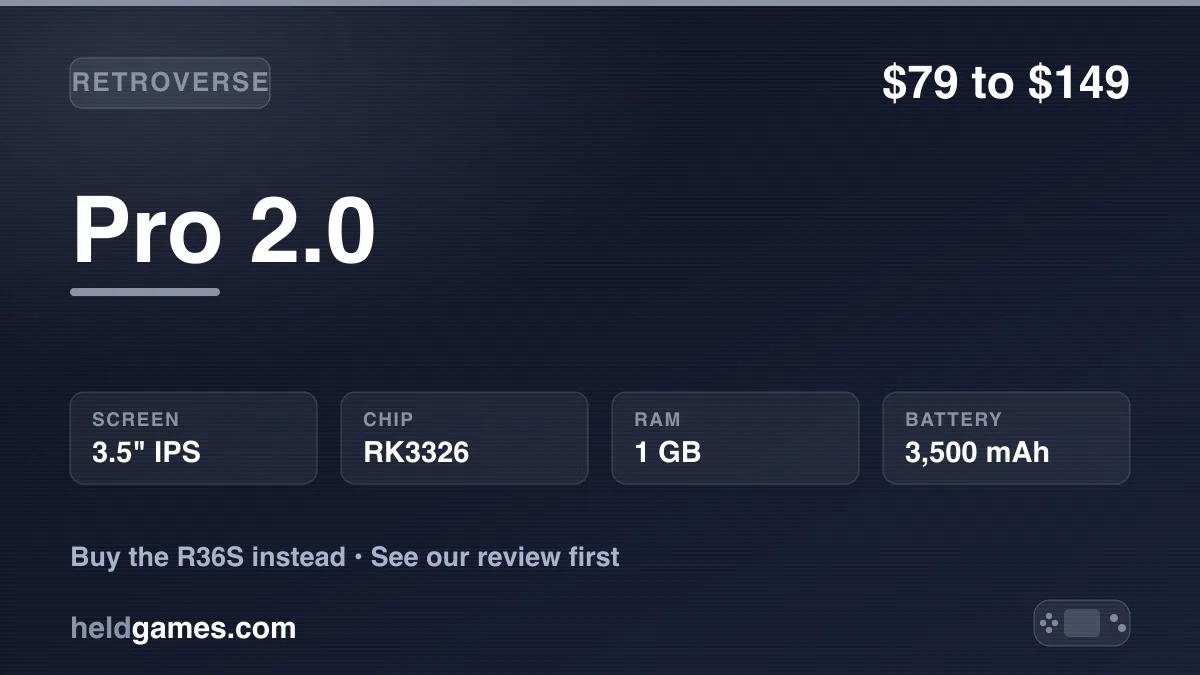
If a slick video ad for the Retroverse Pro 2.0 brought you here, you are asking the right question before clicking buy. That instinct is correct.
Here is the short version. The Retroverse Pro 2.0 is a rebranded R36S, a generic budget handheld that has been around for years. This is not our detective work. The Retroverse store's own product page titles it an "R36S Retro Handheld Console." The device is real and it functions. The business model is buying a $35 device in bulk, wrapping it in social media marketing, and reselling it for $79 or more. The store's own listing has shown prices as high as $149.
We have not bought one, and we do not need to. The R36S underneath is one of the best documented budget handhelds in the hobby. So let us look at what you would actually get.
Affiliate disclosure: This page contains affiliate links. As an Amazon Associate, we earn from qualifying purchases at no extra cost to you. Learn more.
What You Actually Get
| Marketing claim | Reality | |
|---|---|---|
| Device | "Retroverse Pro 2.0" | Standard R36S, rebranded |
| Chip | "RK3326 64-bit 1.5GHz, ultra-smooth, zero-lag" | A 2019 era budget chip, fine for 2D and PS1 |
| Systems | NES through N64, DS, PSP, Dreamcast, NAOMI | Great through PS1. N64, PSP, and Dreamcast mostly struggle on RK3326 |
| Games | "20,000+ preloaded" | Auto-scraped ROM dumps of wildly varying quality |
| Battery | "Up to 10 hours" | Realistic for light 2D play on R36S hardware |
| Street price | "$79 instead of $149" | The same hardware sells for around $35 as the R36S |
The screen is a 3.5 inch 640x480 IPS panel, and it is honestly nice. The RK3326 with its Mali-G31 GPU handles 8 bit, 16 bit, Game Boy lines, and most of PS1 well. That part of the pitch is true, because the R36S was always a decent little 2D machine.
The overreach is everything past that. Listing NAOMI, Dreamcast, N64, DS, and PSP as supported systems is technically true in the sense that emulators exist and some light titles boot. It is misleading as a promise. On this chip, most of those libraries run poorly or not at all.
The 20,000 Games Problem
The headline feature is the preloaded library, and it deserves a clear-eyed look.
First, the legal side. These devices ship with massive collections of ROMs that nobody licensed. Selling hardware stuffed with copyrighted games sits in a legal gray zone at best, and Nintendo in particular has been aggressive about this category. You are buying a library that could not exist through any legitimate channel.
Second, the practical side. Bulk ROM collections are auto-scraped. Expect duplicates, broken dumps, bad regional versions, and menus stuffed with shovelware padding the count. The number 20,000 is doing marketing work, not gaming work.
Our position is the same as always: emulation is wonderful, and the right way to use it is playing backups of games you actually own. Our ROMs and legality guide explains the full picture.
No Wi-Fi, No Community, No Support
The Retroverse has no Wi-Fi, which the marketing spins as a feature. In practice it means no RetroAchievements, no netplay, and no easy updates.
The bigger issue is support. Anbernic, Miyoo, Retroid, and TrimUI are real manufacturers with track records, parts, and firmware communities. A drop-ship storefront is none of those things. If your unit develops a stick problem in month three, a 30 day guarantee and an anonymous brand will not help you.
One silver lining: because it is an R36S, the excellent community firmware ArkOS can run on this hardware. Be warned that R36S clones vary internally, panel revisions matter for compatibility, and flashing is at your own risk on an unsupported rebrand.
What to Buy Instead
The money the ad wants is enough to buy something genuinely better.
- A standard R36S. The identical device at its honest price, around $35. If the R36S formula appeals to you, buy it without the markup.
- Anbernic RG35XX H, about $58. A better built horizontal with analog sticks, Wi-Fi, HDMI out, and first class muOS support. Our full review explains why it is the budget king of this shape.
- Miyoo Mini V4, about $35. The best tiny vertical option, with the beloved Onion OS style experience. See our Miyoo Mini V4 buying guide.
Every one of these comes from a real brand with a real community, and every one costs the same or less than the Retroverse ads.
Frequently Asked Questions
Is the Retroverse Pro 2.0 a scam?
Not strictly. A real device ships and it plays games. It is a rebranded R36S sold at a large markup through social media ads, so it is better described as a bad deal than a scam.
Is the Retroverse Pro 2.0 the same as the R36S?
Yes. The official Retroverse product page itself lists the device as an R36S. The hardware, chip, and screen are the standard R36S package under new branding.
Can the Retroverse Pro 2.0 really play N64, PSP, and Dreamcast?
Mostly no. The RK3326 chip handles 8 bit through PS1 well. Some light N64, PSP, and Dreamcast titles boot, but most of those libraries run poorly on this hardware.
What should I buy instead of the Retroverse Pro 2.0?
A standard R36S for the same hardware at around $35, or an Anbernic RG35XX H at about $58 for a big step up in build, features, and firmware support. Our best handhelds under $100 guide has more options.
Related Reading
The Verdict2 / 5
The Retroverse Pro 2.0 is not a scam in the sense that a real device arrives and it works. It is a bad deal. The product page itself calls it an R36S, a handheld that normally sells for around $35, and the ads resell it at $79 or more. The RK3326 chip is fine for 8 bit through PS1 and nothing more, whatever the marketing implies about N64, PSP, and Dreamcast. Buy a standard R36S or an Anbernic RG35XX H instead and pocket the difference.
Related reading
 ReviewReviewReview