
Affiliate disclosure: This guide contains affiliate links. As an Amazon Associate, we earn from qualifying purchases at no extra cost to you. Learn more.
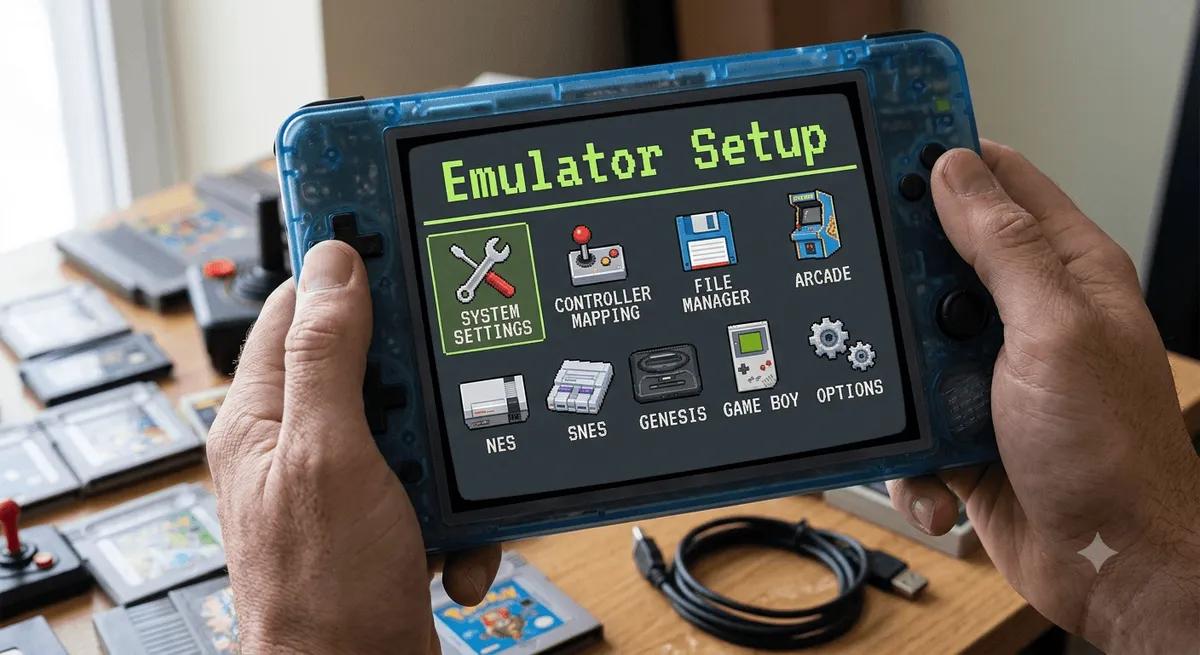
PSP emulation has never been better. PPSSPP — the gold-standard PSP emulator — runs beautifully on a wide range of modern retro handhelds, and the best titles in your UMD collection can look sharper and run smoother than they ever did on original hardware. This guide walks you through everything: which devices to use, how to install PPSSPP, and how to dial in settings for the best experience on a handheld screen.
Affiliate disclosure: As an Amazon Associate I earn from qualifying purchases. Links in this guide help support the site at no extra cost to you.
Which Devices Can Run PSP Games Well
PSP emulation is moderately demanding — more so than GBA or PS1, but well within reach of any mid-range handheld released in the last few years. Here's how the two most common choices stack up.
Retroid Pocket 5 is the best handheld for PSP emulation short of a smartphone. Its MediaTek Dimensity 1100 chip handles every PSP title at 1× native resolution without breaking a sweat, and most games run flawlessly at 2× — which makes them look genuinely crisp on the RP5's large screen. Demanding titles like God of War: Chains of Olympus and Crisis Core run at full speed with settings to spare.
Anbernic RG40XXV is a solid choice for lighter PSP titles. Its Allwinner H700 chip manages 2D-heavy games and early-era PSP titles well at 1× resolution, but struggles with 3D-intensive games — expect slowdown in Gran Turismo PSP, Tekken: Dark Resurrection, and other GPU-heavy titles. If PSP is a priority for you, the RG40XXV will work for a good chunk of the library but isn't the ideal primary PSP device. See our Anbernic RG40XXV review for a full breakdown.
Technical Specifications
| RP5 SoC | MediaTek Dimensity 1100 (4× Cortex-A78 + 4× Cortex-A55) |
| RP5 GPU | Mali-G77 MC9 |
| RP5 RAM | 8 GB LPDDR4X |
| RP5 PSP performance | Excellent — full speed at 1×–2× render resolution |
| RG40XXV SoC | Allwinner H700 (4× Cortex-A53 @ 1.8 GHz) |
| RG40XXV GPU | Mali-G31 |
| RG40XXV RAM | 1 GB DDR3 |
| RG40XXV PSP performance | Good for lighter titles; struggles with demanding 3D |
PPSSPP Standalone vs. the RetroArch Core
You have two options for running PSP games: PPSSPP standalone (the dedicated app) or the PPSSPP core inside RetroArch. The recommendation here is clear — use standalone.
✓ Pros
- • Standalone: faster updates and bug fixes directly from the PPSSPP team
- • Standalone: more granular graphics and performance settings
- • Standalone: better shader support and texture replacement
- • Standalone: lower overhead — no RetroArch wrapper between you and the emulator
- • RetroArch core: unified interface if you already use RetroArch for everything else
- • RetroArch core: RetroArch achievements and overlay system
✗ Cons
- • Standalone: separate app to manage outside RetroArch
- • Standalone: its own save state system, not shared with RetroArch
- • RetroArch core: lags behind standalone by weeks or months
- • RetroArch core: fewer graphics options exposed through the core interface
- • RetroArch core: noticeably worse performance on weaker hardware like the RG40XXV
For most users — especially on the RG40XXV where every bit of performance matters — standalone PPSSPP is the right call. If you're already running RetroArch for your other systems and you only want to dip into PSP occasionally, the core is fine. For anything serious, go standalone.
Dumping Your UMD Collection
To play your PSP games in PPSSPP, you first need to dump them from your UMD discs to ISO or CSO files. The most accessible way is to use a PSP with custom firmware (CFW) — specifically, the free CFW Infinity or ARK firmware — which adds a built-in ISO dumper.
- Install CFW on your PSP (instructions vary by model; PSP-1000/2000/3000 all support it)
- Insert the UMD you own
- Use the built-in ISO tool under the Game menu to dump the disc to your memory stick
- Transfer the resulting
.isofile to your handheld's SD card
The CFW dumping method writes your ISOs to the PSP's Memory Stick first, so make sure you have one with enough room for your library:
.ISO vs. CSO: CSO is a compressed ISO format that saves significant space with minimal performance impact. PPSSPP handles both natively — CSO is worth using if storage is a concern.
Installing PPSSPP
On Android-based handhelds (Retroid Pocket 5, RG40XXV with Android):
- Open the Play Store and search for PPSSPP — install the free version (PPSSPP Gold supports the developer but is functionally identical)
- Launch PPSSPP and tap Games at the bottom
- Navigate to the folder on your SD card where you put your ISOs
- Tap any game to launch it
Sideloading the APK (if your device doesn't have the Play Store): Download the APK from ppsspp.org and install it directly. You may need to enable "Install from unknown sources" in your device settings first.
On Linux-based handhelds (RG40XXV with KNULLI or muOS):
The easiest path is to install the PPSSPP standalone binary through your firmware's package manager, or place it in the ports/ directory if your firmware supports ports. Check your firmware's documentation for the specific method.
Recommended Graphics Settings for Handheld Screens
Open PPSSPP → Settings → Graphics. These are the settings that matter most.
Rendering Resolution
- Retroid Pocket 5: Start at 2× PSP (960×544). Most games run flawlessly. Push to 3× for visually simple titles.
- RG40XXV: Stick to 1× PSP (480×272). Bumping resolution is the fastest way to introduce slowdown on the H700 chip.
The PSP's native resolution is 480×272. Even at 1×, games look clean on a small handheld screen — the native pixel density is actually quite good.
Graphics Backend
- Vulkan — use this on the Retroid Pocket 5 and any device with good Vulkan support. Lowest overhead, best performance.
- OpenGL — fallback for devices with incomplete Vulkan drivers. Some older handhelds perform better here.
Set this under Settings → Graphics → Backend. If you see graphical glitches, try switching backends before adjusting anything else.
Texture Filtering
- Anisotropic Filtering: Set to 4× or 8× — essentially free performance cost and noticeably improves texture sharpness at angles.
- Texture Scaling: Leave at Off (1×) on the RG40XXV. On the RP5, xBRZ 2× adds a soft upscaling pass to textures that can look nice on some titles.
Display Layout
Go to Settings → Graphics → Display layout & effects:
- Aspect ratio: Set to 1:1 PAR (preserves the PSP's native pixel aspect ratio) or 4:3 stretched — both are reasonable; 1:1 PAR is technically accurate.
- Upscaling filter: Linear for a clean look; Nearest if you prefer a sharper, harder-pixel appearance.
Performance Tips
Rendering Resolution First
Before touching any other performance setting, drop your rendering resolution to 1× PSP. This single change has more impact than any other setting on weak hardware.
Frame Skipping
Frame skipping tells PPSSPP to skip rendering certain frames to stay at target speed. It trades smoothness for speed.
- Auto frameskip: Off — ideal when your device can handle the game at full speed
- Auto frameskip: On — enables PPSSPP to skip up to the set maximum when needed
- Frameskip: Set to 1 as a last resort. Anything above 2 makes games feel noticeably choppy.
On the RG40XXV with demanding titles: set rendering to 1×, then enable auto frameskip with a max of 1 before accepting that a title may just be too heavy for the hardware.
Fast Memory
Settings → System → Fast memory (unstable): Turning this ON skips some memory access validation and gives a small speed boost. The tradeoff is occasional glitches in a handful of games. Worth enabling on the RG40XXV; not necessary on the RP5.
CPU Clock
Settings → System → CPU clock: The default is 111 MHz (original PSP speed). Increasing this to 222 MHz or higher helps with games that ran slowly on original hardware — but note this increases battery drain and heat. Most games are fine at the default.
Control Mapping
The PSP had one analog stick, a d-pad, face buttons, shoulder buttons (L and R), Start, Select, and a Home button. Modern handhelds have two sticks, which lets you do something the original hardware couldn't: map the right stick to camera control for games that supported it via IR accessories or later revisions.
To remap controls in PPSSPP:
- Go to Settings → Controls → Control mapping
- Tap any PSP button to reassign it
- Press the physical button you want to map it to
Recommended right-stick mapping:
For third-person or action games (God of War, Monster Hunter Freedom Unite, Crisis Core), map the right analog stick to the PPSSPP analog substitute or use the "right analog" camera controls if the game supports them. PPSSPP calls this "right analog Y+" / "right analog Y−" etc. in the mapping menu.
Shoulder buttons: PSP only had L and R. If your device has L2/R2 triggers, map them to useful in-game functions or leave them unbound — they won't conflict with anything.
Save State Management
PPSSPP has its own save state system, separate from RetroArch's. Save states are accessed from inside a running game.
To save or load a state:
- Android: Tap the back button or use the on-screen overlay → Save state / Load state
- Quick save/load: You can map save and load state to physical buttons under Settings → Controls → Control mapping — search for "Save state" and "Load state" in the list
Save slots: PPSSPP supports 5 save slots per game (slots 0–4). Cycle through them in the same save/load menu.
Where saves live on device:
- Save states:
PSP/PPSSPP/PPSSPP State/ - In-game saves (the game's own save data):
PSP/SAVEDATA/
Back up the entire PSP/ folder to keep both. In-game saves are the more durable format — they survive PPSSPP version updates and are what you'd transfer to a different device or a real PSP.
Tip: Save states are tied to a specific PPSSPP version. If you update PPSSPP mid-playthrough and a save state won't load, use an in-game save instead — those are always compatible.
Frequently Asked Questions
Is PPSSPP standalone better than the RetroArch core?
The standalone app, generally. It gets updates sooner, exposes more settings, and has better per game configuration. The RetroArch core is convenient if you want everything inside one frontend.
What resolution should I run PSP games at?
The PSP rendered at 480x272, so whole number multiples keep things clean. 3x gives 1440x816, which suits a 1080p handheld well. Higher costs battery for diminishing returns.
Why do some PSP games have graphical glitches?
Usually a rendering mode or a game specific quirk. PPSSPP has per game settings for exactly this, and the community has documented fixes for most of the well known problem titles.
Can budget handhelds run PSP games?
Many can. PSP is one of the more forgiving demanding systems, and even modest Android and Linux handhelds handle a good part of the library, though not always at upscaled resolutions.
Do I need a BIOS for PPSSPP?
No. PPSSPP does not require a PSP BIOS file. You supply your own game dumps from UMDs or digital purchases you own.
How do I dump my own UMD collection?
Through homebrew on a PSP you own, which the guide above covers. The output is a disc image PPSSPP reads directly.
Related Guides
- How to Set Up RetroArch: The Complete Beginner's Guide — if you want a single interface for all your systems alongside PPSSPP
- Anbernic RG40XXV Review — full breakdown of the RG40XXV's performance ceiling and whether it fits your needs
Related reading
 GuideGuideGuide