
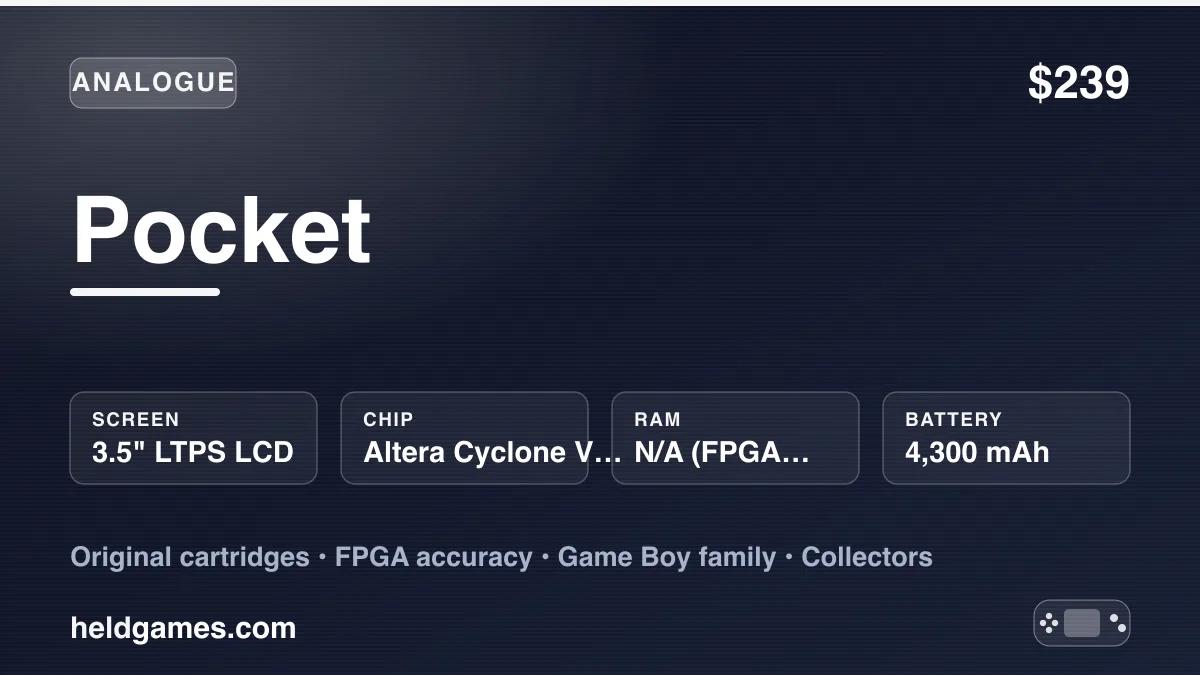
Most handhelds in 2026 are emulation machines. The Analogue Pocket is something else. It plays your original Game Boy, Game Boy Color, and Game Boy Advance cartridges through an FPGA, which is a chip configured to behave like the original hardware. The result is accuracy and low latency that software emulation is still chasing. If you own real carts, this is how you want to play them.
The other half of the story is the screen. The 3.5 inch panel packs an enormous pixel count, and it makes classic Game Boy games look better than they ever have. Add cartridge adapters and the openFPGA community scene, and the Pocket becomes far more than a Game Boy device. It is a premium purchase. It is also a special one.
For the bigger picture on why FPGA matters, read our FPGA vs emulation explainer.
What FPGA Means Here
A quick primer. An FPGA is a chip you can program to act like other hardware at the circuit level. The Pocket uses one to recreate the original Game Boy family hardware. It is not running an emulator. It is behaving like the real thing.
The practical wins are accuracy and responsiveness. Timing quirks, audio, and input latency all track the original hardware closely. For purists, that is the entire appeal.
Specs
| Display | 3.5 inch LTPS LCD, 1600x1440 |
| Main FPGA | Altera Cyclone V |
| Secondary FPGA | Altera Cyclone 10 |
| Native carts | Game Boy, Game Boy Color, Game Boy Advance |
| Adapters | Game Gear, Neo Geo Pocket and Color, Atari Lynx, TurboGrafx 16 and PC Engine, SuperGrafx |
| Expansion | microSD card slot for openFPGA cores and saves |
| Dock | Optional, around $99, adds video out and controllers |
| Street price | $239 |
The Screen Steals the Show
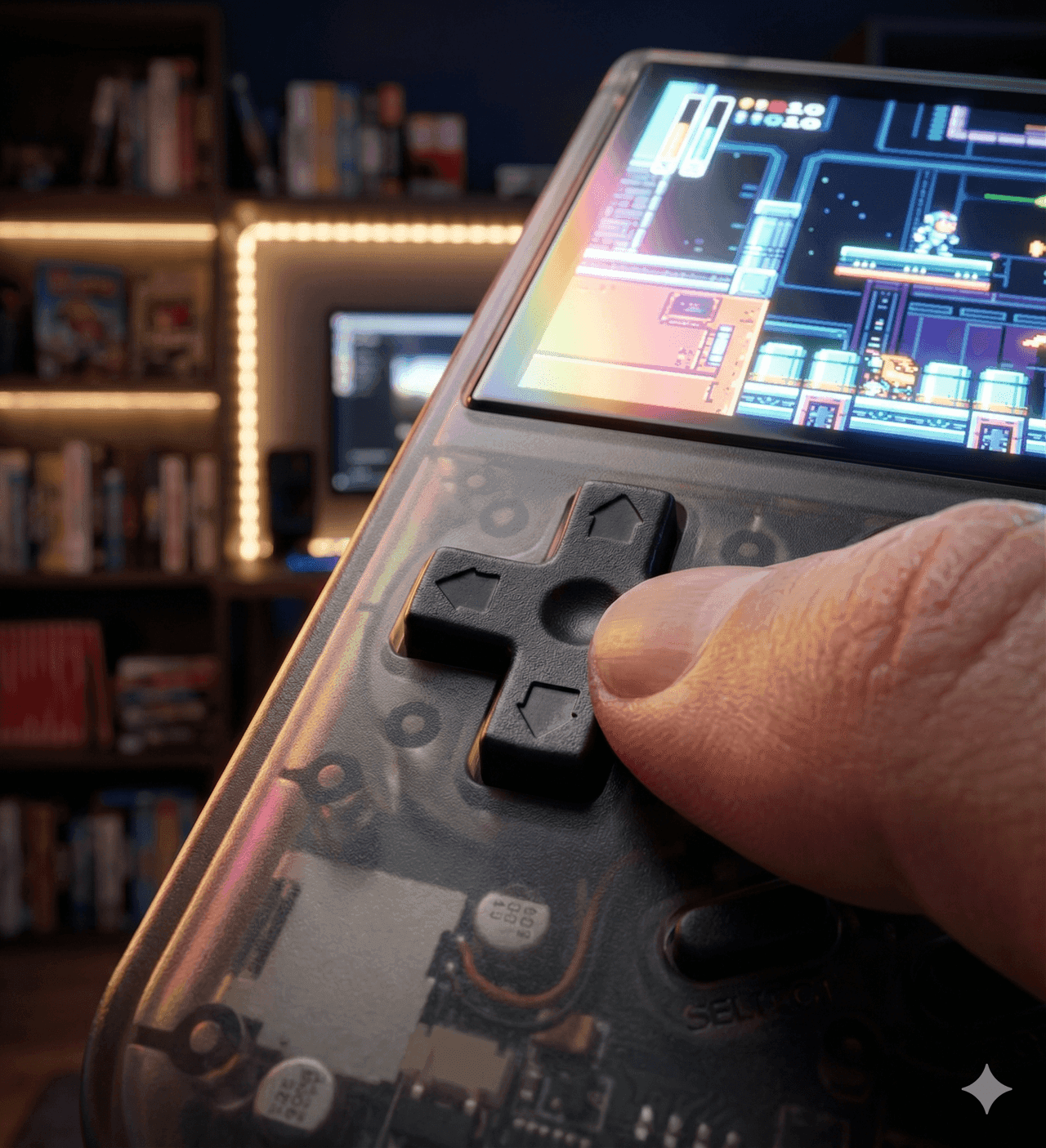
The display is the first thing everyone notices. The 3.5 inch panel runs at a very high resolution, which lets it scale classic Game Boy output with clean integer math. Pixels are crisp and square. There is no blur and no awkward stretching.
Analogue also bakes in display modes that mimic the original Game Boy dot matrix screen, the Game Boy Pocket, and more. Switch one on and the Pocket looks like the handheld you remember, only sharper and backlit. It is a lovely touch.
Cartridge Support and Adapters
Out of the box the Pocket plays Game Boy, Game Boy Color, and Game Boy Advance cartridges. Slot your real game in and play. This is the core use case and it is flawless.
Analogue sells cartridge adapters that unlock more systems on the same FPGA hardware. With adapters you can play Game Gear, Neo Geo Pocket and Color, Atari Lynx, TurboGrafx 16, PC Engine, and SuperGrafx carts. The adapters are sold separately, so factor them into your budget if you collect for those systems.
openFPGA Opens It Up
The openFPGA framework lets the community write FPGA cores for the Pocket. This is where it stops being only a Game Boy device. There are community cores for NES, SNES, Genesis, arcade boards, and a long list of other systems.
To be clear about the rules. openFPGA cores are the hardware recreations. You still supply your own game files for systems that need them, and we only ever cover playing games you legally own. The FPGA vs emulation guide explains the landscape in more depth.
The Dock
The optional dock costs around $99 and turns the Pocket into a living room machine. It adds video output to a TV and supports controllers over Bluetooth and USB. If you want to play your cartridge collection on the big screen, the dock is the way. It is not required for handheld use.
Build and Software
The Pocket feels premium in hand. The buttons are crisp. The shell is clean and minimal. Analogue OS is simple and tasteful, with cartridge metadata, save management, and the display filters all a few taps away.
The one ongoing frustration is buying one. Analogue tends to sell the Pocket in batches, and stock comes and goes. Prices have crept up over the years. If you see one in stock at a fair price and you want it, that is the moment to act.
Who Should Buy the Analogue Pocket
Buy the Analogue Pocket if you own original Game Boy, Color, or Advance cartridges and want to see them at their best; you value FPGA accuracy and low latency; you want the finest handheld screen for classic Nintendo handheld games; you enjoy the openFPGA scene and the adapter ecosystem.
Skip the Analogue Pocket if you want a single device that emulates everything up to PS2 (look at the Retroid Pocket 6); you do not own physical carts and have no interest in them; you want the lowest possible price (the Miyoo Mini Plus covers Game Boy through PS1 in software for a fraction of the cost).
The closest rival is the ModRetro Chromatic, which is a more focused Game Boy and Game Boy Color device. We compare them directly in Analogue Pocket vs ModRetro Chromatic.
Frequently Asked Questions
Is the Analogue Pocket an emulator?
No. It uses an FPGA, which is hardware configured to behave like the original Game Boy family. It plays your real cartridges. This is the main reason it is so accurate.
What cartridges does the Pocket play?
Game Boy, Game Boy Color, and Game Boy Advance natively. With Analogue cartridge adapters it also plays Game Gear, Neo Geo Pocket and Color, Atari Lynx, TurboGrafx 16, PC Engine, and SuperGrafx.
How much does the Analogue Pocket cost?
$239 for the handheld. The dock is around $99 and cartridge adapters are sold separately.
What is openFPGA?
It is a framework that lets the community build FPGA cores for the Pocket, adding systems beyond the Game Boy family. We only cover playing games you legally own.
Analogue Pocket or ModRetro Chromatic?
The Pocket is more versatile thanks to GBA support, adapters, and openFPGA. The Chromatic is a focused Game Boy and Game Boy Color device with its own strengths. See the full comparison.
Related Reading
The Verdict4.6 / 5
The Analogue Pocket is the best handheld ever made for original Game Boy, Game Boy Color, and Game Boy Advance cartridges. The FPGA approach means accuracy and low latency that software emulation still chases. The screen is genuinely stunning. Cartridge adapters and the openFPGA scene stretch it far beyond Nintendo handhelds. At $239 it is a premium purchase aimed at collectors and purists, not bargain hunters. If you own real carts and want to see them at their absolute best, nothing else comes close.
Related reading
 ReviewReviewReview