
Affiliate disclosure: This review contains affiliate links. As an Amazon Associate, we earn from qualifying purchases at no extra cost to you. Learn more.
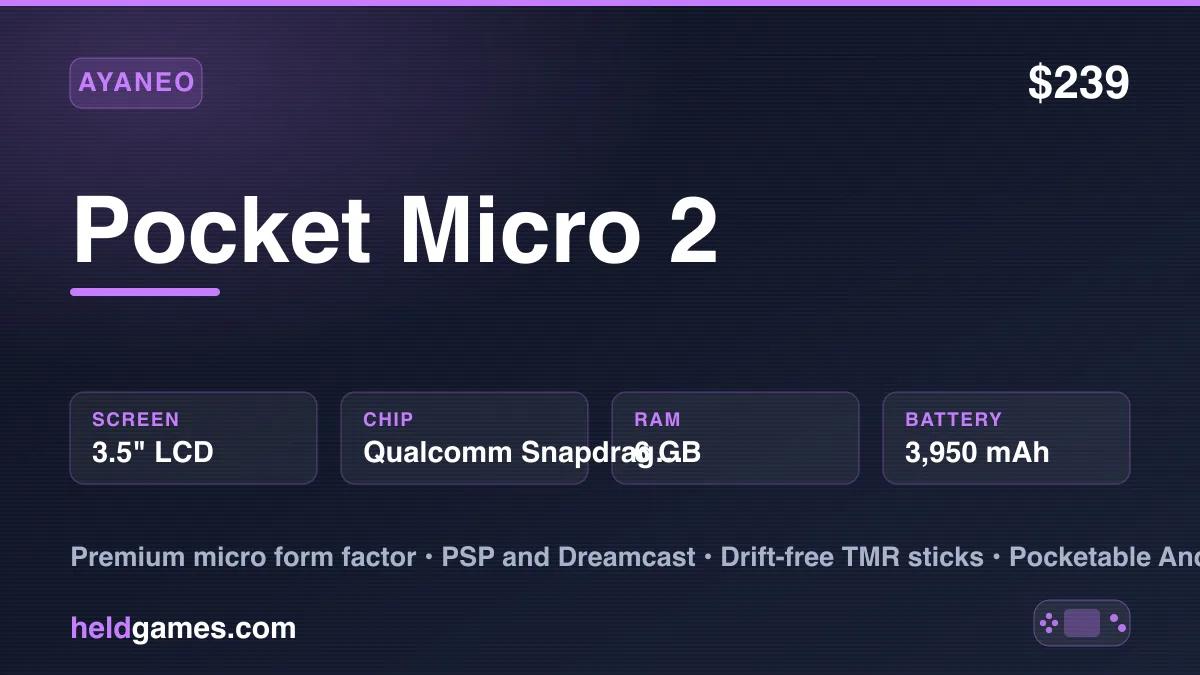
The original AYANEO Pocket Micro was a charming little device with one real flaw. The Helio G99 inside it ran out of road right after PSP. The Pocket Micro 2 fixes exactly that. AYANEO kept the sharp 3.5 inch screen and the pocketable feel, then dropped in a Qualcomm Snapdragon 865. That single change turns a cute retro toy into one of the most capable micro handhelds you can buy. It launched at $239 on June 26, 2026, and sold out in every color almost immediately.
✓ Pros
- • Snapdragon 865 with the well supported Adreno 650 GPU
- • Sharp 3.5 inch 960x640 3:2 screen, perfect for 4:3 systems
- • TMR sticks that should never drift
- • 3,950 mAh battery, roughly double the original
- • The 3.5mm headphone jack is back
- • Genuinely pocketable premium build
✗ Cons
- • Snapdragon 865 is a 2020 flagship, not a new chip
- • 3.5 inch screen is small for widescreen 3D
- • Digital triggers, not analog
- • Android setup curve for newcomers
- • Stock and resale prices climb fast when it sells out
Build and Design
The Pocket Micro 2 is a horizontal micro handheld, and it feels like a premium object the moment you pick it up. It measures about 162 by 67.8 by 18 mm and weighs roughly 248 g, so it is small enough to ride in a jacket pocket but dense enough to feel solid. AYANEO grew the shell slightly over the first model, which gives your hands a little more to hold without losing the pocketable charm that made the original a cult favorite.
The control layout puts the D-pad up top on the left with the left stick below it, a classic micro arrangement. The face buttons are crisp, and the whole thing is built around short, comfortable sessions. It launched in Frosty White, Midnight Black, and a higher tier Stardust Purple.
Display
The screen is the part AYANEO did not need to change, so it mostly did not. You get a 3.5 inch LCD at 960 by 640 in a 3:2 aspect ratio, around 330 PPI, with slimmer bezels than before.
That 3:2 shape is the quiet hero here. It frames 4:3 systems like the NES, SNES, Genesis, and PS1 beautifully, with only thin bars on the sides. Pixel art looks crisp and colors are punchy. It is an LCD rather than an OLED, so blacks are not the inky kind you get on the AMOLED panels in the Retroid Pocket Mini or the AYANEO Pocket Air. For a screen this size and this sharp, though, it is a lovely place to play.
Technical Specifications
| Screen | 3.5 inch LCD, 960x640, 3:2, 60Hz |
| Processor | Qualcomm Snapdragon 865 (Adreno 650) |
| RAM | 6GB or 8GB LPDDR4X |
| Storage | 128GB or 256GB + microSD |
| Battery | 3,950 mAh, USB-C PD |
| OS | Android 13 |
| Controls | TMR sticks, digital triggers |
| Connectivity | Wi-Fi 6, Bluetooth 5.1, USB-C, 3.5mm |
The Snapdragon 865 Is the Whole Point
The original Pocket Micro used a MediaTek Helio G99. It was fine for 2D and most of PSP, and it stopped there. The Pocket Micro 2 moves to the Snapdragon 865, a 2020 phone flagship with the Adreno 650 GPU.
That chip choice matters more than the raw numbers suggest. The Adreno 650 has some of the most mature emulator driver support on Android. Years of Snapdragon 865 phones in the wild mean Vulkan and the open source Turnip drivers are dialed in, so Dolphin, AetherSX2, and the rest behave predictably instead of fighting the hardware. A newer mid tier chip on paper can deliver a worse real world experience than a well supported older flagship, and the 865 is the well supported one.
The honest framing is this. The Pocket Micro 2 is not chasing the newest silicon. It is taking a proven, capable chip and putting it in a tiny shell with a great screen. For emulation, that is a smart trade.
Emulation by System
Here is where the Snapdragon 865 actually lands across the systems most people care about.
- NES, SNES, Genesis, GBA: Flawless. This is the device's home turf, and the 3:2 screen suits these systems perfectly.
- PS1: Flawless. Upscaled cleanly with room to spare.
- Nintendo 64: Excellent. The big names run great, with the usual handful of fussy titles.
- Dreamcast: Excellent. Runs full speed across nearly the whole library.
- Sega Saturn: Very good. A historically hard system that the 865 handles well with the right core.
- PSP: Excellent. Most of the library runs at 2x resolution.
- GameCube: Very good. The majority of the library runs well, with demanding titles needing per game tuning.
- PS2: Good and selective. Many games run well, but the heaviest titles need patience and settings work.
- Wii: Mixed. Lighter games run, motion heavy and demanding ones struggle.
- Switch: Skip it. This is not the device for Switch emulation.
The takeaway is that the Pocket Micro 2 comfortably covers everything through PSP and Dreamcast, opens up most of GameCube, and lets you cherry pick PS2. That is a huge step up from the original and remarkable for something this small. For a deeper breakdown of where this chip tops out, see our Snapdragon 865 emulation guide.
Android and Software
The Pocket Micro 2 runs full Android 13. That means you install your own emulators, whether that is RetroArch, standalone Dolphin, PPSSPP, Flycast, or a frontend like Daijisho or ES-DE. You can add streaming apps and cloud gaming clients too. The flexibility is the reward, and the setup curve is the cost. If you are new to Android handhelds, our Pocket Micro 2 setup guide walks through first boot, the best emulators, and the per system settings that matter on this screen.
The TMR sticks deserve a callout. TMR is a magnetic sensing technology like hall effect, so the sticks should not develop drift over time. The triggers are digital rather than analog, which is the one control compromise worth knowing about for racing games and shooters.
Battery Life
The 3,950 mAh battery is the other headline upgrade. It is roughly 52 percent larger than the cell in the original, which had famously short runtime for a premium device. In practice you get long sessions on 2D and PSP, and the more demanding GameCube and PS2 sessions naturally draw the pack down faster. Charging is over USB-C with Power Delivery, and the headphone jack returning means you are not stuck with Bluetooth latency for audio.
Pocket Micro 2 vs the Original and the Pocket Air
If you owned the first Pocket Micro, the upgrade math is simple. The new chip roughly doubles the emulation ceiling, the battery roughly doubles the runtime, and you get a headphone jack back. Our full Pocket Micro 2 vs original Pocket Micro breakdown covers every difference.
If you are weighing it against the AYANEO Pocket Air, the choice is about size and screen. The Pocket Air has a gorgeous 5.5 inch AMOLED and a bigger body. The Pocket Micro 2 is far more pocketable with a sharper, smaller LCD. Pick the Air for the screen, the Micro 2 for the size.
Who Is This For?
The AYANEO Pocket Micro 2 suits:
- Players who want the most capable truly pocketable handheld without stepping up to a 5 inch device
- Retro fans who live in the NES through PSP and Dreamcast era and want it to look sharp
- GameCube and selective PS2 players who do not need Switch
- Power users who want full Android in a tiny shell
It is not the right pick for serious Switch emulation, for widescreen 3D where a bigger screen helps, or for anyone who wants analog triggers.
Final Verdict
The Pocket Micro 2 is the device the original always wanted to be. AYANEO left the charming part alone and fixed the one thing holding it back. The Snapdragon 865 is not new, but it is exactly the right chip for emulation, and pairing it with a sharp 3:2 screen, drift resistant TMR sticks, and a real battery makes for one of the most satisfying micro handhelds on the market. The $239 starting price is fair, assuming you can find one in stock.
If you want a pocketable Android handheld that plays everything through PSP and Dreamcast beautifully and reaches into GameCube and PS2, the Pocket Micro 2 is an easy recommendation.
Related reading
 Guide
Guide ComparisonComparison