
Affiliate disclosure: This review contains affiliate links. As an Amazon Associate, we earn from qualifying purchases at no extra cost to you. Learn more.
The Mangmi Pocket Max is the most distinctive Android handheld launching this year. A 7 inch 1920x1080 AMOLED panel at 144Hz catches the eye first. Then you notice the magnetic modules around the screen. The D pad on the left can be swapped for a second analog stick. The face button cluster on the right can be replaced with a different layout. The shoulder modules detach. The whole thing is built like a tiny Lego set.
It is not a perfect device. The brand is new, the software is rough, and the ecosystem of accessories is thin. But it is genuinely novel. In a market mostly defined by iterating on familiar form factors, the Pocket Max is doing something nobody else is doing.
Specs
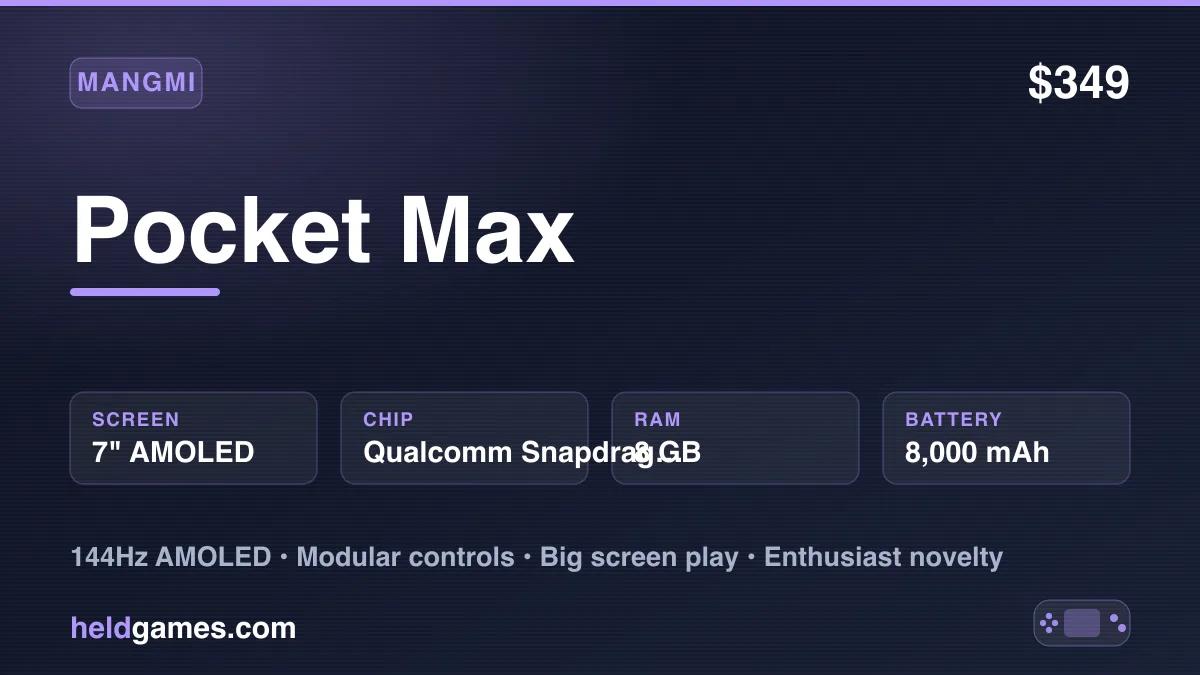
| Screen | 7 inch AMOLED, 1920x1080, 144Hz refresh, touch enabled |
| Processor | Qualcomm Snapdragon 865 |
| GPU | Adreno 650 |
| RAM | 8 GB LPDDR4X |
| Storage | 128 GB UFS 3.1, microSD expansion |
| Battery | 8000 mAh, 27W USB C fast charging |
| OS | Android 13, Play Store unlocked |
| Cooling | Active fan |
| Controls | Magnetic swappable D pad and face button modules, Hall effect sticks, six axis gyro |
| Chassis | Reinforced ABS plastic with magnetic module connectors |
| Audio | 3.5mm headphone jack, stereo front facing speakers |
| Connectivity | Wi-Fi 6, Bluetooth 5.1, USB 3.1 Type-C |
The Modular Controls
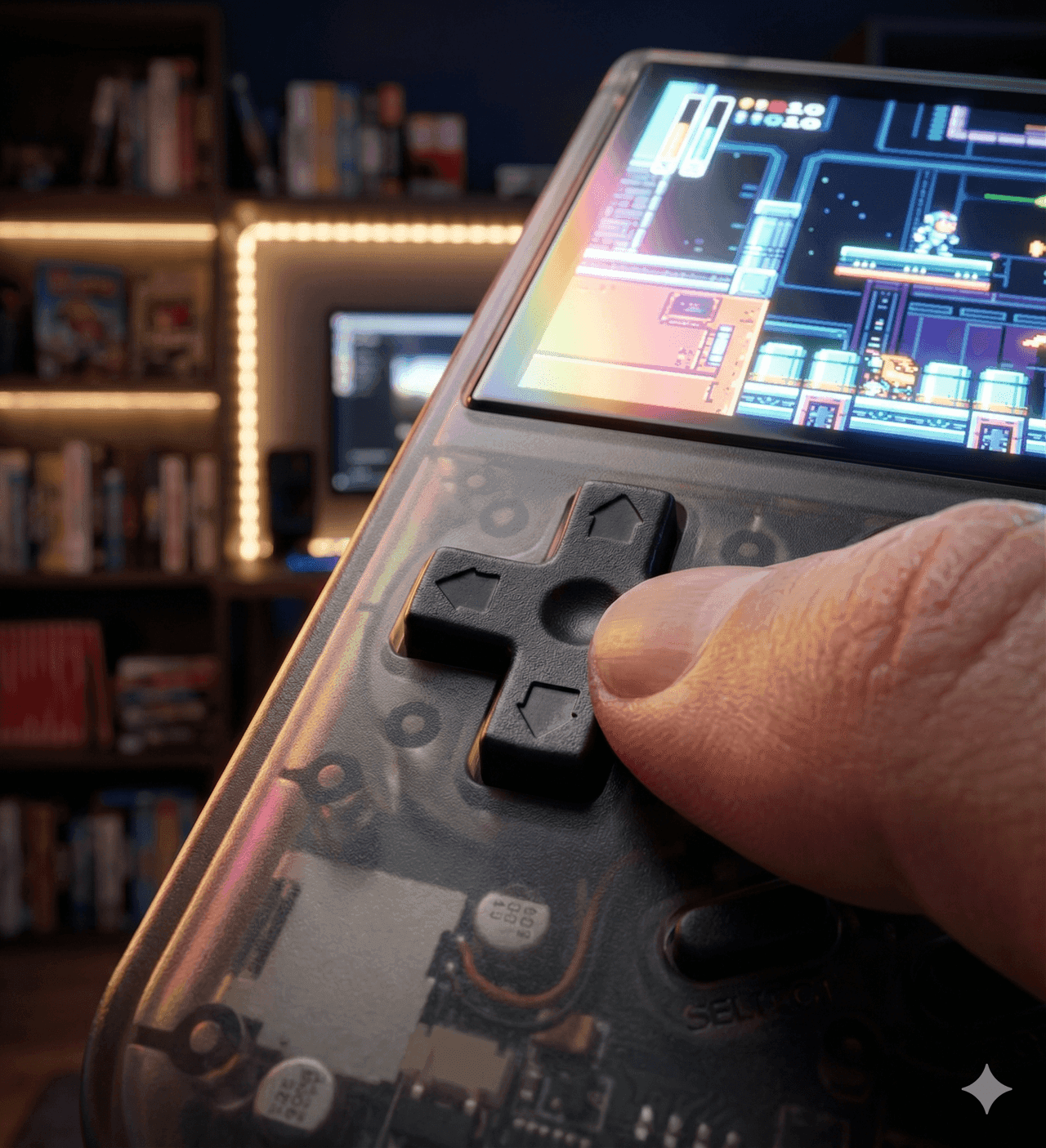
The headline feature deserves a section of its own. The Pocket Max ships with a default D pad on the left and a four button face cluster on the right. Each module is held in place by recessed magnets and a small contact array.
Pulling a module off is straightforward. You grip the corner, give it a small twist, and the magnet releases. Snapping a different module on is just as easy. Mangmi ships the Pocket Max with three module options: the standard D pad, a second analog stick, and an alternate face button cluster with different button spacing.
In practice the modules feel solid in use. There is no flex, no rattle, no accidental pop off during normal grip. The contact arrays do need occasional cleaning to stay reliable. If you swap modules frequently, give the contacts a quick wipe every few weeks.
The bigger question is whether you actually swap modules. After the first week, most users will find a preferred layout and stop swapping. The novelty is real and the feature works, but it is more of a "set it once and forget it" experience than a "switch between layouts every session" one.
The Display
The 7 inch 1920x1080 AMOLED panel at 144Hz is the second standout feature. 144Hz is unusually high for any handheld and noticeable for Android native content, modern indies, and the high refresh emulator targets like Dreamcast and Switch 1 at 60 fps with smooth frame pacing.
Color reproduction is excellent. Blacks are real OLED black. Outdoor brightness is on par with the Portal Pro. The 16:9 aspect ratio matches modern content and pillarboxes 4:3 retro content like every other 16:9 device.
The trade off of the 144Hz panel is battery life. Driving 144Hz costs power. We cover battery specifics below.
Performance
The Snapdragon 865 is a 2020 flagship chip. It is a capable emulator, especially for PS2 and GameCube, but it sits a clear tier below the Snapdragon 8 Gen 2 in the Portal Pro and the Pocket 6. Set expectations there and it delivers.
- NES through PSP: Effortless.
- N64 and Dreamcast: Full library at full speed.
- GameCube and Wii: Strong. Most of the library runs well at native resolution via Dolphin.
- PS2: A real strength. Most of the library runs at native resolution via AetherSX2 or NetherSX2, with lighter titles pushing higher.
- Switch 1: Limited. A subset of lighter titles is playable, but the Snapdragon 865 is not a Switch powerhouse the way an 8 Gen 2 device is.
- Switch 2: Not realistic on this chip. See the Switch 2 emulation guide.
The active cooling fan is audible under sustained heavy load, more so than the Portal Pro. Mangmi's fan curve tuning is less refined than AYN's. Most owners install a custom fan curve mod within the first month.
Software
Android 14 with the Play Store unlocked from first boot. That is the modern minimum and the Pocket Max meets it. The stock Mangmi launcher is rough. It is functional but visually dated and clunky to navigate with the controls. You will want to install Daijisho, ES DE for Android, or Beacon almost immediately.
EmuDeck for Android Beta works on the Pocket Max but Mangmi is not on the official supported device list as of May 2026. The installer treats the device as a Snapdragon 8 Gen 2 generic profile, which works but loses the device specific tuning.
ROCKNIX support for the Pocket Max is community driven rather than official. The ROCKNIX Steam Guide covers what to expect.
Battery Life
The 7200 mAh battery is large in absolute terms but the 144Hz panel and the bigger 7 inch screen pull it down quickly under heavy loads.
- GBA and SNES at 60Hz: roughly five to six hours.
- PSP and Dreamcast: roughly three hours.
- PS2 and Switch 1 with 144Hz on: roughly two to two and a half hours.
Dropping the panel to 60Hz manually in display settings extends battery life by 30 to 40 percent. If you do not need 144Hz for the title you are playing, drop the refresh.
Build Quality
The chassis is reinforced ABS plastic. The magnetic module connectors are the structurally interesting part. The fit and finish are good but not Portal Pro polished. The buttons feel positive. The Hall effect analog sticks are real and drift free.
The footprint is larger than the Portal Pro despite the same 7 inch screen size. The magnetic module bays add width on both sides. Pocketability is poor. This is a bag handheld, not a coat pocket handheld.
Pocket Max vs AYN Odin 2 Portal Pro
The natural comparison. Both are 7 inch Android handhelds at a similar size, though the Portal Pro uses a more powerful Snapdragon 8 Gen 2 while the Pocket Max uses the older Snapdragon 865.
| Pocket Max | Odin 2 Portal Pro | |
|---|---|---|
| Screen | 7 inch 1080p AMOLED, 144Hz | 7 inch 1080p OLED, 120Hz |
| Refresh ceiling | 144Hz | 120Hz |
| Modular controls | Yes | No |
| SoC | Snapdragon 865 | Snapdragon 8 Gen 2 |
| RAM | 8 GB | 12 GB |
| Battery | 8000 mAh | 8000 mAh |
| Polish | Rough | Polished |
| EmuDeck official support | Generic profile | Official |
| Price | $199 | $399 |
The Portal Pro is the more powerful and more polished device. Its Snapdragon 8 Gen 2 is a clear step up from the 865 for Switch and the heaviest emulation, and the software is more refined. The Pocket Max counters with half the price, a higher 144Hz refresh, and the unique modular controls. If you want the most power and polish, pick the Portal Pro. If you want the novelty and the big 144Hz AMOLED for half the cost, the Pocket Max makes a strong case.
Read the full AYN Odin 2 Portal Pro review.
Who Should Buy the Pocket Max
Buy the Pocket Max if the modular controls genuinely appeal to you; you want the highest refresh AMOLED in any handheld; you do not mind being early in a new brand's lifecycle; you can live with a rougher software experience; you mostly use the device on a desk or couch (not pocketable).
Skip the Pocket Max if you want the most polished experience at this price tier (the Odin 2 Portal Pro is the safer pick); you need long battery life on demanding emulation; you want a pocketable handheld (the Retroid Pocket 6 is far more portable); you value strong manufacturer support and a deep accessory ecosystem.
The Pocket Max is a niche pick. For the buyer who specifically wants its niche, it is the only option.
Frequently Asked Questions
How much does the Mangmi Pocket Max cost?
$199 for the 8 GB RAM / 128 GB storage configuration. Mangmi occasionally runs promotional discounts but availability through major retailers is less consistent than with AYN or Retroid.
Are the modular controls actually useful?
Yes, but more as a one time configuration choice than as a frequent swap feature. Most owners find a preferred layout within the first week and stop swapping. The novelty works as advertised, but expect to use it less than you imagine.
Can the Pocket Max emulate Switch?
Switch 1 is limited on the Snapdragon 865. A subset of lighter titles is playable, but this is not a Switch powerhouse like an 8 Gen 2 device. If Switch 1 is your main goal, look at the Portal Pro or the Retroid Pocket 6. Switch 2 emulation is not realistic on this chip.
Is the 144Hz panel worth it?
For Android native gaming and high refresh emulator targets, yes. For most retro content that runs at 60 fps source, no. Dropping to 60Hz extends battery life significantly.
How is the brand support?
Newer and thinner than AYN, Retroid, or Anbernic. If you need fast warranty support or a wide accessory ecosystem, those brands are stronger. If you are comfortable being an early adopter, Mangmi is fine.
Should I buy the Pocket Max or the Odin 2 Portal Pro?
Buy the Pocket Max if the 144Hz panel and modular controls are the features that excited you about the device. Buy the Portal Pro if you want the most polished experience, the longest battery, and the safest manufacturer support at this price tier.
Related Reading
The Verdict4.1 / 5
The Mangmi Pocket Max is genuine novelty in a market that mostly iterates. A 7 inch 144Hz AMOLED and modular controls are both real differentiators. The trade off is a thinner support ecosystem and a less polished software experience than AYN or Retroid. If those novelties speak to you and you do not mind being early in the brand's lifecycle, this device is interesting. Most buyers will be better served by the AYN Odin 2 Portal Pro at $399.
Related reading
 ReviewReviewReview