
Affiliate disclosure: This review contains affiliate links. As an Amazon Associate, we earn from qualifying purchases at no extra cost to you. Learn more.
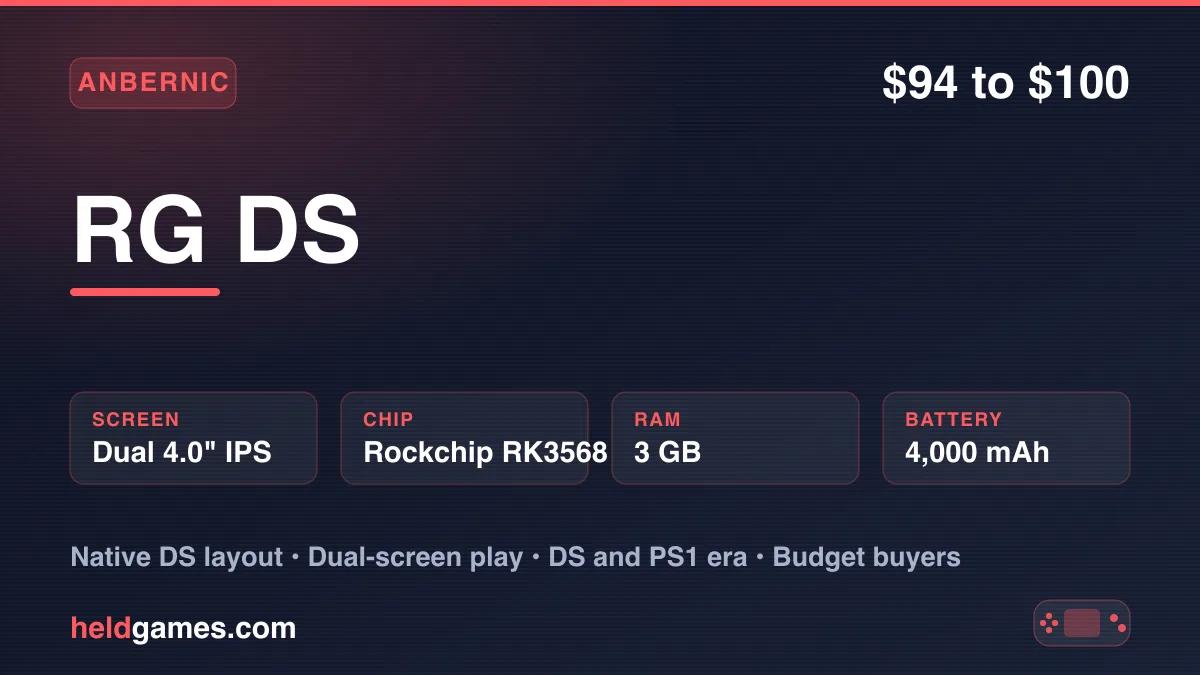
Anbernic has made dozens of handhelds, but never a dual-screen one. The RG DS changes that. It is a clamshell Android device with two screens stacked top and bottom, built to look and play like a modern Nintendo DS. At around $100, it is also the cheapest way to get a real two-screen layout for DS emulation. That focus is the whole point of this device, and it is the right way to judge it.
This is not a flagship. The chip inside is modest, and the spec sheet is humble. What the RG DS offers is something a slab handheld simply cannot, which is the actual DS form factor for the games that need it.
Specs
| Screens | Two 4 inch IPS, 640x480, 4:3, OCA full lamination, multi-touch, capacitive stylus |
| Processor | Rockchip RK3568 (quad-core Cortex-A55 up to 2.0 GHz) |
| GPU | ARM Mali-G52 2EE |
| RAM | 3 GB |
| Storage | 32 GB internal, microSD up to 2 TB |
| Controls | D-pad, four face buttons, dual flush analog sticks, two sets of digital shoulder buttons |
| Battery | 4000 mAh, about 6 hours |
| OS | Android 14 and Linux (dual) |
| Connectivity | 2.4/5 GHz Wi-Fi, Bluetooth 4.2, USB-C, 3.5mm |
| Extras | 6-axis gyroscope, vibration, stereo speakers, hall sensor auto-sleep |
| Design | Clamshell, dual-screen, DS inspired |
| Price | Around $94 preorder, $100 retail |
The Dual-Screen Layout Is the Whole Point
Nintendo DS games were designed for two screens. Maps, inventories, touch controls, and second views all lived on the bottom screen. Playing them on a single slab handheld means squishing both screens into one panel or stacking them with big black bars. It works, but it is a compromise.
The RG DS removes that compromise. You get a real top screen and a real bottom screen, both 4 inch and both touch enabled. For games like the Nintendo DS Castlevania titles, the Phoenix Wright games, the brain training and cooking style titles, and anything that leaned on the touch screen, this is the format they were built for. If you own a DS library and want to replay it properly, this is the appeal in one sentence.
Build and Design
The RG DS uses a clamshell body that folds shut like the console it takes after. Both panels are 4 inch 640x480 IPS with full lamination and touch support, which is a step above the cheap air-gapped screens you sometimes find at this price. The 4:3 ratio suits DS content and most retro systems well.
It does include dual analog sticks, mounted flush like a Switch Joy-Con, plus a d-pad, four face buttons, and two sets of digital shoulder buttons. The d-pad and face buttons are the highlight, clicky and quiet. The sticks are the weak point. They sit deep, feel slippery, and are hard to roll a clean 360, which is a common complaint on clamshell handhelds. For the DS library that leans on the d-pad and touch screen, the mediocre sticks barely matter. This is a focused device, so do not expect flagship materials or hall effect sticks. It is built to do one job at a fair price.
Emulation Performance
This is where expectations matter most. The Rockchip RK3568 is a budget chip. It is capable, but it is not in the same league as the Snapdragon devices that dominate the premium tier. Set your sights accordingly.
- NES, SNES, Genesis, Game Boy through GBA. Full speed.
- Nintendo DS. The headline use case. Most of the library runs well, and now with the proper two-screen layout. See the MelonDS setup guide.
- PS1. Full library, full speed.
- Nintendo 64. Playable, with the usual per game variance.
- PSP and Dreamcast. Many titles run, with the heavier ones needing tuning. This is near the ceiling.
- PS2, GameCube, and 3DS. Not the device for these. The RK3568 does not have the headroom.
If you want strong PS2, GameCube, or 3DS performance, this is the wrong handheld. For DS and below, it does the job and adds the screen layout no rival offers at the price.
Software
The RG DS runs full Android 14 with the Play Store, so any Android emulator works. The key is choosing emulators and front ends that map cleanly to two physical screens. MelonDS handles native DS dual-screen well. For other systems, the second screen can show menus, art, or a control overlay, though support varies by app. New frontends built with dual-screen hardware in mind, like the upcoming iiSU launcher, are worth watching here.
Battery and Charging
The 4000 mAh battery has to drive two screens, so runtime is naturally shorter than a single-screen device of the same capacity. Anbernic rates it at about 6 hours, with lighter systems stretching longer and heavier ones pulling it down. A full charge takes roughly 3.5 hours.
Who Should Buy the Anbernic RG DS
Buy the RG DS if you grew up on the Nintendo DS and want to replay your own library with the real two-screen layout; you want the cheapest dual-screen handheld available; you mostly play DS, PS1, GBA, and below.
Skip the RG DS if you want strong PS2, GameCube, or 3DS performance; you want a flagship build with hall sticks and a powerful chip (look at the Retroid Pocket 6 or AYN Odin 3); you do not specifically care about the dual-screen format, in which case a slab like the Anbernic RG40XXV gives more value.
The RG DS is a niche device done at a fair price. For the DS faithful, that niche is exactly the point.
Frequently Asked Questions
How much does the Anbernic RG DS cost?
Around $94 on preorder and about $100 at retail.
What can the Anbernic RG DS emulate?
Everything from 8 bit and 16 bit systems through PS1, N64, DS, and into PSP and Dreamcast. PS2, GameCube, and 3DS are beyond its chip.
Does the RG DS have two real screens?
Yes. It has two 4 inch 640x480 touch screens stacked top and bottom, built specifically for native Nintendo DS layouts.
Does the RG DS run Android?
Yes. It ships with Android 14, with a Linux option also available, so any Android emulator or front end works.
Is the RG DS good for 3DS?
No. The RK3568 chip does not have the power for reliable 3DS emulation. Stick to DS and below.
Related Reading
The Verdict3.5 / 5
The Anbernic RG DS is a focused device, not a do-everything flagship. For around $100 it gives you something no slab handheld can, which is a true two-screen layout for Nintendo DS games. The RK3568 chip keeps power modest, so set expectations around DS, PSP, Dreamcast, and below rather than PS2 or GameCube. If you grew up on the DS and want to play your own library the way it was designed, the RG DS is the cheapest way to get there. If you want raw emulation power, look elsewhere.
Related reading
 Comparison
 Review
 Guide
Guide