
Affiliate disclosure: This review contains affiliate links. As an Amazon Associate, we earn from qualifying purchases at no extra cost to you. Learn more.
The Retroid Pocket Classic is the device most retro handheld watchers did not see coming. Vertical Android handhelds in 2025 topped out at PSP, give or take. Then Retroid put a Snapdragon G1 Gen 2 and a 3.92 inch AMOLED into a GBA inspired shell and shipped it for $219. The result is the most surprising handheld of the first half of 2026.
This is the kind of device that turns a long flight or a weekend trip into a Game Boy plus PS2 library in one pocket. It is small. It is light. It still runs Final Fantasy X.
Specs
| Screen | 3.92 inch AMOLED, touch enabled |
| Processor | Qualcomm Snapdragon G1 Gen 2 |
| GPU | Adreno integrated |
| RAM | 4 GB LPDDR4X |
| Storage | 64 GB eMMC, microSD expansion |
| Battery | 5000 mAh, USB C PD fast charging |
| OS | Android 14, Play Store unlocked |
| Cooling | Passive cooling |
| Controls | Hall effect analog sticks, Hall triggers, six axis gyro, vibration motor |
| Chassis | Reinforced ABS plastic, GBA inspired vertical layout |
| Audio | 3.5mm headphone jack, stereo front facing speakers |
| Connectivity | Wi Fi 6, Bluetooth 5.2, USB C with OTG |
Build and Design
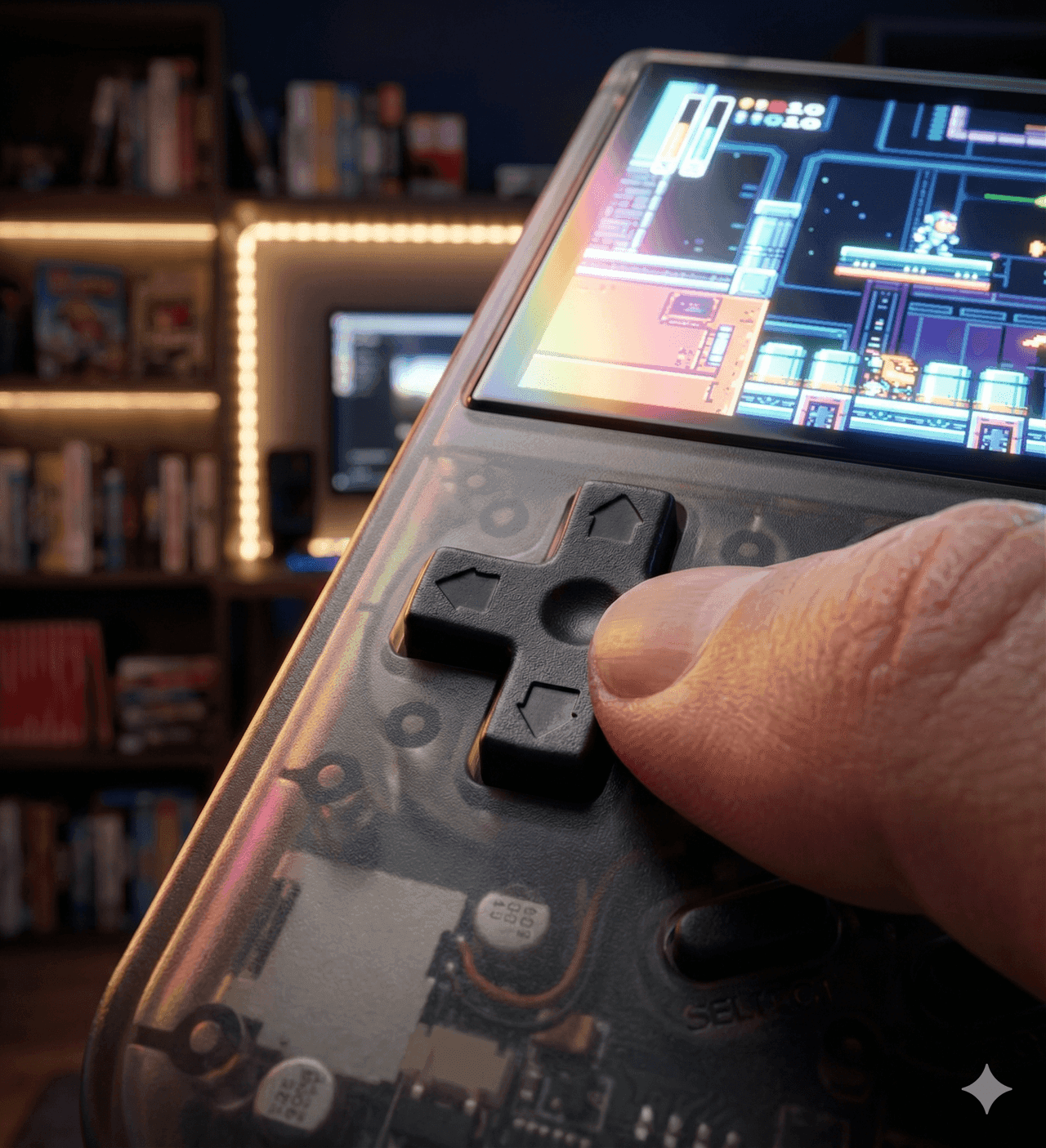
The Pocket Classic looks like a Game Boy Advance and feels like one in the hand. The vertical shape with the D pad on the left and face buttons on the right is exactly the layout your muscle memory expects for GBA, NES, SNES, Game Boy, and Game Boy Color. The grip is thinner than a Game Boy Advance SP because there is no clamshell, but the curved back gives just enough purchase to hold comfortably for an hour or two at a time.
The chassis is reinforced ABS plastic with a slight textured finish. It feels solid for a $219 device. There is no creak, no flex, and the buttons all feel positive. The shoulder buttons sit at the top edge the way they do on the GBA. Retroid added two analog sticks angled below the D pad and face buttons, which is the modern compromise needed for PS2 era and later content.
The Hall effect sticks are the standout. Retroid did not skimp here. They are real, full Hall implementations with the same drift free behavior as on the Pocket 6 and the Portal Pro. That is impressive at this price point in this form factor.
The Display
The 3.92 inch AMOLED is genuinely good. Color saturation is high. Blacks are real blacks. Brightness is high enough for outdoor play in shade and just shy of comfortable in direct sunlight. The aspect ratio sits in a friendly zone for the systems this device targets, particularly Game Boy, Game Boy Color, GBA, and DS (with a split screen mode). NES and SNES content sits with comfortable letterboxing.
For 16:9 content like PSP and the Switch 1 library, the small screen means everything reads a little small. That is the trade off of a vertical pocketable. The Pocket 6 or the RG557 at 5.5 inches will always be more comfortable for 16:9 titles. The Pocket Classic earns its keep on 4:3 and vertical content.
Performance
The headline is what the Snapdragon G1 Gen 2 can actually do in this shell.
- NES through Saturn: Trivial. Full speed, full library, no tuning needed.
- N64 and Dreamcast: Full library, full speed.
- PSP: 2x and 3x native resolution in PPSSPP comfortably.
- GameCube and Wii: Selective. Many titles run well at native via Dolphin, with the demanding ones (Metroid Prime, Twilight Princess) needing careful tuning or dropping resolution.
- PS2: This is the surprise. AetherSX2 and NetherSX2 handle the bulk of the PS2 library at native resolution comfortably. Some demanding titles need internal resolution stayed at 1x to keep stable frame rates, but PS2 on a vertical $219 handheld is real in 2026.
- Switch 1: At the edge of the chipset's ceiling. Lighter Switch titles run. The heavier first party Nintendo releases are not where this device shines.
- Switch 2: Out of reach. See the Switch 2 emulation guide for context.
The passive cooling is the limitation under sustained heavy load. For PS2 and GameCube sessions longer than 45 minutes, the back of the device gets warm enough to notice. Frame rates hold. Battery drain ticks up. This is not a device for marathon Switch 1 sessions. It is excellent for grabbing a 30 minute play on a flight or a commute.
Software
Android 14 with the Play Store unlocked from first boot. Retroid also includes its own retro front end pre installed, which is more polished than the stock Anbernic launcher and roughly on par with the AYN front end. Most owners will use the Retroid front end for retro work and the standard Android home screen for everything else.
EmuDeck for Android Beta installs cleanly on the Pocket Classic and is the recommended path for new owners who want a one click multi emulator setup. RetroArch, PPSSPP, Dolphin, AetherSX2, and the Switch emulators all work from the Play Store.
Battery Life
Roughly six to eight hours of GBA and 8 bit content, four hours of PSP, and around two and a half to three hours of PS2 or GameCube emulation. USB C PD fast charging gets the device back to full in about 90 minutes.
The smaller 5000 mAh battery compared to the 8000 mAh Portal Pro reflects the form factor. This is a pocketable device. It is not a Steam Deck.
Pocket Classic vs Anbernic RG34XX SP
The natural comparison in the vertical pocketable category. The RG34XX SP is the $90 budget pick. The Pocket Classic is the premium pick.
| Pocket Classic | RG34XX SP | |
|---|---|---|
| Form factor | GBA vertical | Clamshell |
| Screen | 3.92 inch AMOLED | 3.4 inch IPS |
| SoC | Snapdragon G1 Gen 2 | Allwinner H700 |
| RAM | 4 GB LPDDR4X | 1 GB LPDDR4 |
| Hall sticks | Yes | No (no sticks at all) |
| PS2 | Yes, native and some 1.5x | Not capable |
| Switch 1 | Selective | Not capable |
| OS | Android with Play Store | Linux (Knulli, muOS, etc.) |
| Price | $219 | $90 |
These devices serve different buyers. The RG34XX SP is the budget GBA replacement. The Pocket Classic is the premium vertical handheld that also happens to run PS2. If you want a $90 device that plays NES through PSP comfortably, the SP is the right pick. If you want an AMOLED vertical that handles PS2 and is Android friendly, the Pocket Classic is.
Read the full Anbernic RG34XX SP review.
Pocket Classic vs Pocket 6
The Pocket 6 is the standard 5.5 inch Snapdragon 8 Gen 2 handheld. The Pocket Classic is the same family in a different shell.
The Pocket 6 wins on raw performance, screen size, and battery life. The Pocket Classic wins on pocketability, vertical form factor for retro, and price. If you mostly play GBA, SNES, NES, and PS1, the Pocket Classic is the more enjoyable shape. If you mostly play PSP, GameCube, and Switch 1, the Pocket 6 is the better device.
Read the full Retroid Pocket 6 review.
Who Should Buy the Pocket Classic
Buy the Pocket Classic if you love the GBA shape and want a modern Android version of it; you want a pocketable AMOLED handheld that still runs PS2; your library skews toward NES, SNES, GBA, and PS1 with PS2 as a bonus; you want Hall effect sticks at this size; you can live with a smaller battery for the pocketable form.
Skip the Pocket Classic if your library is mostly 16:9 content like PSP, modern Android games, and Switch 1 (the larger Pocket 6 is the better pick); you want the strongest possible PS2 and Switch emulation (look at the Odin 2 Portal Pro); you want a $90 vertical handheld for the basics (look at the RG34XX SP).
For the buyer who specifically wants a vertical Android handheld with real horsepower in 2026, this is the device.
Frequently Asked Questions
How much does the Retroid Pocket Classic cost?
$219 for the standard 4 GB / 64 GB configuration. Retroid often runs $20 launch discounts on the official store.
Can the Pocket Classic emulate PS2?
Yes. AetherSX2 and NetherSX2 handle the bulk of the PS2 library at native resolution comfortably. Some demanding titles need to stay at 1x internal resolution for stable frame rates, but PS2 is genuinely playable on this device.
Does the Pocket Classic have AMOLED?
Yes. The Pocket Classic ships with a 3.92 inch AMOLED panel.
Can the Pocket Classic emulate Switch?
Selective titles, yes. Lighter Switch 1 games run. Heavy first party releases push the chipset past its comfortable ceiling. For Switch focused buying, the Odin 2 Portal Pro or Pocket 6 are better picks.
How does the Pocket Classic compare to the original Game Boy Advance?
The shape is similar. The screen, performance, and feature set are not comparable. The Pocket Classic plays GBA, every system before it, and several systems after it including PS2. The original GBA plays GBA, GBC, and GB.
Should I buy the Pocket Classic or the Pocket 6?
Buy the Pocket Classic for the vertical pocketable form factor and a library focused on 4:3 and vertical content. Buy the Pocket 6 for raw performance, a larger 5.5 inch screen, and 16:9 content.
Related Reading
The Verdict4.5 / 5
The Retroid Pocket Classic is the most surprising handheld of the year so far. The GBA shape is honest and feels right. The 3.92 inch AMOLED is genuinely good. The Snapdragon G1 Gen 2 punches way above where this form factor used to land, running PS2 comfortably and pulling off selective GameCube. If you want a pocketable AMOLED handheld with serious emulation chops, this is the pick.
Related reading
 Review
 GuideReview