
Affiliate disclosure: This page contains affiliate links. As an Amazon Associate, we earn from qualifying purchases at no extra cost to you. Learn more.
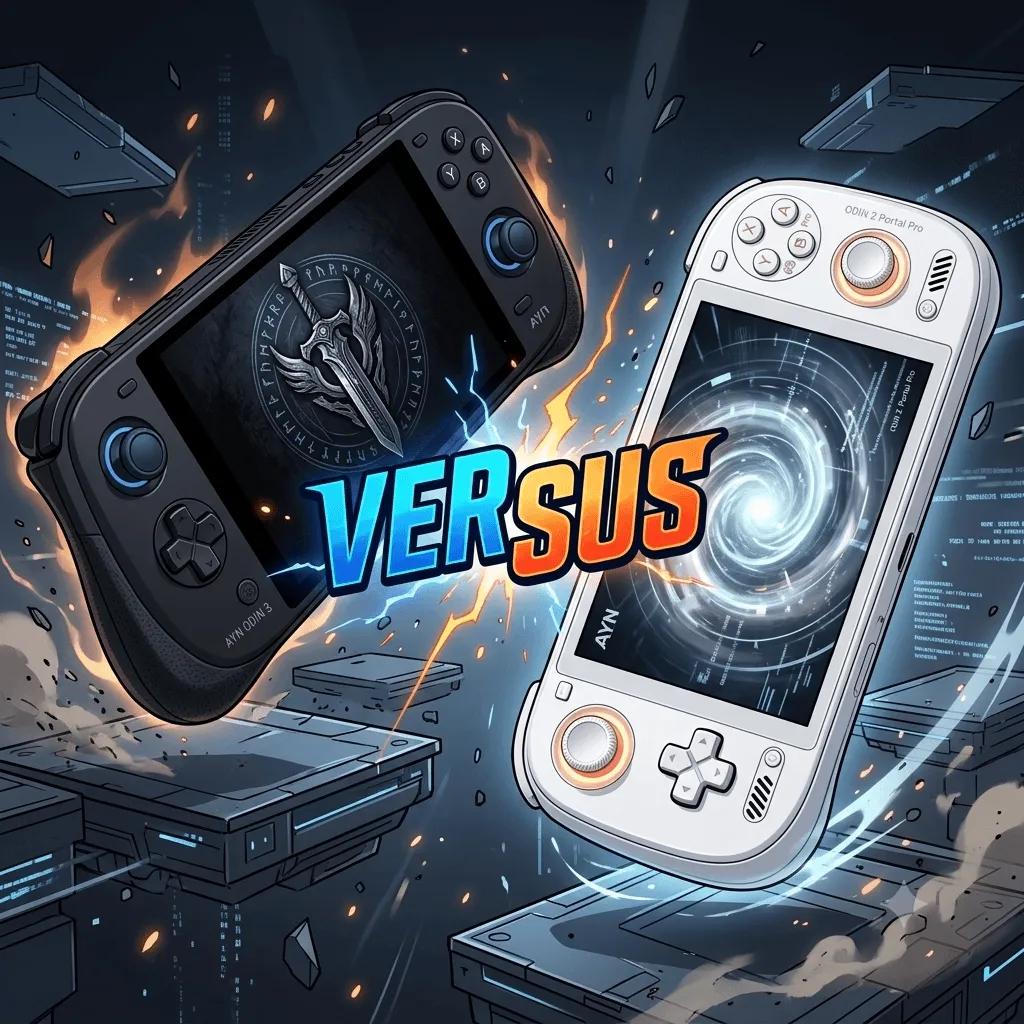
AYN now sells two premium Android handhelds at once. The Odin 3 is the successor, with a Snapdragon 8 Elite class chip and a 6 inch OLED. The Odin 2 Portal Pro is the device that earned our top Switch emulation pick for most of 2026, with a big 7 inch OLED and a mature, proven driver stack.
This is the classic upgrade question. The newer device is faster and more pocketable. The older one has a larger screen and zero launch quirks. Let us sort out who should buy which.
Price note, October 2026. The Odin 3 has had three price increases since launch and now starts at $369 rather than $329. It also quietly dropped from UFS 4.0 to UFS 3.1 storage from batch 7 onward, as did the Thor from batch 6. Both changes trace back to the DRAM and flash shortage, which we cover in the RAM shortage and handheld prices. Every price here is as of October 2026.
Quick Verdict
| AYN Odin 3 | Odin 2 Portal Pro | |
|---|---|---|
| Chip | Snapdragon 8 Elite class | Snapdragon 8 Gen 2 |
| Screen | 6 inch OLED, 1080p, 120Hz | 7 inch OLED, 1080p, 120Hz |
| RAM | 8 to 24 GB by tier | 12 GB |
| Battery | 8000 mAh | 8000 mAh |
| Storage | UFS 3.1 from batch 7 onward | UFS 4.0 |
| Street price | From $369 | $399 |
| Best for | Newer power, portability | Biggest screen, proven today |
Note the storage row, because it is now a point in the Portal Pro's favour and almost no comparison reflects it. The Portal Pro kept UFS 4.0. The Odin 3 dropped to UFS 3.1 from batch 7. UFS 3.1 runs at roughly half the sequential read speed, which you feel in install and load times rather than in frame rates — but it does mean the newer, more expensive device has the slower storage.
Performance
The Odin 3 has the newer chip and wins the raw numbers. The Snapdragon 8 Elite class part is a clear step up from the 8 Gen 2 in the Portal Pro.
There is still a real world catch, though it is smaller than it was. Turnip drivers for the 8 Elite now exist, so the launch situation where the Odin 3 simply had no mature driver path is over. What persists is tuning: the Portal Pro's 8 Gen 2 has years of Turnip work behind it, and in the most demanding open world Switch titles it can still match or slightly beat the Odin 3. The Odin 3 has more horsepower; the Portal Pro has more of its horsepower actually reachable today. That gap keeps narrowing with each driver release.
Winner: AYN Odin 3 on potential, with the Portal Pro stronger for day one Switch.
Screen and Size
This is the most personal part of the decision. The Portal Pro has a glorious 7 inch OLED. It is one of the best screens on any handheld, and it is fantastic for PS2, GameCube, and Switch. The trade off is size. The Portal Pro is large, closer to a Steam Deck silhouette.
The Odin 3 has a 6 inch OLED. It is smaller, lighter, and easier to carry. For many people that is the better daily balance.
If you want the largest possible screen, pick the Portal Pro. If you want a more pocketable device, pick the Odin 3.
Winner: Tie, decided by your size preference.
RAM and Storage
The Odin 3 scales much higher. RAM tiers run from 8 GB up to 24 GB, and storage reaches 1 TB. The Portal Pro is a single sensible 12 GB and 256 GB configuration. For emulation, both have plenty. The Odin 3 only pulls ahead if you want extreme headroom or a giant local library.
Winner: AYN Odin 3 for the high end tiers.
Battery
Both carry an 8000 mAh battery. Real world endurance is similar. The Odin 3 chip is more efficient in places, while the Portal Pro drives a larger panel. Call it a wash for most users.
Winner: Tie.
Software
Both run AYN's polished Android software. The Portal Pro experience is fully proven and quirk free. The Odin 3 ships Android 15 with the latest Odin Launcher, plus the launch driver caveat above. Both are pleasant to live with once configured.
Winner: Odin 2 Portal Pro today, by a shrinking margin as the Odin 3 drivers mature.
Price and Value
This is the section that has changed most since we first published, and it nearly flips the verdict.
The Odin 3 started at $329 against the Portal Pro's $399, a $70 gap that made the base Odin 3 clearly both newer and cheaper. After three price increases the Odin 3 starts at $369. The gap is now $30. The higher Odin 3 tiers climb well past the Portal Pro, to $469 for the Pro and $529 for the Max.
So the entry tier argument still technically holds, but $30 is close to noise — and for that $30 you give up a 7 inch screen for a 6 inch one, and UFS 4.0 storage for UFS 3.1. The Odin 3 entry tier is no longer the obvious value play it was in May.
If you want the newest chip and the most pocketable body, the base Odin 3 is still the pick. If you want the biggest screen, the fastest storage, and the most proven drivers, the Portal Pro at $399 now looks better than it did.
Winner: Too close to call at the entry tier. It was a clear Odin 3 win at $329.
The Final Call
Choose the AYN Odin 3 if:
- You want the newer, faster chip and more future headroom
- You prefer a more pocketable 6 inch device
- You want very high RAM and storage tiers
- You accept UFS 3.1 storage on late batches
- You are comfortable with Switch drivers that are good now and still improving
Choose the Odin 2 Portal Pro if:
- You want the biggest screen, a stunning 7 inch OLED
- You want the faster UFS 4.0 storage, which the Odin 3 no longer has
- You want a fully proven device with no quirks today
- Switch emulation on the hardest titles is your top priority
- You like the larger, Steam Deck style form factor
If you already own a Portal Pro and love it, there is no urgent reason to upgrade — and that is a stronger statement now than it was in May, because the Odin 3's price advantage has mostly evaporated and it lost the storage advantage entirely. The Odin 3 is still the better device on paper. The Portal Pro is the better buy for more people than it used to be. And if these prices have you eyeing the value tier instead, see how the Portal Pro fares against the Retroid Pocket 6 in our Retroid Pocket 6 vs Odin 2 Portal Pro comparison.
Affiliate disclosure: This comparison contains affiliate links. As an Amazon Associate, we earn from qualifying purchases at no extra cost to you. Learn more.
Related reading
 ComparisonComparisonComparison