
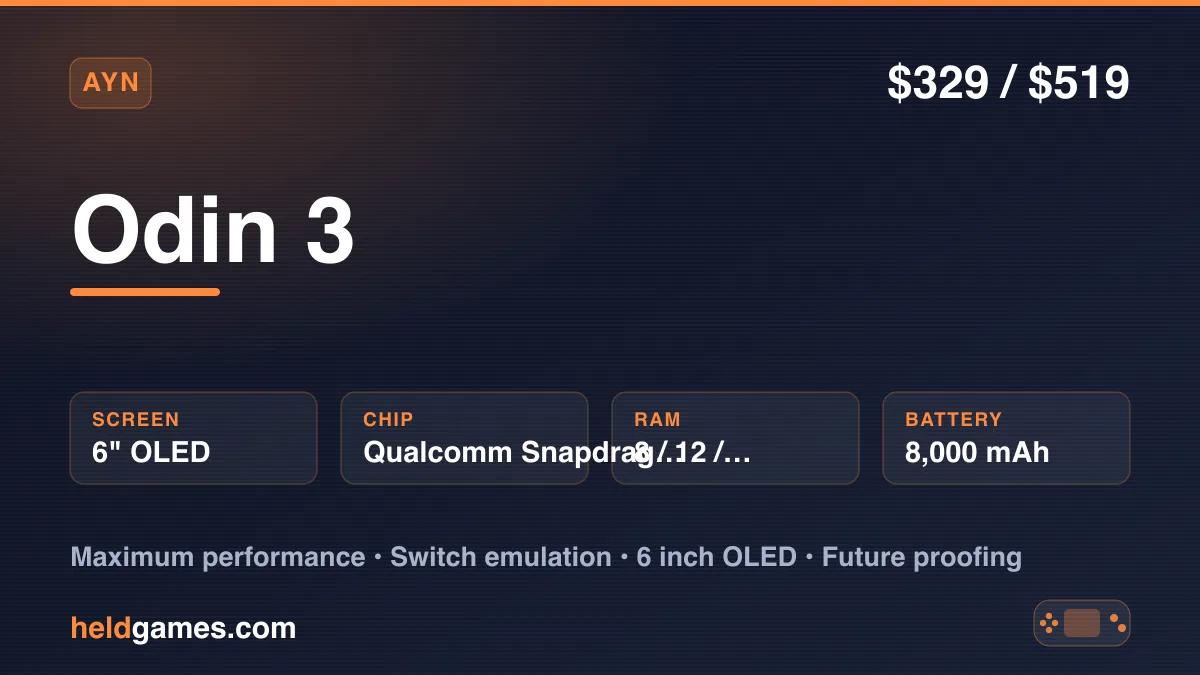
The AYN Odin 2 Portal Pro spent most of 2026 as our top pick for Switch emulation. The Odin 3 is the device that takes the crown for the whole premium Android tier. AYN moved to a Snapdragon 8 Elite class chip, and the jump is real. Synthetic benchmarks land close to double the Odin 2 in some tests. The 6 inch 1080p OLED runs at 120Hz and looks fantastic. The RAM tiers now stretch from a sensible 8 GB Base up to a frankly enormous 24 GB Ultra.
This is the new flagship to beat. It is not perfect at launch, and we get into the one real catch below. But if you want the most powerful emulation handheld you can buy in 2026, this is it. It sits above the Retroid Pocket 6 and the Anbernic RG557, and it leapfrogs its own predecessor, the Odin 2 Portal Pro.
Specs
| Screen | 6 inch OLED, 1920x1080, 120Hz refresh, 152% sRGB, touch enabled |
| Processor | Qualcomm Snapdragon 8 Elite |
| GPU | Adreno 830 |
| RAM | 8 GB / 12 GB / 16 GB / 24 GB LPDDR5X by tier |
| Storage | 128 GB / 256 GB / 512 GB / 1 TB UFS by tier, microSD expansion |
| Battery | 8000 mAh, 60W USB C PD fast charging |
| Display out | USB C with 4K60 output |
| OS | Android 15, Play Store unlocked |
| Cooling | Active fan with adjustable curve |
| Controls | Hall effect analog sticks, Hall triggers, gyro, vibration motor |
| Connectivity | Wi Fi 7, Bluetooth 5.4, USB C |
Which Tier Should You Buy
The Odin 3 ships in four configurations. Most buyers do not need the top one. Here is the simple way to think about it.
- Base, 8 GB RAM and 128 GB storage, around $299. The value pick. It handles everything up to PS2 and most of GameCube without breaking a sweat. If your library is retro through PS2, start here.
- Pro, 12 GB RAM and 256 GB storage. The sweet spot for most people. The extra RAM helps Switch 1 emulation and heavy multitasking, and 256 GB gives you real room before you reach for a microSD card.
- Max, 16 GB RAM and 512 GB storage. For enthusiasts who want headroom and a large built in library.
- Ultra, 24 GB RAM and 1 TB storage, around $519. Overkill for pure emulation. It makes sense if you also run demanding native Android games, keep a giant local library, or simply want to future proof.
For the typical reader who wants strong Switch 1 emulation without overspending, the Pro tier is the one we point to.
Build and Design
The Odin 3 keeps the comfortable AYN ergonomics and dials them in further. The grips are sculpted for adult hands. The face buttons have good spacing and a satisfying click. The sticks and triggers both use Hall sensors, so stick drift is simply not something you need to worry about over the life of the device.
The 6 inch screen sits between the 5.5 inch pocket flagships and the larger 7 inch Portal Pro. It is more pocketable than the Portal Pro and easier to hold for long sessions than you might expect.
The USB C port supports 4K60 video output, so the Odin 3 doubles as a capable docked device for couch play on a TV or monitor. A microSD slot handles storage expansion.
The 6 Inch OLED
The screen is a highlight. It is a 6 inch 1080p OLED at 120Hz with wide color coverage. OLED contrast makes retro content pop, and the high refresh ceiling keeps 60 fps emulation runs feeling smooth.
The 1080p resolution gives you clean native scaling. PSP looks crisp at higher multipliers. GameCube and Switch 1 have the pixels to upscale into. Outdoor visibility is strong thanks to the high peak brightness. If your library leans on 4:3 retro systems, you get the usual pillarbox bars on a 16:9 panel, which is the same trade off you make on almost every modern handheld.
Emulation Performance
This is the reason to buy an Odin 3. The Snapdragon 8 Elite class chip is a large step up from the Odin 2, and it shows across the demanding systems.
- NES through PSP. Trivial. Everything runs at full speed with plenty of headroom.
- Nintendo 64. Full library, full speed, clean with the Mupen64Plus Next core in RetroArch.
- Dreamcast. Full library, full speed via Flycast. See our Flycast Dreamcast setup guide.
- PSP and PS Vita. PSP is effortless. PS Vita through Vita3K is one of the better experiences on any handheld here. See the PS Vita emulation guide.
- GameCube. Excellent. Dolphin runs most of the library at 2x to 3x native.
- Wii. Strong, though a few titles depend on GPU driver maturity. See the launch caveat below.
- PS2. 3x native on most titles via the AetherSX2 family, with demanding games closer to 2x.
- Switch 1. Very capable hardware, with one launch asterisk. The raw power is there for the bulk of the library. At launch, the lack of custom Turnip GPU drivers holds back some titles until the community catches up. For emulator choices, see Eden vs Kenji NX vs Citron.
- Switch 2. Experimental, as it is on every device in 2026. The Odin 3 is one of the most capable platforms for the attempt, but expect crashes and glitches. Background in our Switch 2 emulation guide.
On a 4K external display, the Odin 3 can push GameCube and PS2 with headroom to spare. The active cooling fan stays quiet during normal play and only spins up on the heaviest loads.
The One Real Catch: GPU Drivers at Launch
Here is the honest caveat. At launch the Odin 3 lacks the custom Turnip GPU drivers that mature Snapdragon handhelds rely on for the trickiest emulation. The practical effect is that some Switch and Wii U titles either run below their potential or refuse to start.
This is a software problem, not a hardware one. The community has solved it on previous AYN and Retroid devices, and the same fix is expected here. If you are buying primarily for day one Switch emulation, it is worth checking the current driver status before you order. If you are buying for everything up to PS2, this caveat does not affect you at all.
Software
Android 15 ships with the Play Store unlocked from first boot. Every major emulator and front end works out of the box. The EmuDeck for Android Beta Setup Guide covers the one click installer we recommend as a starting point.
The Odin Launcher is mature and pleasant to use. It is one of the better stock launchers in the category. Many owners still swap in Daijisho, ES DE for Android, or Beacon, but none of that is required.
For Linux fans, the Odin family has a strong track record with ROCKNIX and native Steam through the FEX translation layer.
Battery and Charging
The 8000 mAh battery is large and it shows. Expect roughly all day light retro play, several hours of PSP or Dreamcast, and a solid block of PS2 or Switch 1 time. The 60W USB C PD charging refills it quickly. Idle drain is well managed, so the device sips power in sleep.
Steam Streaming and Cloud Gaming
The Wi Fi 7 radio plus the 1080p 120Hz OLED make the Odin 3 a superb streaming device. Steam Link from a home PC feels native. Xbox Cloud Gaming and GeForce Now both run beautifully. If couch streaming is part of your plan, the Odin 3 covers it as well as anything in the handheld space.
Odin 3 vs the Competition
The short version. For the full breakdowns, see the dedicated comparisons.
- Odin 3 vs Retroid Pocket 6. The Pocket 6 is the value flagship. The Odin 3 is the power flagship. If $249 fits better and you want a smaller body, the Pocket 6 is the smart buy.
- Odin 3 vs Odin 2 Portal Pro. The upgrade question. The Odin 3 wins on raw power and screen tech. The Portal Pro wins on a larger 7 inch panel and a proven driver stack today.
- Odin 3 vs Steam Deck OLED. Android emulation king versus PC handheld. Pick the Deck for native PC games. Pick the Odin 3 for emulation and streaming.
Who Should Buy the AYN Odin 3
Buy the Odin 3 if you want the most powerful emulation handheld on the market in 2026; you want a top tier 6 inch OLED; you value a big battery and a mature launcher; you want a device with real future headroom for Switch and beyond; you can stretch past the $299 starting price.
Skip the Odin 3 if your budget tops out around $249 (the Retroid Pocket 6 covers most of the same ground); you want the smallest pocketable form factor; you need flawless day one Switch emulation and cannot wait on the Turnip driver fix; you want a native PC handheld (look at the Steam Deck OLED).
For the buyer who wants the strongest Android emulation device in 2026, the AYN Odin 3 is now the answer.
Frequently Asked Questions
How much does the AYN Odin 3 cost?
It starts around $299 for the 8 GB Base tier and climbs to roughly $519 for the 24 GB Ultra. The 12 GB Pro tier is the sweet spot for most buyers.
Is the Odin 3 good for Switch emulation?
The hardware is excellent for it. There is a launch asterisk. Until the community ships custom Turnip GPU drivers, some Switch titles run below their potential or refuse to start. Check the current driver status before ordering if Switch is your main use.
Can the Odin 3 emulate Switch 2?
It can attempt it. Switch 2 emulation in 2026 is experimental on every device. The Odin 3 is among the most capable platforms for the attempt, but expect crashes and graphical glitches.
How much RAM should I get?
For most people the 12 GB Pro tier is plenty. Go 8 GB Base if your library is retro through PS2. Reach for 16 GB or 24 GB only if you also run demanding native Android games or want maximum future proofing.
How long does the Odin 3 battery last?
The 8000 mAh battery delivers all day light retro play and a solid block of demanding emulation. 60W fast charging refills it quickly.
Should I buy the Odin 3 or the Odin 2 Portal Pro?
Buy the Odin 3 for the newer chip, the higher performance ceiling, and the more pocketable 6 inch body. Buy the Odin 2 Portal Pro if you want the larger 7 inch screen and a fully proven driver stack today. See the full Odin 3 vs Odin 2 Portal Pro comparison.
Related Reading
The Verdict4.7 / 5
The AYN Odin 3 is the new Android flagship to beat in 2026. The Snapdragon 8 Elite class chip is a genuine generational leap over the Odin 2, the 6 inch OLED is one of the best screens on any handheld, and the RAM tiers stretch from a sensible 8 GB Base all the way to a 24 GB Ultra. The one real catch is the GPU driver situation, which holds back some Switch and Wii U titles at launch until the community ships custom Turnip drivers. For most buyers the 12 GB Pro tier is the sweet spot. If you want the strongest emulation device on the market and can stretch past the Retroid Pocket 6, the Odin 3 is the new pick.
Related reading
 Review
 ComparisonComparison