
Affiliate disclosure: This page contains affiliate links. As an Amazon Associate, we earn from qualifying purchases at no extra cost to you. Learn more.
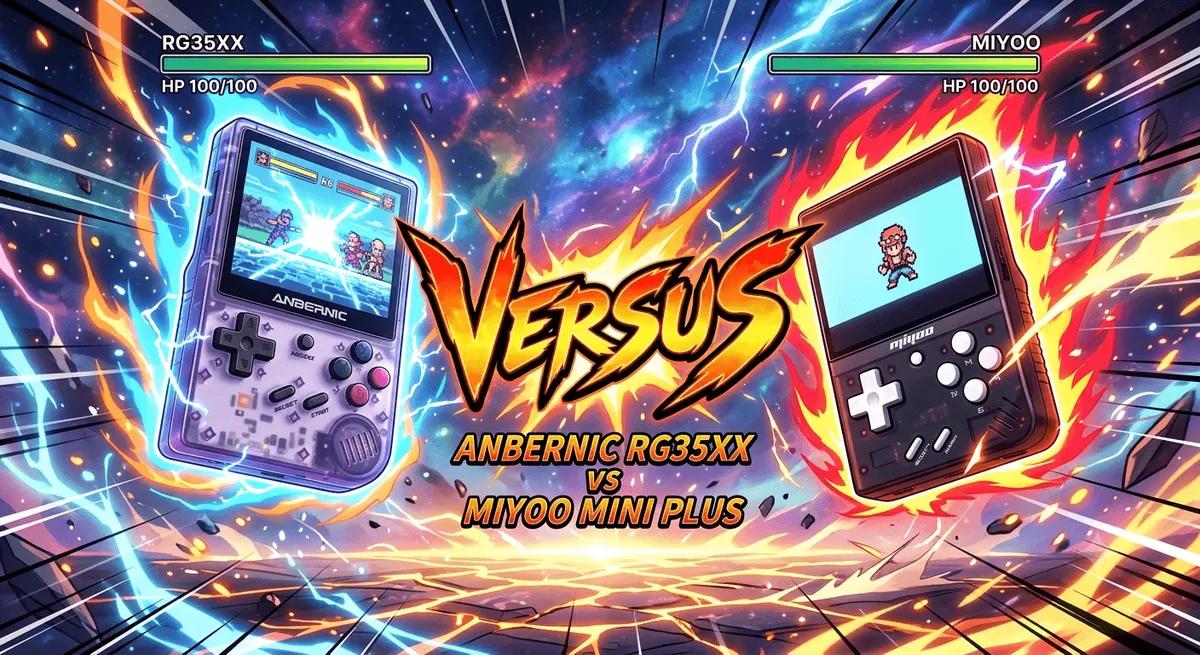
The Anbernic RG35XX Pro and the Miyoo Mini Plus are the two best budget retro handhelds you can buy right now — and they take completely different approaches. The RG35XX Pro is the feature-packed option with dual sticks, Wi-Fi, and HDMI out. The Miyoo Mini Plus is the pocketability champion with the most polished custom firmware in the business.
Both cost around $50. Both handle the retro library beautifully. The right choice depends entirely on what you value most.
Specs Head-to-Head
| Spec | RG35XX Pro | Miyoo Mini Plus |
|---|---|---|
| CPU | Allwinner H700 (Cortex-A53 @ 1.5 GHz) | Allwinner (ARM Cortex-A7) |
| RAM | 1 GB LPDDR4 | 128 MB DDR3 |
| Display | 3.5" IPS, 640×480 | 3.5" IPS, 640×480 |
| Analog Sticks | Dual | None |
| Wi-Fi | Yes (2.4/5 GHz) | No |
| Bluetooth | 4.2 | No |
| HDMI Out | Yes (mini HDMI) | No |
| Battery | 3,200 mAh (~5–7 hrs) | 3,500 mAh (~5–7 hrs) |
| Weight | ~198 g | ~162 g |
| Best Firmware | muOS / KNULLI | Onion OS |
| Price | ~$50 | ~$50 |
Pocketability
The Miyoo Mini Plus wins this category convincingly. At roughly 162 grams and the size of a deck of cards, it genuinely disappears into a jeans pocket. You can carry it every day without thinking about it. The RG35XX Pro is pocketable in a jacket or cargo shorts, but it's noticeably chunkier — you'll feel it in slim pants.
If you want a device that's always on you and ready to pull out for a quick GBA session on a bus or during a lunch break, the Miyoo Mini Plus is the pocket king.
Performance
The RG35XX Pro has the more powerful chip. The H700 significantly outperforms the Miyoo Mini Plus's processor, particularly for PS1, Dreamcast, and N64 emulation. The RG35XX Pro handles Dreamcast games well and can manage most N64 titles with tweaking. The Miyoo Mini Plus tops out at PS1 — it runs most PS1 games excellently but can't meaningfully stretch beyond that.
For 8-bit and 16-bit systems (NES, SNES, GBA, Genesis), both devices deliver flawless performance. The difference only shows up when you push into PS1 and beyond.
Winner by system:
- NES/SNES/GBA/Genesis: Tie
- PS1: RG35XX Pro (slightly better performance ceiling)
- N64: RG35XX Pro (Miyoo can't run it)
- Dreamcast: RG35XX Pro (Miyoo can't run it)
- PSP: RG35XX Pro (light titles only, but Miyoo can't attempt it)
Firmware and Software
This is where the Miyoo Mini Plus fights back hard. Onion OS is the most polished custom firmware experience on any budget handheld. It's beautiful, intuitive, fast, and loaded with thoughtful features — Game Switcher for quickly hopping between titles, a built-in box art scraper, a blue light filter, and a UI that anyone can navigate without a guide.
The RG35XX Pro has muOS and KNULLI, both excellent options, but neither matches Onion OS's out-of-the-box polish. muOS is fast and clean but more utilitarian. KNULLI is feature-rich but requires more setup. Our firmware comparison guide breaks down the differences in detail.
If you're buying this as a gift for someone who isn't tech-savvy, the Miyoo Mini Plus with Onion OS is the safer bet. It just works, beautifully, from the moment you turn it on.
Analog Sticks and 3D Games
The RG35XX Pro's dual analog sticks are a genuine differentiator. Any game that uses an analog stick — N64 titles, Dreamcast games, PS1 3D games, PSP titles — is significantly better on the RG35XX Pro. Without sticks, the Miyoo Mini Plus is limited to D-pad-controlled games, which rules out a meaningful chunk of the PS1 library and makes N64 essentially unplayable.
If your library is heavy on 2D games (GBA, SNES, NES, 2D PS1 games like Castlevania: Symphony of the Night), the lack of sticks on the Miyoo Mini Plus isn't a loss. If you want to play Ocarina of Time, Tony Hawk, or Ape Escape, you need sticks.
Connectivity
The RG35XX Pro offers Wi-Fi, Bluetooth, and HDMI output. The Miyoo Mini Plus has none of these.
Wi-Fi enables RetroAchievements, Netplay, wireless file transfers, and firmware updates. HDMI transforms the RG35XX Pro into a basic home console setup. Bluetooth allows wireless controllers and headphones. The Miyoo Mini Plus is a pure handheld-only device — no TV output, no wireless anything.
Build Quality
Both feel well-made for the price. The Miyoo Mini Plus has a slightly more premium hand-feel due to its compact, dense form factor. The RG35XX Pro is solid but chunkier. Both use quality IPS displays at the same resolution. Neither will feel like a toy in your hands.
The Verdict
Buy the Anbernic RG35XX Pro if: You want the most versatile budget handheld with analog sticks, N64/Dreamcast capability, Wi-Fi, HDMI out, and the deepest custom firmware ecosystem. It does more things.
Buy the Miyoo Mini Plus if: You want the most pocketable device with the most polished firmware (Onion OS), and your library is primarily 2D games (GBA, SNES, NES, 2D PS1). It does fewer things, but does them with more polish.
Both are outstanding devices at $50. You can't go wrong with either — the question is whether you value versatility (RG35XX Pro) or pocketability and polish (Miyoo Mini Plus).
Related reading
 ComparisonComparisonComparison