
Affiliate disclosure: This page contains affiliate links. As an Amazon Associate, we earn from qualifying purchases at no extra cost to you. Learn more.
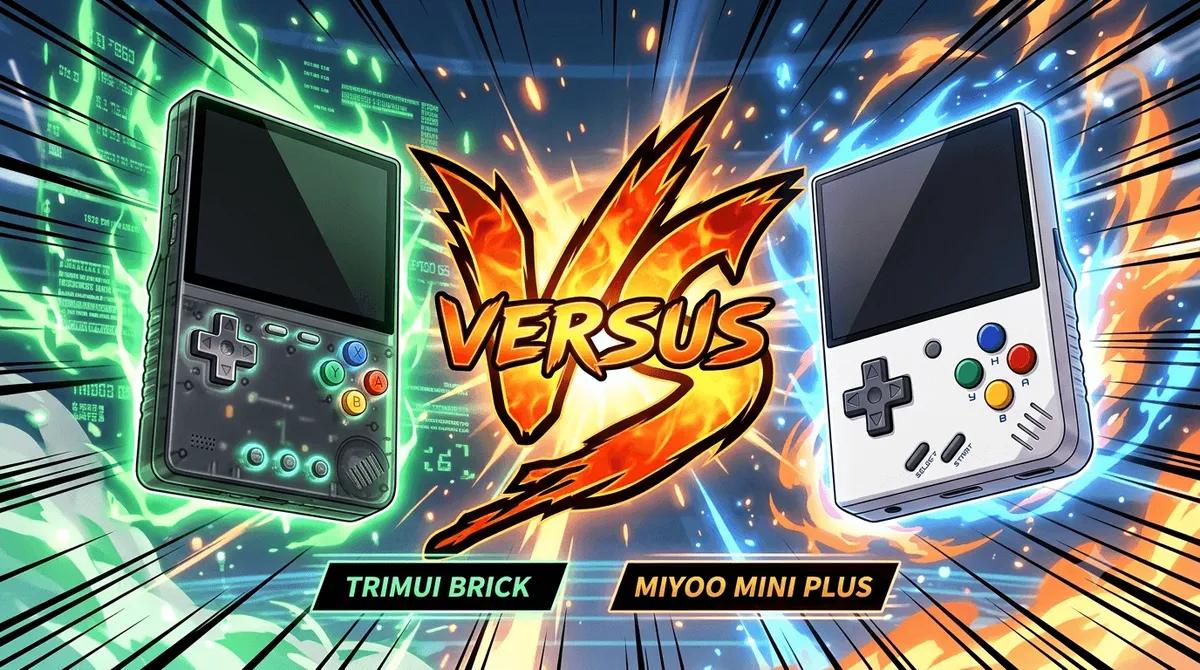
The Trimui Brick and the Miyoo Mini Plus are the two devices that come up most when people want a tiny, cheap retro handheld. Both are pocketable. Both stop around PS1. Both skip analog sticks. The Brick brings a much sharper screen and a newer chip. The Miyoo Mini Plus brings the most polished firmware on any budget device. Here is how they compare.
Specs Head to Head
| Spec | Trimui Brick | Miyoo Mini Plus |
|---|---|---|
| CPU | Allwinner A133P (quad Cortex-A53) | SigmaStar SSD202D (ARM Cortex-A7) |
| RAM | 1GB | 128MB DDR3 |
| Screen | 3.2 inch IPS, 1024x768 | 3.5 inch IPS, 640x480 |
| Analog sticks | None | None |
| Wi-Fi | Yes | Yes (2.4GHz) |
| Battery | 3,000 mAh | 3,000 mAh |
| Best firmware | CrossMix / KNULLI / MinUI | Onion OS |
| Price | around $40 | around $65 |
Screen
This is the Brick's biggest win. Its 3.2 inch panel runs at 1024x768, which is a far higher resolution than the Miyoo Mini Plus at 640x480. Retro pixel art looks dramatically sharper on the Brick, and the higher density is obvious side by side.
The Miyoo Mini Plus has a slightly larger 3.5 inch screen, which some players prefer for visibility, but it cannot match the Brick for sharpness. If screen quality is your priority, the Brick wins clearly.
Performance
The Brick has the stronger chip. Its Allwinner A133 with 1GB of RAM comfortably outclasses the older, weaker processor and 128MB of RAM in the Miyoo Mini Plus. Both devices are excellent for 8-bit and 16-bit systems, and both top out around PS1.
The gap shows up in headroom. The Brick handles PS1 with more comfort and runs custom firmware features more smoothly. The Miyoo Mini Plus is still a fine PS1 machine, but it is working closer to its limit.
Firmware
This is where the Miyoo Mini Plus fights back. Onion OS is the most polished custom firmware on any budget handheld. It is beautiful, fast, and loaded with thoughtful features, and it works perfectly out of the box. For a buyer who wants a flawless experience with no fuss, Onion OS is a real advantage.
The Brick has strong firmware options too, including CrossMix, KNULLI, and MinUI. They are excellent, but the experience asks for a bit more setup than the plug and play polish of Onion OS.
Battery Life
The Miyoo Mini Plus wins here, but not on capacity. Both pack a 3,000 mAh battery. The difference is efficiency. The Miyoo's very low power chip stretches to roughly 8 to 10 hours, while the Brick's stronger chip and sharper screen land closer to 4 to 5 hours. If you want the longest unplugged playtime, the Miyoo Mini Plus is the better pick.
Size and Feel
Both are pocketable. The Brick is smaller and boxier, which is charming but cramped for larger hands. The Miyoo Mini Plus has a more rounded, ergonomic shape that many find more comfortable for longer sessions. Neither has analog sticks, so both are best for 2D games.
The Verdict
Buy the Trimui Brick if: You want the sharpest small screen, a newer chip, and the lowest price. The 1024x768 panel is the reason to choose it, and it is a fantastic 2D handheld.
Buy the Miyoo Mini Plus if: You want the most polished out of the box experience with Onion OS, longer battery life, and a slightly larger, more ergonomic body.
Both are excellent tiny handhelds. The Brick wins on screen and value. The Miyoo Mini Plus wins on polish and battery. Pick the one whose strengths match what you care about most.
Related reading
 ComparisonComparisonComparison