
Affiliate disclosure: This page contains affiliate links. As an Amazon Associate, we earn from qualifying purchases at no extra cost to you. Learn more.
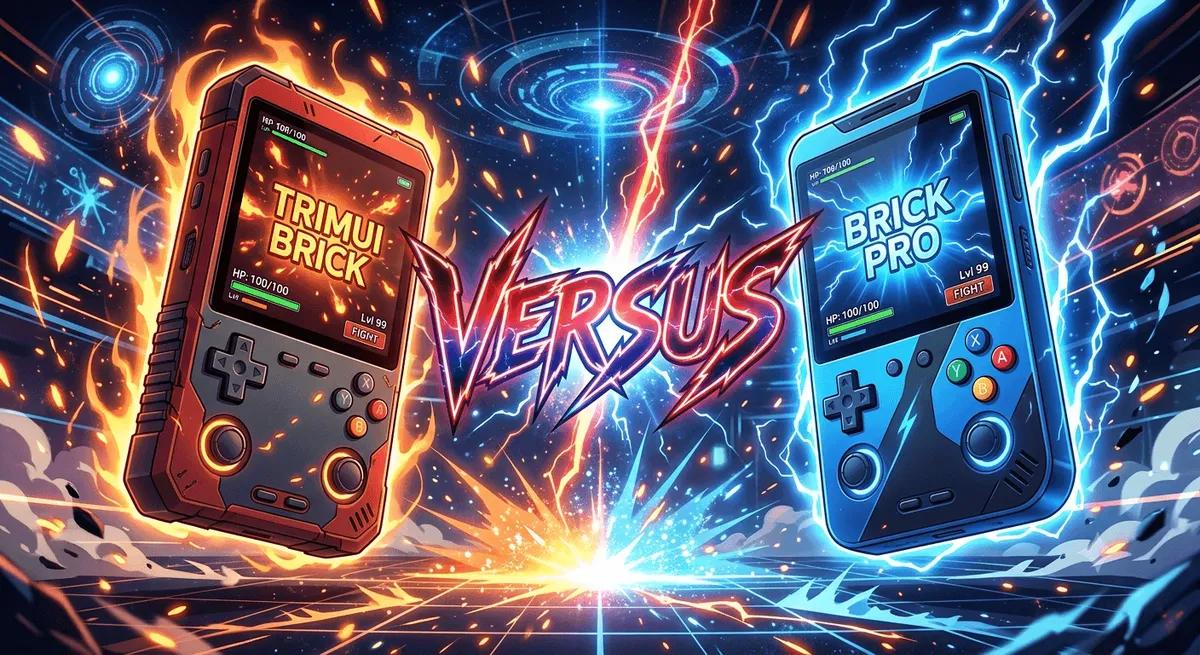
The original TrimUI Brick became a budget legend on the strength of one feature, a stunningly sharp 1024x768 screen on a tiny, cheap handheld. The Brick Pro keeps that sharp panel and makes it bigger. If you have been eyeing a Brick, the obvious question is which one to get. Here is how they compare.
Specs Head to Head
| Spec | TrimUI Brick | TrimUI Brick Pro |
|---|---|---|
| CPU | Allwinner A133P (quad Cortex-A53) | Allwinner A133P (quad Cortex-A53) |
| RAM | 1GB | 1GB |
| Screen | 3.2 inch IPS, 1024x768 | 3.95 inch IPS, 1024x768 |
| Analog sticks | None | None |
| Storage | microSD | 8GB internal + microSD |
| Best firmware | CrossMix / KNULLI / MinUI | CrossMix / KNULLI / MinUI |
| Price | around $40 | around $85 to $100 |
Screen
This is the whole reason the Brick Pro exists. Both panels run at the same sharp 1024x768 resolution, but the Brick Pro grows the screen from 3.2 inches to 3.95 inches. That is a big jump in usable size.
The original Brick looks razor sharp because of its high pixel density on a small panel. The Brick Pro keeps that sharpness while giving you a noticeably larger image. If you found the original Brick's screen a touch cramped, the Pro fixes exactly that. If you valued how tiny the original was, the smaller screen is part of the charm.
Performance
There is little to separate them here. Both use the same Allwinner A133P family chip with 1GB of RAM, so both top out around PS1. Expect identical real world emulation, which means full speed for everything from 8 bit and 16 bit systems through PS1, and no N64, PSP, or Dreamcast on either.
Neither has analog sticks, so both are 2D machines first and foremost.
Size and Feel
This is the trade. The original Brick is smaller and more pocketable, which is part of its appeal but cramped for larger hands. The Brick Pro is bigger and more comfortable to hold for longer sessions, but it is less of a true pocket device.
Both keep the boxy vertical Brick silhouette. Which you prefer comes down to whether you want maximum pocketability or maximum comfort and screen size.
Firmware
Identical. Both run TrimUI's stock Linux out of the box and both support the same custom firmware lineup, including CrossMix, KNULLI, and MinUI. Whatever you would run on one, you can run on the other.
Price
The original Brick is the budget champion at around $40. The Brick Pro lands higher, roughly $85 to $100 depending on promotions. That gap is the real decision point. You are paying extra for the bigger screen and a more comfortable body, not for more performance.
The Verdict
Buy the TrimUI Brick if: You want the lowest price and the most pocketable size. At around $40 it is still one of the best value handhelds you can buy, and the sharp screen is the same resolution as the Pro.
Buy the TrimUI Brick Pro if: You want the same sharpness on a bigger, more comfortable 3.95 inch screen and you do not mind paying more for it. For many people the larger panel is worth the step up.
Performance is a tie, so this comes down to size and price. Want tiny and cheap? The Brick. Want bigger and more comfortable? The Brick Pro. If you need more power than either, look at the premium TrimUI Brick Hammer Pro U or the GameMT EX8 instead.
Related reading
 ComparisonComparisonComparison