
Affiliate disclosure: This review contains affiliate links. As an Amazon Associate, we earn from qualifying purchases at no extra cost to you. Learn more.
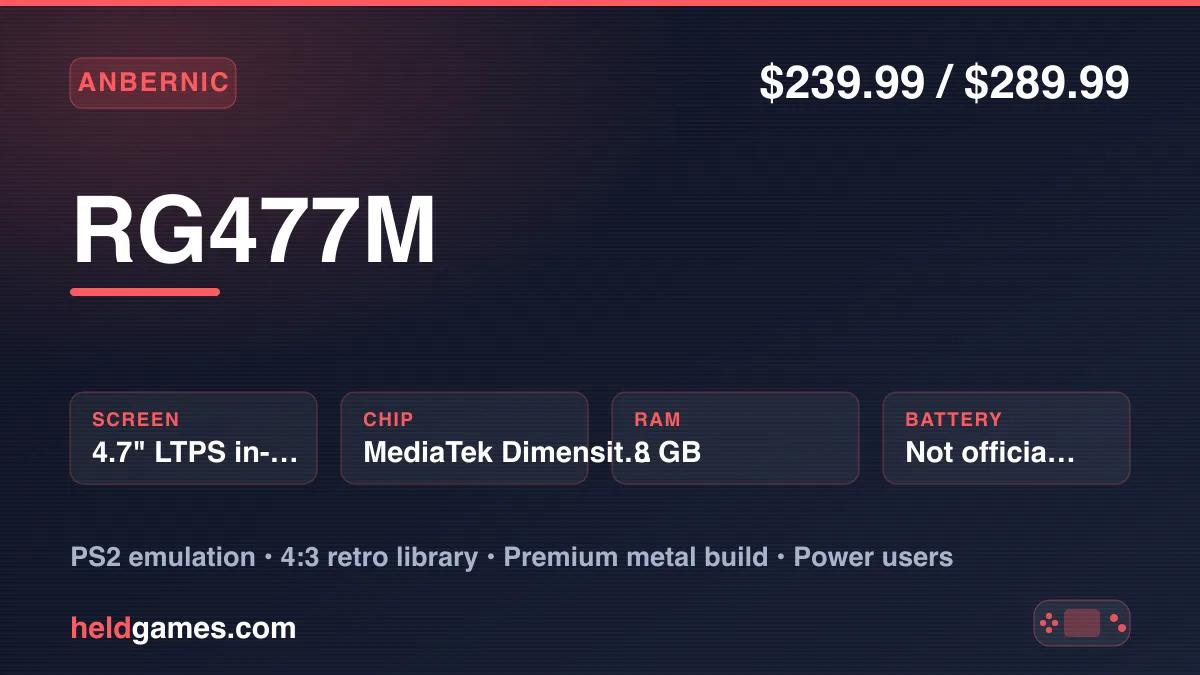
The Anbernic RG477M is the first Anbernic Android handheld that does not feel like a budget compromise. According to launch coverage from Retro Handhelds, RetroDodo, and HandheldModz, the RG477M ships in a CNC-machined aluminum chassis, runs a MediaTek Dimensity 8300 with up to 12 GB of LPDDR5X RAM, and drives a 4.7-inch 1280×960 LTPS in-cell display at 120 Hz. The spec sheet lists PS2 emulation at 2.5× native resolution and Switch viability on the harder end of the library.
At $239.99 for the 8 GB / 128 GB SKU and $289.99 for the 12 GB / 256 GB SKU, the RG477M lands in a competitive bracket against the Retroid Pocket 6 and the AYN Thor. This review summarizes what the RG477M is, what early reviewers are saying about it, and who should consider buying it over the alternatives.
Specs
| Screen | 4.7" LTPS in-cell, 1280×960 (4:3), 120Hz max refresh, OCA lamination, touchscreen |
| Processor | MediaTek Dimensity 8300, 4nm, octa-core (4× Cortex-A715 + 4× Cortex-A510) |
| GPU | Mali-G615 MC6 |
| RAM | 8GB or 12GB LPDDR5X |
| Storage | 128GB (8GB SKU) or 256GB (12GB SKU) UFS, microSD expansion |
| Battery | Active cooling fan; battery capacity not yet officially listed |
| OS | Android (version not yet confirmed in launch press) |
| Cooling | Active fan with adjustable curve |
| Controls | Hall-effect analog sticks with RGB lighting, six-axis gyro, vibration motor, clicky shoulder buttons |
| Chassis | CNC-machined aluminum alloy — Chocolate Bronze or Silver Blade |
| Audio | 3.5mm headphone jack, stereo speakers |
| Connectivity | Wi-Fi, Bluetooth, USB-C with DisplayPort output |
Build Quality and Design
The headline of the RG477M is the chassis. Anbernic's recent lineup — the RG556, the RG Cube, the RG Vita Pro — has been built largely from solid plastic. The RG477M is the brand's first mass-market Android handheld with a full CNC-aluminum body, available in two finishes: Chocolate Bronze and Silver Blade. Early reviewers consistently call out the in-hand feel as the strongest point of differentiation against the Retroid Pocket 6.
That metal construction does come with weight. Reviewers describe the device as "chonky" and notably heavier than the comparable Retroid devices. For couch and desk play this is a non-issue; for long handheld sessions, expect to feel it.
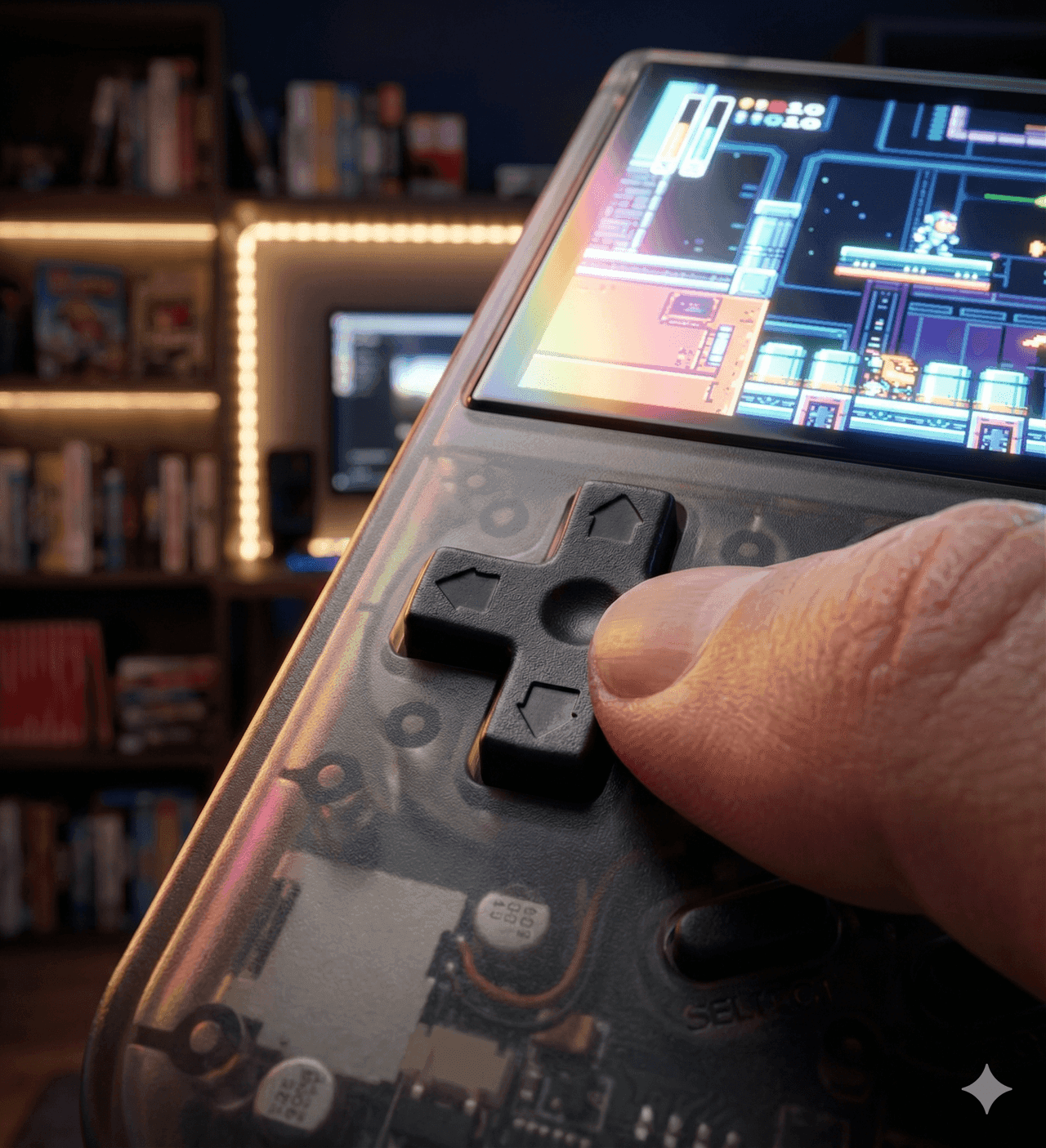
The control deck includes hall effect analog sticks (with configurable RGB lighting around the rings), a clicky D-pad, and shoulder triggers that early reviewers have flagged as more polarizing. The shoulder buttons are noticeably clicky rather than analog, and the ergonomics of holding them down for extended driving or shooter sessions is a recurring complaint in launch coverage. Expect a community shell-mod or trigger replacement scene to emerge.
A 3.5mm headphone jack, USB-C with DisplayPort output, and microSD expansion round out the physical interface. This is a more complete connectivity package than the RG Rotate or several recent budget Anbernic units.
Display
The 4.7-inch LTPS in-cell panel runs at 1280×960 — a true 4:3 aspect ratio at a higher resolution than most retro-class handhelds. OCA lamination eliminates the air gap between the glass and the panel, which translates to noticeably better contrast in direct sunlight. The 120Hz refresh ceiling is supported by the Dimensity 8300 and matters for Android-native titles and high-frame-rate emulator output (Dreamcast, Switch, GameCube targets).
The 4:3 aspect ratio is a deliberate choice. Most retro content from the NES through PS2 era was authored for 4:3 displays. On a 4:3 panel, NES, SNES, Game Boy, GBA, N64, Saturn, GameCube, and PS2 content all display without letterboxing. The trade-off is that 16:9 content (PSP, modern Android games, cloud streaming) will display with top and bottom bars. The RG477M's panel is the right shape for retro and the wrong shape for newer content — for this device, that is the correct decision.
Emulation Performance
The Dimensity 8300 puts the RG477M near the top of the Android handheld performance ladder. Launch coverage from Retro Handhelds and RetroDodo reports the following with confidence:
- NES through PSP: Flawless across the board.
- N64 and Dreamcast: Full library at full speed.
- GameCube and Wii: Strong. Most of the library plays well via Dolphin standalone, with demanding titles requiring per-game settings.
- PS2: Reviewers consistently cite PS2 at 2.5× native resolution as a real, sustained capability. This is meaningfully better than the Retroid Pocket 5's PS2 ceiling and on par with the Retroid Pocket 6.
- Switch: Capable of running a range of Switch titles, with results varying by game and emulator. Treat as "many titles playable" rather than "full library."
The active cooling fan is the enabler here. Sustained high loads on PS2 and Switch emulators benefit substantially from the fan over the passive cooling found in slimmer competitors. The trade-off — covered below — is fan noise.
Thermals and Fan Noise
This is the most consistent criticism in early RG477M coverage. Reviewers from Retro Handhelds and RetroDodo both flag the same issue: under demanding emulation loads, the fan ramps up audibly and produces a noticeable whine. Anbernic ships the device with a configurable fan curve, and reviewers note that adjusting the curve helps but does not eliminate the whine. Expect community firmware tweaks and curve presets to appear within weeks of launch.
For headphone or earbud users this is a non-issue. For speaker users in a quiet room, the fan can be intrusive during sustained 3D emulation.
Software
The RG477M ships with Android. As is now standard for premium Anbernic Android devices, Google Play Store access lets you install any emulator or storefront directly. Anbernic preinstalls common emulators with mappings, which means the device is usable out of the box rather than requiring a multi-hour first-time setup.
The stock Anbernic launcher remains the weakest part of the software experience — functional but visually dated. Replacing it with Daijishō, ES-DE for Android, or running EmuDeck for Android (currently in open beta) significantly improves the polish.
For users who prefer a Linux experience, the RG477M is a strong candidate for ROCKNIX as Qualcomm and MediaTek support continues to mature. As of launch, Android is the supported configuration.
RG477M vs Retroid Pocket 6
The Retroid Pocket 6 is the natural cross-shop. Both target premium Android emulation; both can handle PS2 and selective Switch.
| RG477M | Retroid Pocket 6 | |
|---|---|---|
| Chassis | CNC aluminum (Chocolate Bronze or Silver Blade) | Plastic with metal accents |
| SoC | MediaTek Dimensity 8300 | Snapdragon 8 Gen 2 |
| RAM | 8GB or 12GB LPDDR5X | Configurable up to 12GB |
| Display | 4.7" 1280×960 LTPS, 120Hz, 4:3 | 5.5" AMOLED, 120Hz, 16:9 |
| Cooling | Active fan | Active fan |
| Weight | Heavier (metal body) | Lighter |
| 3.5mm jack | Yes | Yes |
| Price | $239.99 / $289.99 | $249 |
The decision largely comes down to screen shape. If your library skews retro (NES through PS2-era 3D), the RG477M's 4:3 LTPS panel is a better match. If you want the AMOLED contrast and your library leans on PSP, modern Android games, or cloud streaming, the Pocket 6 is the better pick. Performance is roughly comparable at the same workload.
RG477M vs Anbernic RG556
The RG556 was Anbernic's prior premium Android handheld. The RG477M replaces it as the new top of the line.
| RG477M | RG556 | |
|---|---|---|
| Chassis | CNC aluminum | Plastic |
| SoC | Dimensity 8300 | Unisoc T820 |
| RAM | 8GB or 12GB LPDDR5X | 8GB LPDDR4X |
| Display | 4.7" 1280×960 LTPS 120Hz | 5.48" AMOLED |
| PS2 ceiling | 2.5× native | Native |
| Price | $239.99 / $289.99 | $199 |
The RG556 stays as the better-value pick if you specifically want AMOLED contrast and a larger 16:9 screen. The RG477M is the upgrade for anyone who prioritizes raw emulation performance and build quality.
Who Should Buy the RG477M
Buy the RG477M if you want the most powerful Anbernic Android handheld currently shipping; you prefer a 4:3 display because your library is retro-heavy through PS2; you value a metal chassis and are willing to carry the extra weight; PS2 at 2.5× and Switch viability matter to you; you can tolerate a fan that audibly ramps under load.
Skip the RG477M if you want AMOLED contrast (look at the RG556 or Retroid Pocket 6 instead); your library leans on PSP, modern Android, or 16:9 content; you want fanless silence at any cost; the $239.99 / $289.99 price is outside your budget — the Retroid Pocket 5 covers most of the same emulation tiers for $219.
For most retro-first buyers in 2026, the RG477M is the strongest Anbernic emulation device on the market. The metal body and the Dimensity 8300 finally let Anbernic compete head-to-head with Retroid in the premium Android tier rather than ceding that segment.
Frequently Asked Questions
How much does the Anbernic RG477M cost?
$239.99 for the 8 GB RAM / 128 GB storage configuration and $289.99 for the 12 GB RAM / 256 GB configuration. Anbernic offered a $20 launch discount on both SKUs during the first 72 hours after release.
Can the Anbernic RG477M emulate PS2 games?
Yes. According to launch coverage, the RG477M handles PS2 emulation at up to 2.5× native resolution on its 4.7" 1280×960 display, supported by the Dimensity 8300 and active cooling.
Can the Anbernic RG477M emulate Switch games?
Yes, with caveats. The RG477M can run a range of Switch titles, but performance varies by game and emulator. Treat it as "many titles playable" rather than a full Switch library at locked frame rates.
Does the Anbernic RG477M have a fan?
Yes. The RG477M includes an active cooling fan with an adjustable fan curve. Multiple early reviewers note that the fan whines audibly under sustained heavy load.
What screen does the RG477M use?
A 4.7-inch LTPS in-cell display at 1280×960 (4:3 aspect ratio), with OCA lamination and a 120Hz refresh rate.
Is the RG477M body actually metal?
Yes. The chassis is CNC-machined aluminum alloy, available in Chocolate Bronze and Silver Blade finishes. It is the first Anbernic Android handheld with a full metal body.
Should I buy the RG477M or the Retroid Pocket 6?
If you want a 4:3 LTPS display and a metal body, choose the RG477M. If you want a 16:9 AMOLED screen and lower weight, choose the Retroid Pocket 6. Performance between the two is roughly comparable.
Related Reading
The Verdict4.4 / 5
The RG477M is the first Anbernic Android handheld that earns the 'premium' label without an asterisk. The metal body, the Dimensity 8300, and the 120Hz LTPS panel push it into Retroid Pocket 6 and AYN Thor territory — and according to launch coverage, it holds its own. If you want the strongest Anbernic emulation device on the market and you can tolerate the fan whine, this is the one to buy.
Related reading
 Review
 ComparisonReview