
Affiliate disclosure: This review contains affiliate links. As an Amazon Associate, we earn from qualifying purchases at no extra cost to you. Learn more.
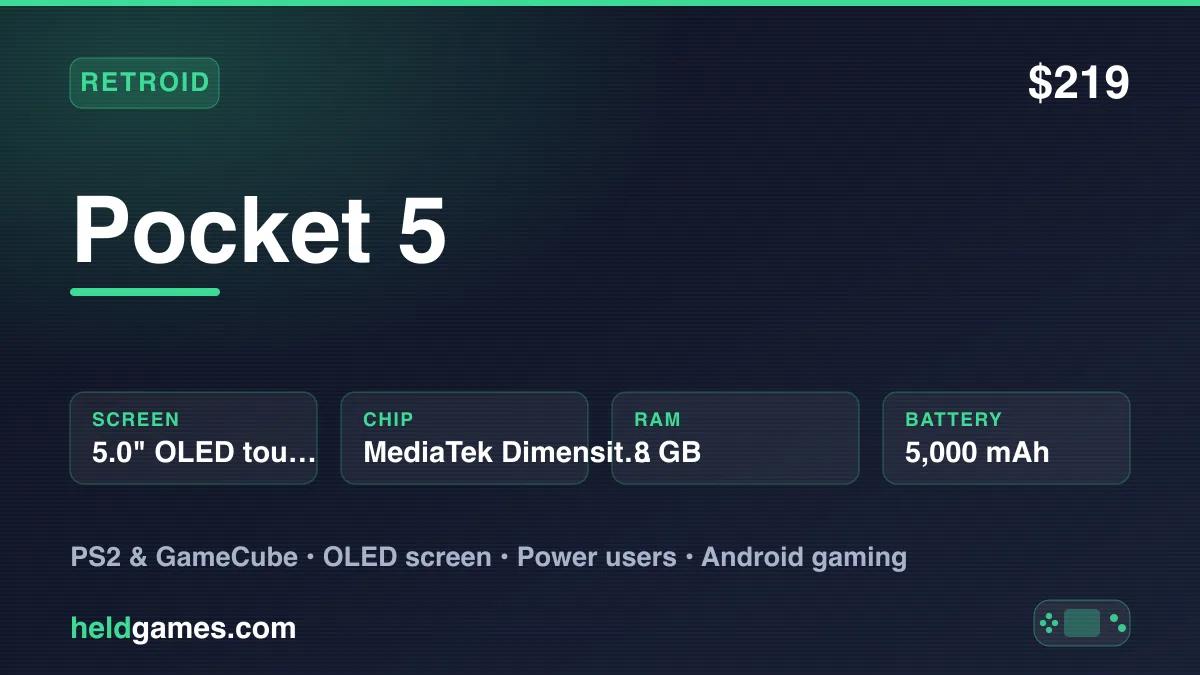
The Retroid Pocket 5 sits at an interesting inflection point in the retro handheld market. At $219 it's too expensive to compare to a $65 Anbernic, but it's not trying to. It's targeting the buyer who has hit the ceiling of budget hardware and wants to emulate PS2, GameCube, and PSP reliably — without paying the Steam Deck's $789 entry fee. The Snapdragon 865 chip inside it handles that job without complaint, wrapped in a 5.5" OLED screen and Hall-effect sticks that belong on a device costing significantly more.
✓ Pros
- • 5.5" OLED screen — vivid color and true blacks on a full-size display
- • Snapdragon 865 handles PS2, GameCube, and PSP with ease
- • Hall-effect analog sticks — no drift by design
- • Full Android 13 — install any emulator or streaming app
- • Retroid app store provides optimized emulator builds out of the box
- • WiFi 6 for fast network transfers and online features
- • Comfortable full-size ergonomics — better for extended sessions than compact devices
- • Strong battery life at lighter workloads — up to ~11 hours on GBA
✗ Cons
- • Too large for a jeans pocket — carry this in a bag
- • $219 is a meaningful step above budget Anbernic alternatives
- • Android setup curve for users new to the platform
- • PS3 and Switch emulation not reliable — Snapdragon 865 isn't enough for those systems
- • Shorter battery life under heavy load (~3.5 hours at PS2/GameCube)
Specs
Technical Specifications
| Screen | 5.5" OLED touchscreen, 1080×1920 resolution |
| Processor | Qualcomm Snapdragon 865 (octa-core, Adreno 650 GPU) |
| RAM | 8GB LPDDR4X |
| Storage | 128GB UFS + MicroSD slot |
| Battery | ~5,000mAh — ~3.5h (demanding) to ~11h (GBA) |
| OS | Android 13 |
| Connectivity | USB-C (DP out), Wi-Fi 6, Bluetooth 5.2, 3.5mm |
| Controls | Hall-effect analog sticks, D-pad, ABXY, L1/R1/L2/R2, Start/Select |
| Weight | ~280g |
Build Quality and Ergonomics
The Retroid Pocket 5 feels like a device designed by people who actually use handhelds for long sessions. The shell has a firm matte texture, all seams are flush, and nothing creaks or flexes under pressure. At roughly 280g it has meaningful heft without feeling heavy — the weight distributes across both hands in a way that keeps fatigue low over hour-plus sessions.
The full-size form factor is the biggest ergonomic difference from the compact Retroid Pocket Mini. The wider grip puts your thumbs in a more natural position relative to the analog sticks and face buttons, and the larger body allows for proper trigger travel on L2 and R2. For games that demand precision — racing titles, action games, anything where the analog sticks do real work — the RP5's layout is meaningfully more comfortable than a compact handheld.
The Hall-effect analog sticks deserve specific mention. Traditional potentiometer sticks develop drift through normal wear; hall-effect sticks use magnets to measure position and are essentially immune to drift. At $219, getting hall-effect sticks is no longer the premium feature it was two years ago — Retroid has made it standard across the RP lineup, and the competition has noticed.
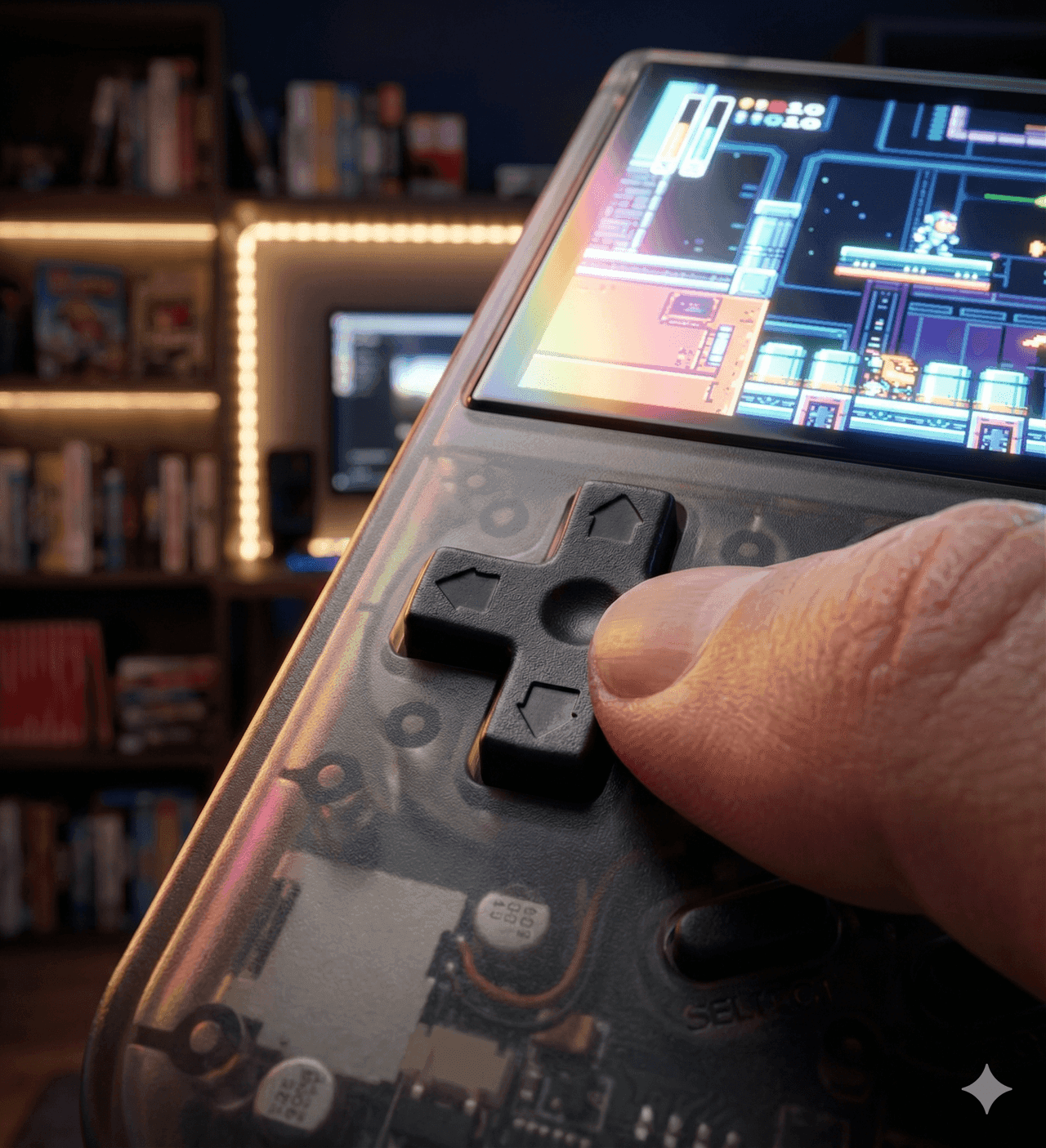
The D-pad is accurate and well-positioned for both 2D games and fighting game inputs. The ABXY buttons have clean tactile breaks with consistent spacing. Shoulder buttons and triggers have proper throw without mushiness — a failure point on many handhelds in this price range.
Display: The 5.5" OLED Advantage
The screen is the RP5's most compelling feature.
A 5.5" OLED panel at this price point is unusual. OLED technology produces light at the pixel level, meaning black pixels emit zero light — true black, not a dimmed backlight. The contrast ratio is effectively infinite. For retro gaming, where dark games like Castlevania: Symphony of the Night, Super Metroid, or any horror title are part of the canon, the difference between OLED and IPS is visible and meaningful. Dark scenes look dramatic rather than murky.
At 5.5" the screen is large enough that text in menus is readable without squinting, 3D geometry in PS1 and PS2 games reads clearly, and high-resolution upscaling on GameCube titles looks genuinely impressive. At the same time, 5.5" keeps the overall device compact enough that it fits in a jacket pocket, even if it won't fit in jeans.
GBA games look stunning. The Retroid Pocket 5's screen reveals what GBA art direction was trying to achieve before it was compromised by the original hardware's dim, washed-out display. The vivid OLED colors and dense pixel pitch show the games as the artists intended.
The pixel density at 1080×1920 on a 5.5" panel is sharp enough that individual pixels are not discernible at normal viewing distance. Retro pixel art looks clean without being blurry; 3D titles upscaled in software look polished.
Android and the Retroid Launcher
Running full Android 13 is the RP5's strategic advantage over dedicated retro firmware like muOS or KNULLI. You are not locked into a curated emulator selection — you can install RetroArch, standalone Dolphin, PPSSPP, PCSX2, DuckStation, or any other emulator directly from the Retroid app store or via sideloaded APK. You can also install streaming apps: Xbox Game Pass, GeForce NOW, Steam Link, and Moonlight all work, turning the RP5 into a cloud gaming device with a proper controller when WiFi is available.
Retroid's custom launcher softens the Android experience into something console-like: games are organized by system, box art scrapes automatically, and everything is accessible without navigating Android's app drawer. New users can live entirely in the Retroid launcher and never feel lost. Experienced users can drop into full Android for granular configuration.
The Retroid app store provides curated emulator builds tested on Retroid hardware specifically. For most users this is the fastest path to a working setup — install from the store, configure a few emulator settings, add your personal game files. Getting fully operational takes an hour, not a weekend.
WiFi 6 noticeably speeds up large file transfers over the local network. Copying a full PS2 library from a NAS or PC takes minutes rather than the extended sessions common on slower connections.
Emulation Performance
The Snapdragon 865 is a capable mobile processor that handles everything up to and including PS2 and GameCube without meaningful configuration. This is the same chip in the Retroid Pocket Mini, so the emulation ceiling is identical — the RP5's larger body doesn't add processing power, it adds screen size and battery.
- NES / Game Boy / GBC / GBA — Trivial. Perfect performance on every title, with resolution upscaling available.
- SNES — Flawless, including demanding SA-1 and SuperFX titles that trip up lesser hardware.
- PS1 — Perfect. Every game runs without compromise at upscaled resolution.
- N64 — Excellent. Near-full library compatibility with the Mupen64Plus-Next core.
- Dreamcast — Very good. The vast majority of titles run at full speed.
- PSP — Perfect. Every title, including demanding 3D games like God of War and Monster Hunter.
- GameCube — Excellent via Dolphin. Most of the library runs at full speed; a handful of demanding titles need minor settings tweaks.
- PS2 — Very good. Most titles run well; open-world and late-era PS2 games may need per-game configuration.
- Wii — Good on most titles; some demanding games need resolution compromises.
- DS / 3DS — Excellent on both systems.
- PS3 / Switch — Not recommended. These systems require more than the Snapdragon 865 can reliably deliver. Expect limited compatibility and significant performance issues.
For anyone whose retro library centers on the classic era — 8-bit through the sixth console generation — the RP5 covers it completely and confidently.
Battery Life
The larger body of the RP5 compared to the Retroid Pocket Mini means more room for a battery, and the difference shows:
- NES / SNES / GBA — ~10–11 hours
- PS1 / N64 — ~7–8 hours
- PSP / Dreamcast — ~6–7 hours
- PS2 / GameCube — ~4–5 hours
- Wii (demanding) — ~3–3.5 hours
For retro gaming through the fifth generation, the RP5's battery life is excellent. Demanding sixth-generation content will drain it in under four hours — adequate for most portable sessions, though heavy GameCube or PS2 players will want to manage screen brightness and keep a USB-C cable nearby for longer gaming days.
The USB-C port supports charging while playing. The device also charges quickly, so a 30-minute top-up adds two or more hours of lighter gaming.
Retroid Pocket 5 vs Anbernic RG40XX V — The Budget Alternative
The Anbernic RG40XX V is the natural budget comparison at roughly $75 — less than a third of the RP5's price. The honest breakdown:
| Retroid Pocket 5 | Anbernic RG40XX V | |
|---|---|---|
| Price | $219 | ~$75 |
| Screen | 5.5" OLED | 4.0" IPS |
| PS2 / GameCube | Excellent | No |
| PSP | Perfect | Limited |
| N64 | Excellent | Decent |
| Hall-effect sticks | Yes | No |
| Android (full) | Yes | No (custom firmware) |
| Battery (retro) | ~10–11h GBA | ~8–9h GBA |
| Pocketable | Jacket pocket | Yes |
Buy the RG40XX V if:
- Your budget is under $100 and that's firm
- Your library is primarily NES, SNES, GBA, and PS1 — the H700 chip handles all of those perfectly
- You want something small enough for any pocket
- You prefer custom firmware (muOS, KNULLI) over Android
Buy the Retroid Pocket 5 if:
- PSP, GameCube, or PS2 emulation is on your list
- You want full Android and the flexibility to install any emulator or streaming app
- The OLED screen quality matters to you
- Hall-effect sticks are a baseline requirement
The Anbernic handles the classic 8/16-bit and PS1 library just as well as the RP5 at one-third the price. The RP5 earns its premium on the sixth-generation systems the Anbernic can't touch.
Retroid Pocket 5 vs Steam Deck OLED — The Premium Alternative
The Steam Deck OLED at $789 is what the RP5 buyer considers when they start thinking about PS3 and Switch. Here's where the two devices actually separate:
| Retroid Pocket 5 | Steam Deck OLED | |
|---|---|---|
| Price | $219 | $789 |
| Screen | 5.5" OLED | 7.4" OLED, 90Hz |
| PS2 / GameCube | Excellent | Excellent |
| PS3 | No | Capable |
| Switch | No | Capable |
| OS | Android 13 | SteamOS (Linux) |
| Steam library | Via Moonlight/Link | Native |
| Battery (retro) | ~10–11h GBA | ~7–8h GBA |
| Pocketable | Jacket pocket | No |
The Steam Deck OLED is the better device by almost every objective measure — bigger screen, more powerful hardware, PS3 and Switch capability. But it costs $330 more and is significantly larger. The RP5 holds its own on portability and Android flexibility, and its battery life at lighter workloads is genuinely better.
If PS2 and below is your ceiling, the RP5 is the smarter buy — you get the same quality of emulation for those systems at less than half the price. If PS3, Switch, or native Steam gaming are on your list, the Steam Deck is the right call despite the cost.
Retroid Pocket 5 vs Retroid Pocket Mini
Both devices share the same Snapdragon 865 chip, so the emulation ceiling is identical. The differences are entirely about form factor:
The Retroid Pocket Mini is genuinely pocketable — it fits in a jeans pocket without bulk. Its 3.7" OLED screen is smaller but equally high quality per inch. It's the right choice for everyday carry and on-the-go gaming.
The RP5 has the larger 5.5" screen and better battery life due to its larger body. Extended home sessions, desk gaming, and any situation where the bigger display improves the experience — reading text, appreciating 3D geometry, watching gameplay details — favor the RP5.
If portability is the primary concern, buy the Mini. If you're mostly gaming at home or want the bigger screen, buy the RP5. The emulation capability is the same either way.
Who Is This For?
The Retroid Pocket 5 is the right device for:
- Retro gamers upgrading from budget handhelds who've hit the PS1 ceiling and want PS2, GameCube, and PSP without going full PC handheld
- Android enthusiasts who want full flexibility — streaming apps, sideloading, standalone emulators — alongside dedicated handheld ergonomics
- Home gamers who don't need pocket portability but want a mid-size OLED screen for extended sessions
- RP Mini owners looking to add a home device — the shared Snapdragon 865 means a familiar emulation setup on a bigger screen
It's not the right fit for users who need something truly pocketable (the Mini), those whose library stops at PS1 (a $75 Anbernic covers that), or anyone who wants PS3 and Switch emulation (the Steam Deck is the answer there).
Frequently Asked Questions
Is the Retroid Pocket 5 still worth buying in 2026?
Yes, for the right buyer. The Snapdragon 865 still clears PS2, GameCube and PSP, and at $219 it undercuts the newer devices by enough to matter. What you give up against the Retroid Pocket 6 is headroom on the heaviest titles and the bigger battery.
Retroid Pocket 5 or Retroid Pocket 6?
The Pocket 6 costs $30 more and buys you a Snapdragon 8 Gen 2, a 120Hz AMOLED, and a 6,000mAh battery. If your library leans on demanding PS2 and Wii titles, pay the $30. If it does not, the Pocket 5 is the better value. Our Pocket 6 vs Pocket 5 comparison has the detail.
Can the Retroid Pocket 5 run PS2 games?
Yes. Most of the library runs well, with the heaviest open world titles needing per game settings. Our best handhelds for PS2 emulation guide shows where it sits against the rest.
Can it run GameCube and Wii?
GameCube runs well across most of the library. Wii is more mixed, with lighter titles fine and the demanding ones needing resolution adjustments.
Does the Retroid Pocket 5 have stick drift?
No. It ships with Hall-effect sticks, which use magnets rather than wearing contacts, so drift is not the failure mode it is on older handhelds.
Is the Retroid Pocket 5 good for beginners?
It runs full Android, so there is a setup curve. Budget a few hours to install emulators and a frontend. If you want something that works immediately out of the box, a Linux handheld with community firmware is the easier start.
Final Verdict
The Retroid Pocket 5 earns its $219 price by doing exactly what it promises: covering the full retro gaming library through PS2 and GameCube on a beautiful 5.5" OLED screen with hardware that won't frustrate you. The Snapdragon 865 handles every sixth-generation system the retro canon cares about, the Hall-effect sticks eliminate drift anxiety, and the Android platform gives you more flexibility than any dedicated retro firmware.
The hard limits — no PS3, no Switch, not pocketable — are real, but they're the right trade-offs for a $219 device. Retroid didn't overpromise. They built a mid-range Android handheld that covers the golden age of retro gaming better than anything at its price, and that's enough.
Related reading
 ReviewReviewReview