
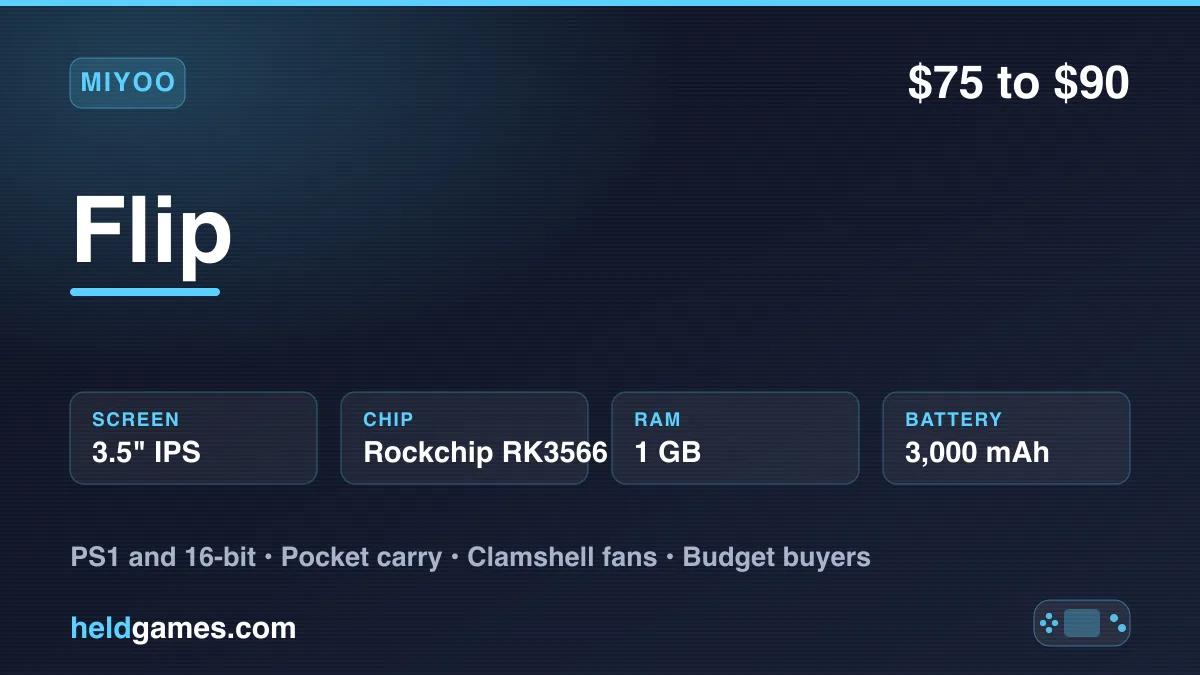
Most budget handhelds are a slab with an exposed screen. You drop them in a bag with your keys and hope. The Miyoo Flip solves that by folding shut, GBA SP style, with the display tucked safely inside.
That is the whole pitch, and it is a good one. What makes the Flip more than a novelty is that the rest of the device holds up. The 3.5 inch 640x480 IPS panel is sharp, the RK3566 is a known and well supported chip, and the 3,000 mAh battery is generous for something this small.
One clarification before anything else. The Miyoo Flip and the Miyoo Mini Flip are different devices. The Flip is the larger one with a 3.5 inch screen and 1 GB of RAM. The Mini Flip is smaller, with a 2.8 inch screen, 128 MB of RAM, and a 2,500 mAh battery. Plenty of listings and articles mix them up. This review is about the Flip.
Specs
| Screen | 3.5 inch IPS, 640x480, 4:3 |
| Processor | Rockchip RK3566 (quad-core Cortex-A55 @ 1.8 GHz) |
| GPU | Mali-G52 2EE |
| RAM | 1 GB LPDDR4 |
| Storage | Dual microSD slots (OS and games separate) |
| Battery | 3,000 mAh |
| OS | Linux |
| Connectivity | 2.4/5 GHz Wi-Fi, Bluetooth 5.2, 3.5mm jack, HDMI out via USB-C adapter |
| Controls | D-pad, face buttons, four shoulder buttons, no analog sticks |
| Design | Clamshell, 84 x 80.4 x 24.5 mm closed, 165 g |
| Street price | Around $75 to $90 |
Affiliate disclosure: This page contains affiliate links. As an Amazon Associate, we earn from qualifying purchases at no extra cost to you. Learn more.
Buy the V2
This is the single most important thing to know before ordering.
The original Miyoo Flip shipped in late 2024 and drew complaints about its hinge. On a clamshell that is the one part you cannot afford to be weak, since it takes every open and close for the life of the device.
Miyoo revised it. The Flip V2, released around March 2025, uses a metal hinge and refreshed internals. That fix addresses the main durability concern with the original.
Listings do not always make the revision obvious. Check the product description for the metal hinge before buying, and be wary of unusually cheap units that may be old V1 stock.
The Clamshell Advantage
Folding matters more in daily use than spec sheets suggest.
An exposed screen on a budget handheld collects scratches. It happens in bags, in pockets, on desks. The Flip closes and the panel faces inward against the button deck, so the glass is protected by default. No case required, no screen protector strictly necessary.
The closed footprint is 84 x 80.4 x 24.5 mm at 165 grams. That is a thick little square that drops into a jacket pocket easily. It is chunkier than a folded GBA SP but it is in the same spirit.
The other benefit is psychological. Closing a clamshell feels like ending a session. Handhelds you can shut tend to get carried more.
Performance
The RK3566 is a familiar budget chip. It also powers the Powkiddy RGB30, so its capabilities are well documented.
- NES, SNES, Genesis, Master System, PC Engine: Perfect, no configuration needed.
- Game Boy, Game Boy Color, GBA: Perfect, and the 4:3 screen suits them beautifully.
- PS1: Excellent across the library. This is the headline capability.
- Arcade (CPS1, CPS2, Neo Geo, most MAME): Very good.
- Nintendo 64: Partial. Lighter titles run acceptably, demanding ones do not.
- Dreamcast: Partial. 2D fighters and lighter games are viable.
- PSP: A handful of simple 2D titles at best. Not a PSP machine.
- Saturn, GameCube, PS2: No.
The 1 GB of RAM is the real constraint alongside the chip. Set your expectations at "everything through PS1, plus some N64 and Dreamcast dabbling" and the Flip will not disappoint you.
No Analog Sticks
The Flip has no analog sticks. For its core library that is entirely fine, since NES through PS1 2D content wants a d-pad and nothing else.
It does mean 3D systems are awkward. N64 without a stick is a compromise no amount of button mapping fully solves, and the same applies to 3D Dreamcast games. Since those systems are only partially playable anyway, the sticks are not the limiting factor. Just do not buy this expecting to play Mario 64 properly.
If you want a budget clamshell with sticks, look at the Anbernic RG34XX SP instead. We compare them directly in our Miyoo Flip vs RG34XX SP breakdown.
The Screen
A 3.5 inch IPS panel at 640x480 in a 4:3 ratio. This is the sweet spot resolution for budget retro handhelds and the reason so many devices use it.
640x480 divides cleanly for a lot of retro sources. GBA at 240x160 scales to exactly 2x with room to spare. NES and SNES land on tidy multiples. You get sharp pixel art without the fuzzy scaling that plagues oddly sized panels.
Colors are good and viewing angles are fine. It is not an AMOLED and it does not pretend to be.
Firmware
The Flip ships with Miyoo's stock Linux firmware, which is serviceable and dull. The device's real potential comes from the custom firmware scene.
KNULLI supports the Flip and is the usual recommendation. It brings a much better interface, broader emulator support, and RetroAchievements integration. Our KNULLI setup guide walks through the process.
The dual microSD slots make this painless. Keep the stock OS on one card and put custom firmware on another. Swapping cards swaps operating systems, and nothing is permanent. This is a genuinely great design decision on a cheap device.
If you are new to any of this, our firmware comparison explains the options in plain terms.
Battery
3,000 mAh in a 165 gram body is generous. With the systems this device is actually good at, meaning 8 bit through PS1, expect long sessions. Real world runtime lands in the region of six to eight hours depending on brightness and system.
Wi-Fi is the biggest drain, and you can leave it off most of the time unless you are using RetroAchievements or transferring files.
Who Should Buy the Miyoo Flip
Buy it if you want a cheap handheld that survives being carried, your library is 8 bit through PS1 and arcade, you like the clamshell form factor, and you want dual microSD slots for painless firmware experimentation.
Skip it if you need analog sticks, you want N64 or Dreamcast properly rather than partially, PSP matters to you, or you can only find V1 stock with the original hinge.
At $75 to $90 the Miyoo Flip is one of the easiest budget recommendations in retro handhelds. It does the thing budget devices normally fail at, which is protecting itself, and it plays the systems most people actually want without complaint.
Frequently Asked Questions
How much does the Miyoo Flip cost?
Typically $75 to $90 depending on the seller and configuration.
What is the difference between the Miyoo Flip and the Miyoo Mini Flip?
They are separate devices. The Miyoo Flip has a 3.5 inch 640x480 screen, 1 GB of RAM, and a 3,000 mAh battery. The Miyoo Mini Flip is smaller, with a 2.8 inch screen, 128 MB of RAM, and a 2,500 mAh battery. The Flip is significantly more capable.
What is the Miyoo Flip V2?
A revision released around March 2025 that replaced the original hinge with a metal one and refreshed the internals. The V1 hinge drew durability complaints, so the V2 is the version to buy.
Can the Miyoo Flip run PS1 games?
Yes, excellently. The Rockchip RK3566 handles the PS1 library comfortably, and it is the device's headline capability.
Can the Miyoo Flip run N64 games?
Partially. Lighter N64 titles are playable, but demanding ones are not, and the lack of analog sticks makes 3D N64 games awkward regardless.
Does the Miyoo Flip support custom firmware?
Yes. KNULLI is the common recommendation. The dual microSD slots let you keep stock firmware on one card and custom firmware on another, so you can switch by swapping cards.
Does the Miyoo Flip have analog sticks?
No. It has a d-pad, face buttons, and four shoulder buttons. For its core 2D library that is fine, but it limits 3D systems.
Related Reading
The Verdict4.3 / 5
The Miyoo Flip nails the thing budget handhelds usually get wrong. It protects its own screen. The clamshell folds shut, the 3.5 inch 640x480 panel stays safe in a bag, and the whole thing weighs 165 grams. Performance lands where the price says it should, which is everything through PS1 plus lighter N64 and Dreamcast. Buy the V2 with the metal hinge, put a good custom firmware on it, and you have one of the most genuinely pleasant cheap handhelds around.
Related reading
 Comparison
 ReviewReview