
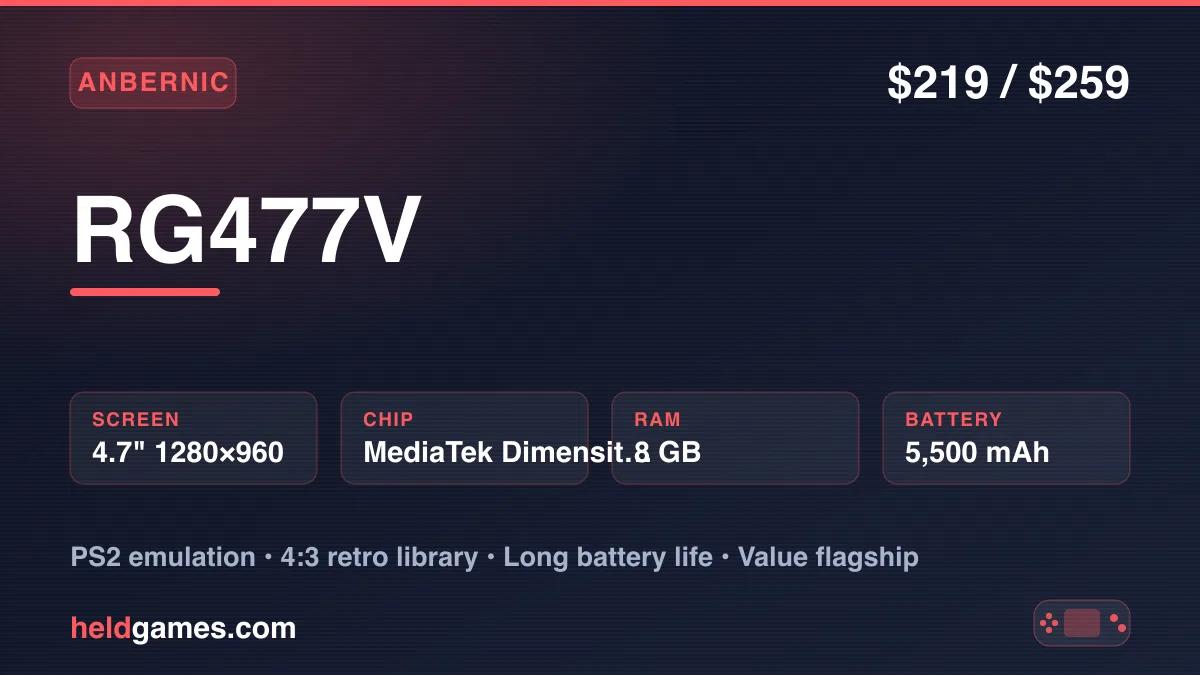
Anbernic's 477 family confused a lot of people this year. There is the RG477M, the CNC aluminum flagship we reviewed in May. Then there is the RG477V, which arrived first, costs less, and is built from plastic. The obvious assumption is that the V is the cut down model.
It is not. The RG477V runs the same MediaTek Dimensity 8300, drives the same 4.7 inch 1280x960 120Hz panel, and carries a considerably bigger battery. What you give up is the metal shell. What you gain is $20 to $30 and roughly a third more runtime.
This review is based on the device's confirmed specifications and published hands on coverage from outlets that spent time with retail units. We have not had one on our own bench.
Specs
| Screen | 4.7 inch, 1280x960, 4:3, 120Hz |
| Processor | MediaTek Dimensity 8300 (4nm octa-core: 4x Cortex-A715 + 4x Cortex-A510) |
| GPU | Mali-G615 MC6 |
| RAM | 8 GB or 12 GB |
| Storage | 128 GB or 256 GB, microSD expansion |
| Battery | 5,500 mAh |
| OS | Android |
| Cooling | Active fan with rear intake |
| Controls | Dual analog sticks, redesigned D-pad, digital microswitch L1/R1/L2/R2 |
| Design | Vertical, Black or Retro Gray |
| Street price | $219 (8/128), $259 (12/256) |
Affiliate disclosure: This page contains affiliate links. As an Amazon Associate, we earn from qualifying purchases at no extra cost to you. Learn more.
Pre-orders opened on December 20, 2025 with a 72 hour early bird window at $199 and $239. Those launch prices are gone. The standing retail prices are $219 and $259.
Why Vertical Works Here
Vertical handhelds ask something of you. Your hands stack underneath the body rather than spreading out, and on a tall device that gets tiring. The RG477V manages it better than most because the 4.7 inch screen sits in a body that is not much taller than it needs to be. Weight lands in the middle of your palms instead of hanging off the bottom.
The shape also suits the library. A vertical device with a 4:3 screen is built for the systems most people actually emulate. NES, SNES, Game Boy, GBA, N64, Saturn, PS1, GameCube, and PS2 all fill the panel edge to edge.
If you want the horizontal experience with grips, Anbernic's own RG557 is the natural alternative in this price bracket.
The Screen
The 4.7 inch panel runs 1280x960 at a true 4:3 ratio with a 120Hz ceiling. This is the same class of display as the RG477M and it is one of the best screens in the category.
The resolution matters more than it sounds. At 1280x960 you get clean integer scaling from a lot of retro sources. SNES at 256x224 scales cleanly. GBA at 240x160 scales cleanly. PS1 output sits comfortably. You are not fighting blurry non integer scaling the way you do on many 720p handhelds.
The 120Hz refresh is real and useful, mostly for Android native games and for emulators that can push past 60fps on lighter systems.
Now the trade off. This is a 4:3 screen, so 16:9 content letterboxes. PSP is the painful one. PSP output is 480x272, a wide format, and on this panel it lands with substantial black bars top and bottom. If PSP is the bulk of your library, buy a 16:9 device instead. The Retroid Pocket 6 or the Anbernic RG556 both make more sense for that.
Emulation Performance
The Dimensity 8300 is a genuine flagship class chip and it puts the RG477V near the top of the Android handheld ladder.
- NES through PS1: Flawless. No thought required.
- N64 and Dreamcast: Full speed across the library.
- PSP: Runs great, but see the letterboxing note above.
- GameCube: Strong. Most of the library plays well through Dolphin standalone, with the heavier titles wanting per game tweaks.
- PS2: Comfortable, including upscaling. This is the tier where the fan earns its place.
- Switch: Mixed. Many titles run, but this is where the GPU drivers bite.
That last point deserves its own section, because it is the honest ceiling on this device.
The Mali Driver Problem
The Dimensity 8300 uses a Mali-G615 MC6 GPU. Mali GPUs have thinner driver support in the emulation world than Qualcomm's Adreno parts do. Snapdragon devices benefit from mature Vulkan drivers and from the Turnip open source driver work, and a lot of emulator optimization gets aimed at them first.
In practice this shows up in two places. Switch emulation sees graphical glitches in some titles that run clean on Snapdragon hardware. Windows on ARM translation layers like Winlator are noticeably less viable than on an Adreno device.
If Switch and PC games are your priority, a Snapdragon device is the better tool. The AYN Odin 3 and the Retroid Pocket 6 both sidestep this. For everything up through PS2, the Mali issue is close to irrelevant.
The Trigger Problem
This is the one design decision that reviewers keep returning to, and it is worth taking seriously.
The shoulder triggers sit far toward the outer edges of the body. Reach for the analog sticks, which are inset toward the center, and your index fingers end up stretched outward to find L and R. For d-pad games it is fine. For anything that uses sticks and triggers together, which is most 3D content from N64 forward, it never quite stops being awkward.
Anbernic did fix the D-pad, which is genuinely better than previous models. The triggers are the miss. Whether this is a dealbreaker depends entirely on your library. A shmup and JRPG player may never notice. A GameCube and PS2 player will.
Battery
The 5,500 mAh cell is the RG477V's quiet advantage. It is meaningfully larger than what fits inside the metal RG477M, and it is one of the largest batteries in a handheld this size.
Real runtime depends on what you are doing. Light 8 bit and 16 bit emulation at low brightness stretches a long way. Sustained PS2 or GameCube with the fan running pulls hard. Treat it as a device you charge every couple of days with mixed use, rather than nightly.
Software
The RG477V ships with Android and full Google Play access, so you install whatever emulators you want. Anbernic preloads a reasonable set with working mappings, which means it is playable out of the box.
The stock Anbernic launcher is still the weak spot. It works and it is dull. Swapping in Daijishō or ES-DE transforms the feel of the device for about twenty minutes of setup. Anbernic pushed an RG Home launcher update in June 2026 that improves things somewhat, and the same update reached the RG477M.
RG477V vs RG477M
This is the comparison that matters most, because these two devices are far closer than the price gap suggests.
| RG477V | RG477M | |
|---|---|---|
| Chassis | Plastic | CNC aluminum |
| SoC | Dimensity 8300 | Dimensity 8300 |
| Display | 4.7 inch 1280x960 120Hz | 4.7 inch 1280x960 120Hz LTPS |
| Battery | 5,500 mAh | Smaller, not officially listed |
| Cooling | Active fan | Active fan |
| Sticks | Dual analog | Hall effect with RGB |
| Street price | $219 / $259 | $239.99 / $289.99 |
Same brain, same eyes, different body. The RG477M gives you the metal shell, Hall effect sticks, and RGB lighting. The RG477V gives you a bigger battery and keeps $20 to $30 in your pocket.
Hall effect sticks are the strongest argument for the M, since they do not develop drift. If that matters to you, pay up. Otherwise the V is the better value, and we walk through it fully in our RG477V vs RG477M comparison.
Who Should Buy the RG477V
Buy it if you want flagship Android emulation without flagship pricing, your library runs heavy on 4:3 systems through PS2, you value battery life, and you can live with reaching for the triggers.
Skip it if PSP or 16:9 content dominates your library, you want the best possible Switch and PC emulation and should be looking at Snapdragon instead, you need Hall effect sticks, or you play a lot of stick plus trigger 3D games where the ergonomics will grate.
For most people shopping the $200 to $250 Android bracket in 2026, the RG477V is the sensible pick. It gets you flagship silicon, one of the best screens in the class, and the biggest battery around, and it asks you to accept a plastic shell and some awkward triggers in exchange.
Frequently Asked Questions
How much does the Anbernic RG477V cost?
$219 for 8 GB RAM and 128 GB storage, or $259 for 12 GB and 256 GB. A 72 hour early bird window at launch offered $199 and $239, but those prices have ended.
Is the RG477V better than the RG477M?
They share the same Dimensity 8300 chip and the same 4.7 inch 1280x960 120Hz screen. The RG477V has a bigger 5,500 mAh battery and costs less. The RG477M has a CNC aluminum body and Hall effect sticks. For most buyers the RG477V is the better value.
Can the Anbernic RG477V run PS2 games?
Yes, comfortably, including upscaling past native resolution. The Dimensity 8300 and the active cooling fan handle PS2 well.
Can the RG477V emulate Switch games?
Many titles run, but results vary. The Mali-G615 GPU has weaker emulator driver support than Qualcomm Adreno GPUs, which causes graphical glitches in some Switch titles. Treat Switch as a bonus rather than a reason to buy.
Does the RG477V have a fan?
Yes. It uses active cooling with a rear intake, which is what lets it sustain PS2 and GameCube performance without throttling.
How is PSP on the RG477V?
Performance is excellent but the 4:3 screen letterboxes PSP's widescreen output with large black bars. If PSP is your main system, a 16:9 handheld is a better match.
Related Reading
The Verdict4.5 / 5
The RG477V is the smart money in Anbernic's 477 family. It runs the same Dimensity 8300 and the same excellent 4:3 120Hz panel as the metal RG477M, adds a much larger 5,500 mAh battery, and costs less at every configuration. PS2 and GameCube are comfortable, and the fan keeps it that way. The trigger placement is a real ergonomic miss and Mali drivers still cap what Switch emulation can do. Neither is enough to spoil it. If you want one Android handheld for a retro heavy library, this is the one to buy.
Related reading
 Comparison
 ReviewReview