
The Anbernic RG 55G1 is the first Anbernic handheld built around a Qualcomm Snapdragon chip, and it went on sale on August 31, 2026 from $139.99. That first part is genuinely notable. Anbernic has spent years on Rockchip, Allwinner, Unisoc and MediaTek silicon, and Qualcomm's Android driver support is the single biggest reason the Retroid and AYN devices have historically had a smoother emulation story.
This is a launch-coverage review. We have not had a retail unit on our own bench, and everything below is drawn from the published specification, Anbernic's own store listing, and hands-on testing from Retro Handhelds, Joey's Retro Handhelds and Gardiner Bryant. Where those sources disagree we say so. We will revise this once we have spent time with one.
The short version: the chip choice was right and the execution around it is uneven.
A Correction, Up Front
In our July preview of this device we stated that the RG 55G1 used a Snapdragon 4 Gen 2 (SM4450), based on a Geekbench listing, and we specifically pushed back on outlets guessing that the "G1" in the name pointed to a Snapdragon G-series part.
That was wrong, and the outlets were right. Anbernic's own store listing confirms the shipping device uses a Qualcomm Snapdragon G1 Gen 2 (SG4250P), a 4 nm part with two Kryo Gold cores at 2.4 GHz, six Kryo Silver cores at 2.0 GHz, and an Adreno A12 GPU.
The pre-release Geekbench entry we relied on either came from a prototype or was misattributed. The practical conclusion in that preview, that this is an entry-tier chip rather than a flagship, held up. The specific part name did not, and we had corrected the wrong outlets by name. Our mistake.
Specs
| Spec | Detail |
|---|---|
| Chip | Qualcomm Snapdragon G1 Gen 2 (SG4250P), 4 nm, 2x Kryo Gold @ 2.4 GHz + 6x Kryo Silver @ 2.0 GHz |
| GPU | Adreno A12 |
| RAM | 4 GB or 8 GB |
| Storage | 64 GB or 128 GB, plus microSD up to 2 TB |
| Screen | 5.5 inch Incell IPS, 1920x1080, OCA full lamination, multi-touch |
| Battery | 6,000 mAh, around 8 hours claimed |
| OS | Android 14 |
| Cooling | Active fan |
| Sticks | Hall effect, with RGB ring lights and removable caps |
| Triggers | Hall effect |
| Audio | Dual front-facing speakers, 3.5 mm jack |
| Weight | 339 g |
| Dimensions | 208 x 86 x 17 mm |
| Colors | Black, Retro Gray, Indigo |
| Street price | $139.99 (4 GB / 64 GB), $174.99 (8 GB / 128 GB) |
| Released | August 31, 2026 |
The Snapdragon Question
The reason to care about this device is the chip, so let us be precise about what changed and what did not.
Qualcomm's advantage in this space has never been raw benchmark numbers. It is drivers. Adreno GPUs have mature, well-tested Vulkan support, and emulator developers target them first because most Android handhelds use them. Mali and PowerVR parts in Anbernic's older devices frequently hit graphical glitches in tricky emulators that Adreno hardware simply did not have.
The RG 55G1 gets that benefit. What it does not get is power. The Snapdragon G1 Gen 2 has two performance cores and six efficiency cores, with no Prime core at all, and it is widely understood to derive from Qualcomm's 6-series mobile parts. It is an entry-tier gaming chip, and it is not close to the Snapdragon 8 Gen 2 class silicon in the Retroid Pocket 6 or the AYN Odin 3.
So the honest framing is that this is Anbernic buying better software compatibility at a modest performance tier, not Anbernic entering the flagship conversation.
Emulation Performance
Hands-on coverage lines up closely on where the ceiling sits.
Excellent: everything through PSP, Dreamcast, N64 and Saturn. Reviewers consistently describe these as looking great upscaled on the 1080p panel, which is exactly what you would hope for. 3DS is viable too.
Mixed: GameCube. Lighter titles run well, with Mario Power Tennis specifically called out as running nicely under Dolphin with OpenGL. Demanding games do not hold up, and The Legend of Zelda: The Wind Waker was reported slowing down.
Not reliable: PS2. One reviewer described it as "very hit or miss" and explicitly said they would not recommend the RG 55G1 as a PS2 handheld, with Burnout Revenge struggling badly at default settings. Another found PS2 and GameCube capped around 1.5x native before stuttering appears.
There is an irony in that last point worth naming. The RG 55G1 has a 1080p screen and a chip that cannot feed it for the harder systems. Running PS2 at 1.5x on a 1920x1080 panel means the image gets scaled up and looks soft, so the nicest thing on the spec sheet works against the hardest thing you might ask it to do. Our best handhelds for PS2 emulation guide covers what the real floor for PS2 looks like, and this sits below it.
The Screen, and the Problem With It
The panel is a 5.5 inch 1920x1080 Incell IPS with full OCA lamination. On paper and in stills it is very good. Reviewers describe it as extremely bright, crisp at 1080p, with blacks that look genuinely deep for an IPS.
In motion it is a different story. Multiple hands-on reports flag significant ghosting, with one reviewer describing it as among the more noticeable examples they have seen recently, possibly worse than the AYANEO Pocket Air Mini, and bad enough to cause motion discomfort during extended play.
This is the single most important thing to know before you buy. Ghosting is a pixel response problem and no firmware update fixes it. It is most visible in fast horizontal scrolling, which is to say platformers, shoot-em-ups and racing games, a large share of what a retro handheld exists to play.
We have flagged this as reported rather than measured because we have not tested a unit, and panel quality can vary between production batches. But it has come up in more than one independent hands-on, which is usually a reliable signal.
Build and Controls
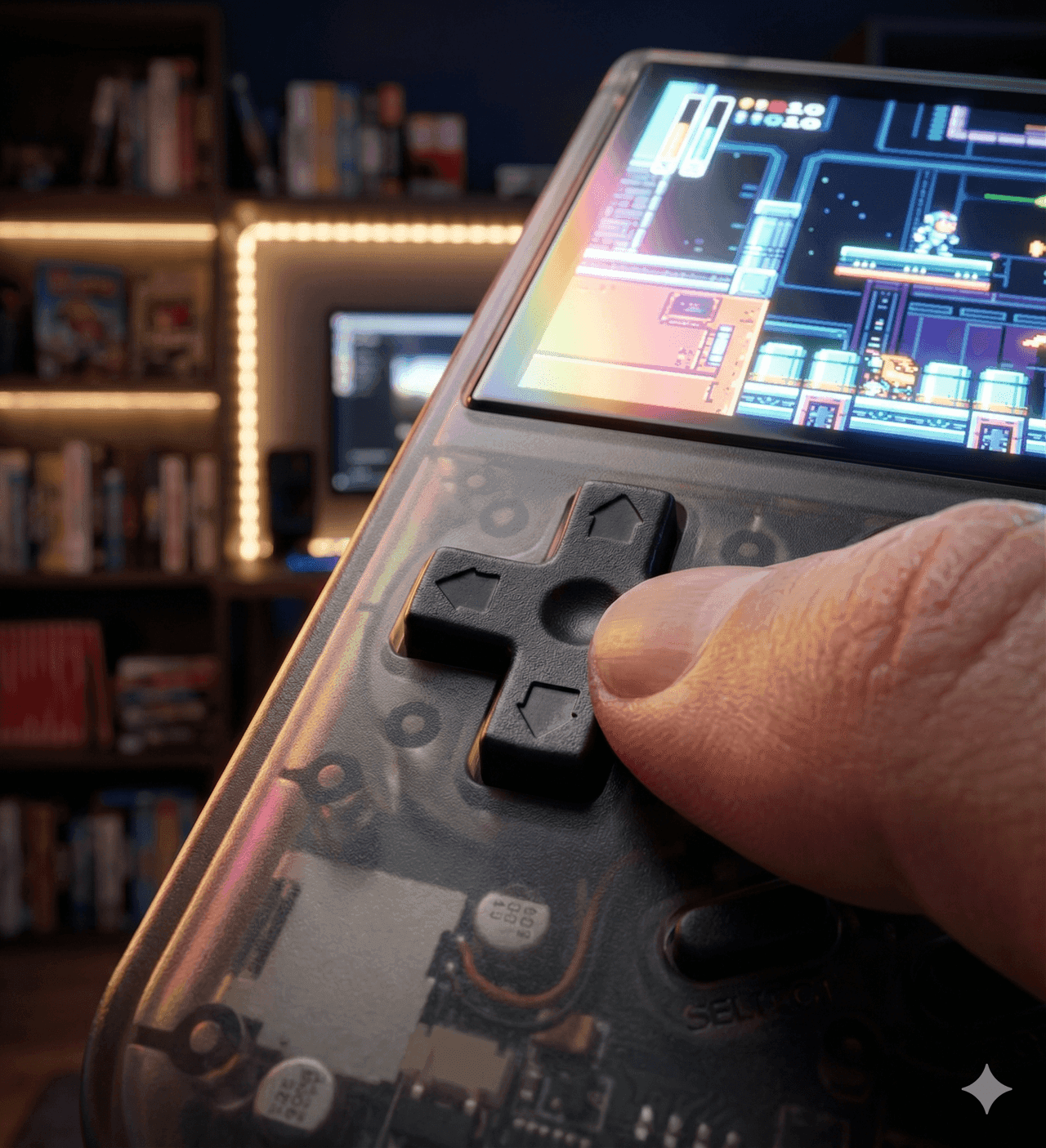
The body is a Switch Lite-style horizontal shell at 339 g, which reviewers found substantial and comfortable, with good width and rounding. The back is close to flat with minimal contouring, which is a preference thing rather than a flaw.
Controls are genuinely mixed:
- D-pad: good, no complaints
- Face buttons: normal travel and resistance, fine
- L1 and R1: clicky and satisfying
- Triggers: require far too much force, and become tiring over long sessions
- Analog sticks: small, slippery caps with awkward natural thumb placement, though the caps are removable and Hall effect sensors mean no drift
The Hall effect sticks and triggers are the right call and are becoming standard at this price. The complaint is about the caps and the trigger springs, not the sensors.
Software
The most interesting new thing here is not the chip. It is Anbernic's new handheld settings interface, which reviewers singled out as the most notable software addition the company has made in a while. It bundles EQ presets, performance profiles, fan control and per-game options into one place.
Anbernic's stock launcher has been a weak point for years, and third-party frontends have been the standard advice. This interface does not replace the launcher, but it does mean the device-level tuning you actually want is no longer buried. Preloaded content remains sloppy, with poorly named ROM files and a lazy bundled game selection, which is normal for the category and normal to ignore.
The device runs Android 14, so ES-DE, RetroArch and the standalone emulators all work as expected.
RG 55G1 vs Anbernic RG476H
This is the comparison that decides the review, because it is the one reviewers keep reaching for.
The RG476H sits at roughly $10 more than the RG 55G1's regular price. Buying advice from hands-on coverage was blunt: get the RG476H instead, or do not buy anything.
The RG 55G1's argument against it is Snapdragon drivers, a bigger 1080p screen and a 6,000 mAh battery. That is a real argument. It is undermined by the ghosting, because a bigger, sharper screen that smears in motion is not obviously better than a smaller, cleaner one.
RG 55G1 vs Retroid Pocket 5
If your budget can stretch, the Retroid Pocket 5 is the more sensible purchase for anyone who wants PS2 to work. The Snapdragon 865 is a substantially stronger chip, PS2 runs properly rather than intermittently, and the AMOLED panel does not have this problem. It costs meaningfully more, and it is the device the RG 55G1 quietly points you toward if your ambitions include the sixth generation.
Battery Life
The 6,000 mAh cell is the largest thing Anbernic has put in a device of this size, and the 8 hour claim is plausible for light 2D and handheld-era content at moderate brightness. Expect that to fall sharply once you are pushing Dreamcast and PSP with the fan running and the screen bright. We do not have measured figures and will add them when we test a unit.
Who Should Buy the RG 55G1
Buy it if your library tops out at PSP, Dreamcast, N64 and Saturn, you want Snapdragon driver support on an Anbernic for the first time, and a large battery matters to you. In that lane it does the job well.
Buy the RG476H instead if you want the most sensible Anbernic at this price and you are not specifically chasing the Snapdragon chip.
Buy the Retroid Pocket 5 instead if PS2 matters. It is not close.
Skip it entirely if you are sensitive to display ghosting or you play a lot of fast horizontal scrolling games. This is the one issue here that no amount of tinkering resolves.
Our overall read: the RG 55G1 is a more interesting device than it is a good one. Anbernic moving to Snapdragon is the right long-term direction and we would like to see it continue with a stronger chip and a better panel. This particular execution is let down by the screen and the triggers, and it lands in a price bracket where its own sibling is the easier recommendation.
Frequently Asked Questions
What chip does the Anbernic RG 55G1 use?
A Qualcomm Snapdragon G1 Gen 2, part number SG4250P. It is a 4 nm chip with two Kryo Gold cores at 2.4 GHz, six Kryo Silver cores at 2.0 GHz, and an Adreno A12 GPU. Pre-release reporting, including our own preview, incorrectly identified it as a Snapdragon 4 Gen 2 based on a Geekbench listing.
How much does the Anbernic RG 55G1 cost?
It launched on August 31, 2026 at $139.99 as a promotional price against a $149.99 regular price for the 4 GB / 64 GB model. The 8 GB / 128 GB configuration is $174.99. Bundles with microSD cards cost more.
Can the RG 55G1 run PS2 games?
Not reliably. Hands-on reviewers describe PS2 as hit or miss, with demanding titles like Burnout Revenge struggling at default settings, and performance capping around 1.5x native resolution. One reviewer explicitly recommended against buying it as a PS2 handheld.
What can the RG 55G1 emulate well?
Everything through PSP, Dreamcast, N64 and Saturn runs excellently, and 3DS is viable. GameCube is mixed, with lighter titles fine and demanding ones like Wind Waker slowing down.
Does the RG 55G1 screen really have ghosting?
Multiple independent hands-on reviews report significant ghosting, with one describing it as among the worst they have seen recently and bad enough to cause motion discomfort. Ghosting is a pixel response issue that firmware cannot fix. It is most visible in fast horizontal scrolling games.
Is the RG 55G1 better than the Anbernic RG476H?
For most buyers, no. The RG476H costs roughly $10 more and hands-on coverage recommended it over the RG 55G1. The RG 55G1's advantages are the Snapdragon chip's driver support, the larger 1080p screen and the 6,000 mAh battery, but the screen ghosting undercuts the display advantage.
Does the RG 55G1 have Hall effect sticks?
Yes, both the analog sticks and the triggers use Hall effect sensors, so they will not develop drift. The complaints are about the physical caps being small and slippery and the triggers requiring too much force, not the sensors themselves.
What is new in Anbernic's software on this device?
The RG 55G1 introduces a new handheld settings interface bundling EQ presets, performance profiles, fan control and per-game options. Reviewers called it the most interesting software addition Anbernic has made recently. The stock launcher is otherwise unchanged, so a third-party frontend is still worth installing.
Related Reading
The Verdict3.6 / 5
The RG 55G1 is a genuinely interesting move from Anbernic and an awkward product. The Snapdragon G1 Gen 2 is a real upgrade in driver support and it flies through PSP, Dreamcast, N64 and 3DS, but it is an entry-tier chip in a device with a 1080p screen, so PS2 and GameCube end up capped and muddy. Add the ghosting that every hands-on reviewer has flagged and the overly stiff triggers, and it is hard to recommend at $150 when the RG476H sits right beside it. Buy it if PSP and Dreamcast are your ceiling and you want Snapdragon drivers on an Anbernic. Look elsewhere if you want PS2.
Related reading
 ReviewReviewReview