
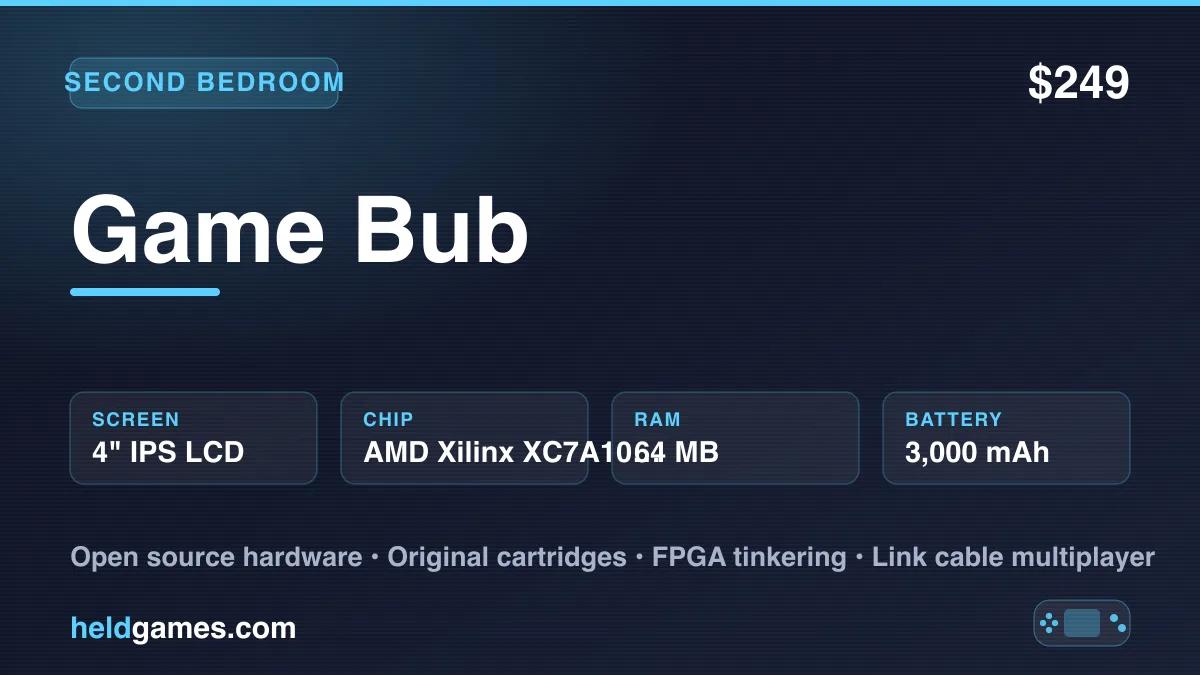
The Game Bub is not trying to be a mainstream product. It is the first fully open source FPGA retro handheld, built by Second Bedroom and funded through Crowd Supply. Every part of it is public. The circuit board, the firmware, and the custom FPGA cores are all out in the open for anyone to read, build on, or repair. In a hobby full of closed hardware, that is a rare and exciting thing.
It also plays your real cartridges. Slot an original Game Boy, Game Boy Color, or Game Boy Advance game into the top and it runs on FPGA hardware, not software emulation. That means accuracy and low latency that track the original systems closely. This review is based on the device's confirmed specifications and the developer's extensive public documentation, gathered as the first units began shipping in 2026.
For the bigger picture on why FPGA matters, read our FPGA vs emulation explainer.
What FPGA Means Here
A quick primer. An FPGA is a chip you can configure to behave like other hardware at the circuit level. The Game Bub uses one to recreate the original Game Boy family hardware. It is not running an emulator. It is behaving like the real thing.
The Game Bub's cores are custom, developed over roughly three years to deliver highly accurate Game Boy, Game Boy Color, and Game Boy Advance behavior. The practical wins are accuracy and responsiveness. Timing quirks, audio, and input latency all aim to match the original hardware. For purists, that is the entire appeal.
Specs
| Display | 4 inch IPS LCD, 720x480 |
| FPGA | AMD Xilinx XC7A100T (Artix 7), around 101,400 logic cells |
| Memory | 64 MB SDRAM, 512 KiB SRAM, block RAM on the FPGA |
| Native carts | Game Boy, Game Boy Color, Game Boy Advance |
| Multiplayer | Link cable support with other Game Bubs and original handhelds |
| Extras | Rumble, accelerometer, gyroscope, real time clock |
| Battery | 3,000 mAh, around 14 hours estimated |
| Connectivity | USB-C, Bluetooth, microSD |
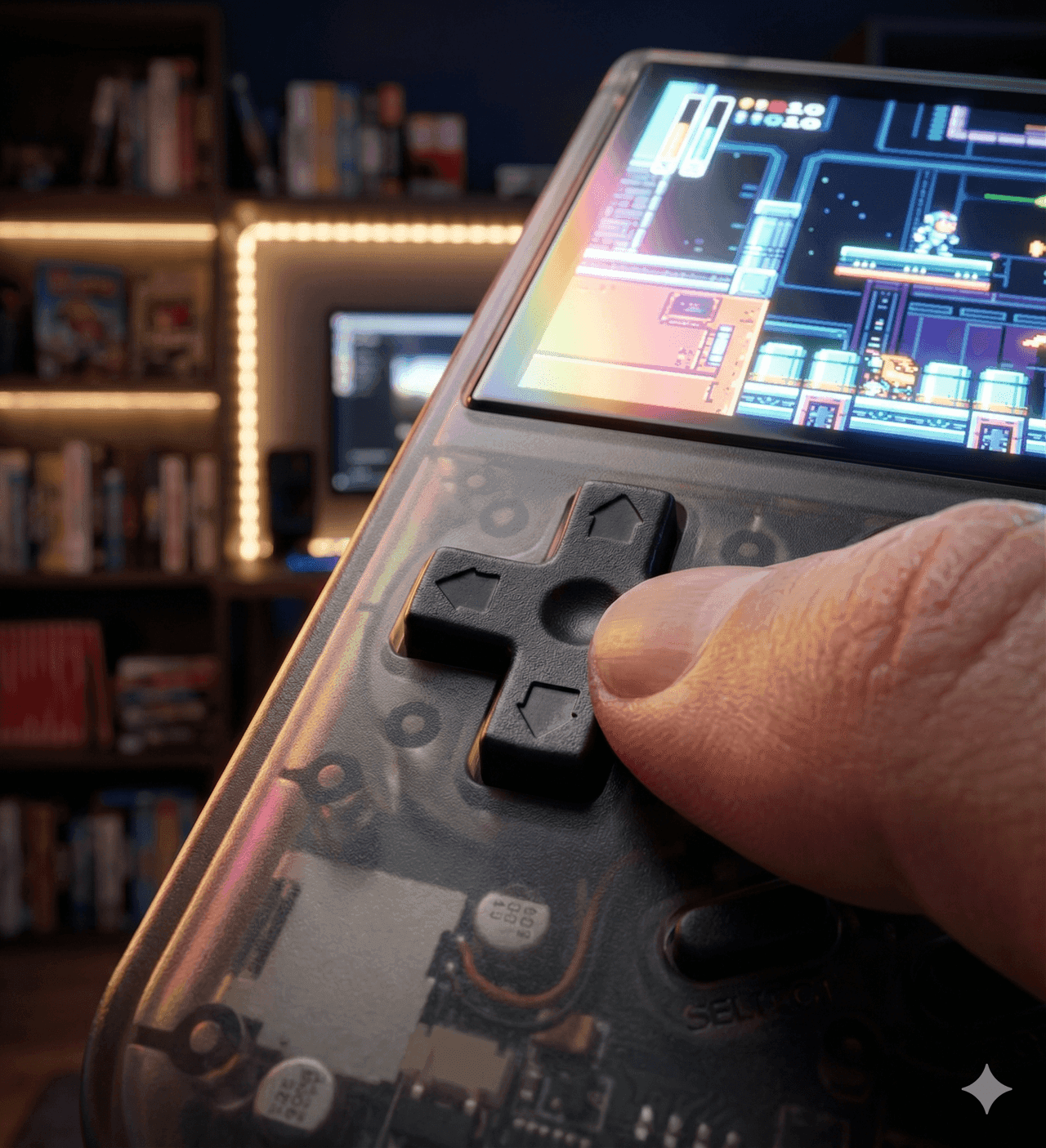
| Enclosure | Transparent, with a limited purple edition |
| Street price | Around $249, purple edition around $299 |
| Sold by | Crowd Supply (Second Bedroom) |
The Game Bub is sold through Crowd Supply, not Amazon. That link is a plain reference, not an affiliate link.
Cartridge Support
Out of the box the Game Bub plays Game Boy, Game Boy Color, and Game Boy Advance cartridges. Slot your real game into the top slot and play. Saves work, and cartridge features like rumble and the built in sensors on motion enabled games are supported through the hardware.
This is the core use case and it is the point of the device. The Game Bub is a Game Boy family machine first. It is not a do everything emulation handheld, and it does not pretend to be. If your goal is to play your original carts on accurate hardware, that focus is a feature.
Open Source Is the Real Story
Plenty of handhelds play Game Boy games. What makes the Game Bub different is that the whole thing is open. The hardware design, the firmware, and the FPGA cores are all published. You can study how it works, fix it if something breaks, flash your own builds, or extend it.
That openness has a second life too. The Game Bub is built on an AMD Artix 7 FPGA, so it can double as a self contained FPGA development platform. For a certain kind of buyer, that is a huge draw. It is a Game Boy you can play and a piece of hardware you can learn from.
To be clear about the rules. FPGA cores are hardware recreations. For any system that uses game files, you supply your own files from games you legally own. We only ever cover playing games you own and game preservation. We do not link to or discuss ROM download sites.
Multiplayer and Sensors
The Game Bub supports the classic link cable, so you can connect it to another Game Bub or to an original Nintendo handheld for multiplayer. Trading and battling across real hardware is exactly the kind of detail that separates an accurate device from a casual one.
It also includes rumble, an accelerometer, a gyroscope, and a real time clock. Those matter for the specific cartridges that used them, from motion controlled games to titles that track the in game clock. Supporting them at the hardware level is a thoughtful touch.
Battery and Connectivity
A 3,000 mAh battery gives an estimated 14 hours or so of play, which is strong for a device this size. USB-C handles charging. There is Bluetooth on board and a microSD slot for expansion. It is a modern feature set wrapped around a faithful retro core.
Who Makes It and Where to Buy
The Game Bub comes from Second Bedroom, a small independent effort led by developer Eli Lipsitz. It was funded on Crowd Supply and, as of 2026, units have left the factory and started shipping, with a limited number still available to order. It is sold through Crowd Supply rather than Amazon or normal retail, so buying one means going through that crowdfunding storefront.
That distribution is worth knowing up front. This is a grassroots enthusiast product. Support, stock, and updates run through a community rather than a large company.
Who Should Buy the Game Bub
Buy the Game Bub if you love open source hardware and want a Game Boy you can fully own, repair, and modify; you own original Game Boy, Color, or Advance cartridges and want accurate FPGA play; you want link cable multiplayer with real hardware; you are a developer or tinkerer who values the Artix 7 platform underneath.
Skip the Game Bub if you want a polished mainstream product with easy retail support (the Analogue Pocket is the smoother buy); you want one device that emulates many systems up to PS2 (look at the Retroid Pocket 6); you want the sharpest possible Game Boy screen, where the Pocket's very high resolution panel still leads.
The natural rival is the Analogue Pocket, which costs about the same and targets a similar collector. We break the two down directly in Game Bub vs Analogue Pocket.
Frequently Asked Questions
Is the Game Bub an emulator?
No. It uses an FPGA, which is hardware configured to behave like the original Game Boy family. It plays your real cartridges. That is the main reason it is accurate.
What cartridges does the Game Bub play?
Game Boy, Game Boy Color, and Game Boy Advance cartridges natively. It also supports the link cable for multiplayer with other units and original handhelds.
How much does the Game Bub cost and where do I buy it?
It is around $249 for the transparent model, with a limited purple edition near $299. It is sold through Crowd Supply, not Amazon or standard retail.
Is the Game Bub really open source?
Yes. The hardware design, firmware, and FPGA cores are all published. You can study, build on, repair, or extend the device, and it doubles as an AMD Artix 7 FPGA development platform.
Game Bub or Analogue Pocket?
The Game Bub is the open source choice for tinkerers and developers. The Analogue Pocket is the more polished, higher resolution, retail friendly pick. See the full comparison.
Related Reading
- Analogue Pocket Review
- Game Bub vs Analogue Pocket
- Best FPGA Handhelds 2026
- FPGA vs Emulation Explained
- ModRetro Chromatic Review
- Best Game Boy Advance Games
Affiliate disclosure: This review contains affiliate links to comparable products. The Game Bub itself is sold on Crowd Supply and is not an affiliate link. As an Amazon Associate, we earn from qualifying purchases at no extra cost to you. Learn more.
The Verdict4.3 / 5
The Game Bub is the first fully open source FPGA retro handheld, and that alone makes it special. It plays your real Game Boy, Game Boy Color, and Game Boy Advance cartridges with FPGA accuracy, adds link cable multiplayer and motion sensors, and puts the entire design in the open for anyone to study, repair, or extend. At around $249 on Crowd Supply it sits right next to the Analogue Pocket in price while aiming at a different buyer. This is a device for tinkerers, developers, and open hardware fans who want a Game Boy they can truly own. If you just want the best looking Game Boy screen, the Pocket still wins. If you want the most open one, the Game Bub is unmatched.
Related reading
 ReviewReview
 Comparison