
Affiliate disclosure: This review contains affiliate links. As an Amazon Associate, we earn from qualifying purchases at no extra cost to you. Learn more.
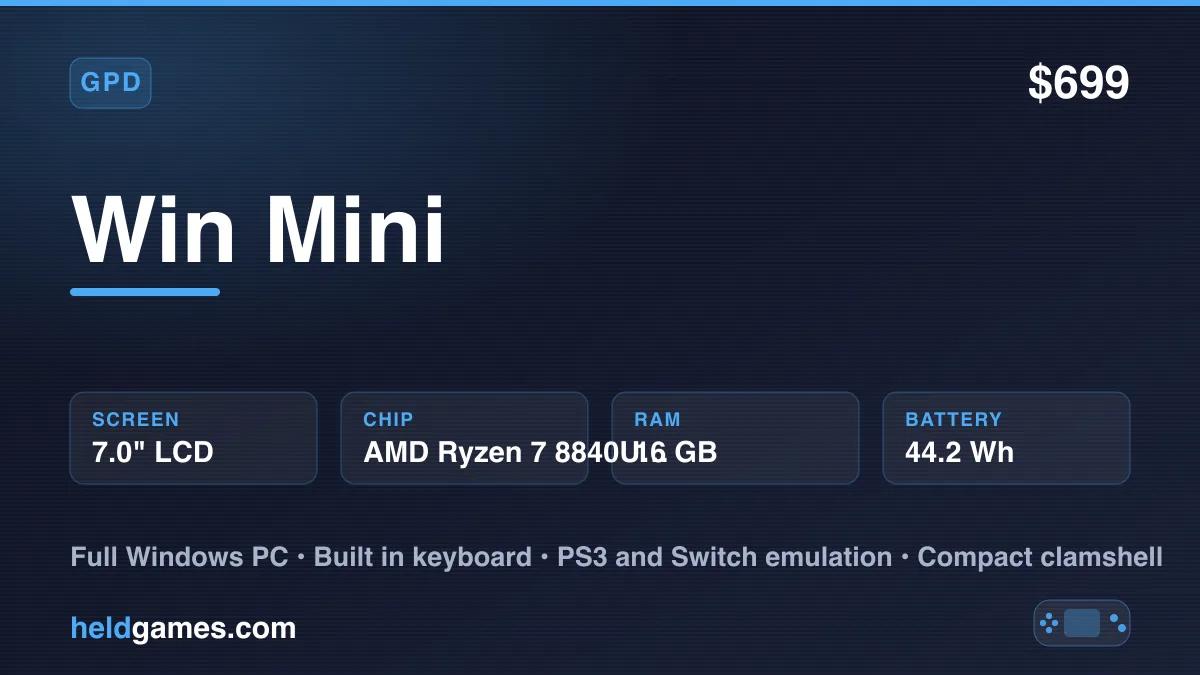
The GPD Win Mini is a Windows handheld shaped like a tiny laptop. It folds open to reveal a 7 inch screen and a full keyboard built into the base. Pair that with a fast AMD chip and full Windows 11, and you get a device that is both a capable PC and a powerful gaming and emulation handheld.
✓ Pros
- • Clamshell design with a real built in keyboard
- • Fast AMD Ryzen performance, strong for games and emulation
- • 7 inch 1080p screen with a high refresh rate
- • Full Windows 11 runs any launcher, emulator, and app
- • Emulates demanding systems through PS3 and Switch with the right software
- • Folds shut to protect the screen and keyboard
✗ Cons
- • Expensive, especially with the newest chip
- • Windows handhelds require setup and tinkering
- • Battery drains fast under heavy load
- • Keyboard is cramped for serious typing
Build and Design
The Win Mini's clamshell shape is its defining feature. It folds open like a miniature laptop, with the screen on top and a full QWERTY keyboard and game controls on the base. Folding shut protects both the screen and the keyboard, which makes it easy to toss in a bag.
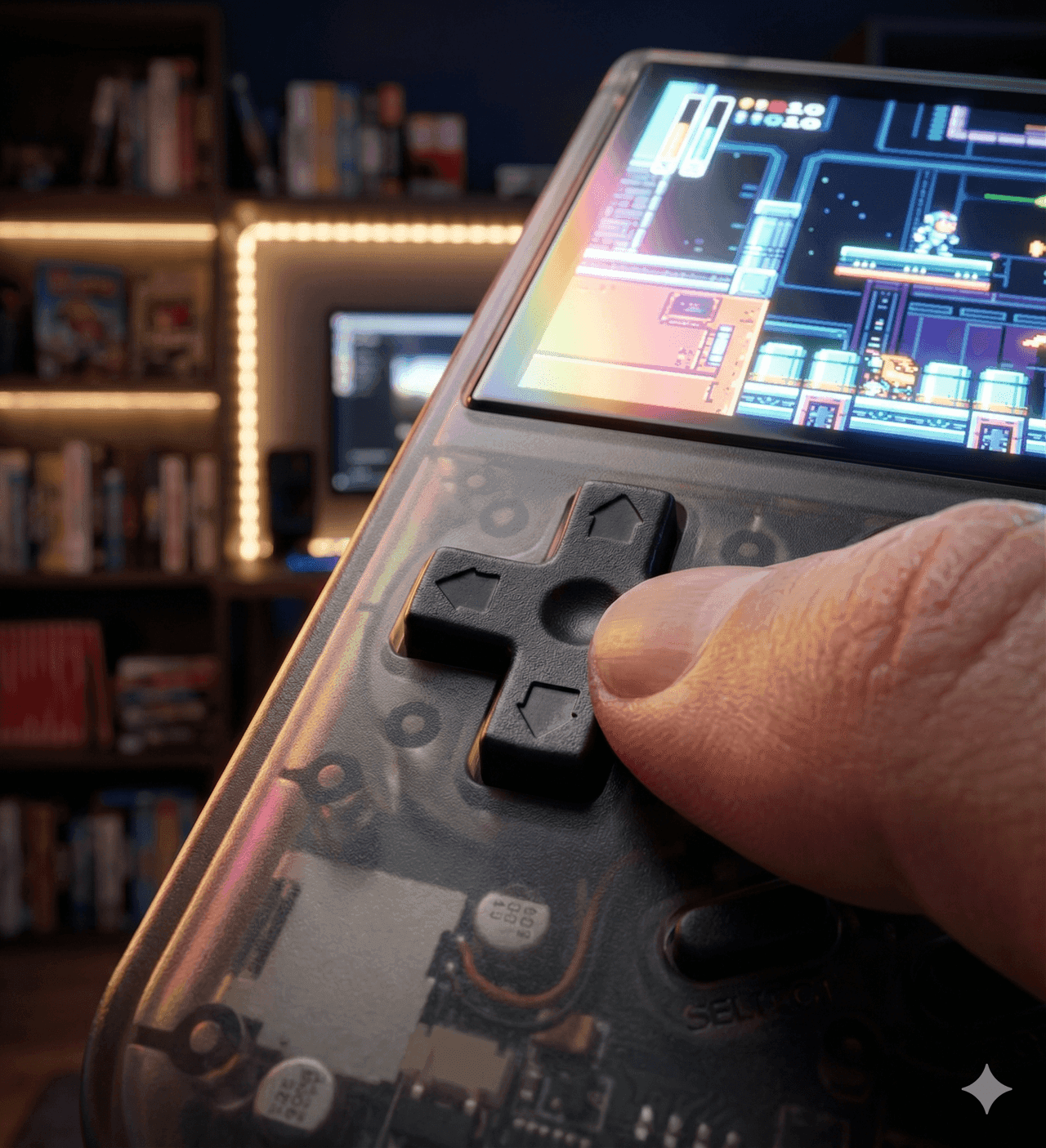
The controls include analog sticks, a D-pad, face buttons, and shoulder triggers, arranged around the keyboard. The build is dense and premium. It is a clever design that makes the Win Mini feel like a true pocket computer.
Which Model to Buy
This is the most consequential decision with the Win Mini, because GPD sells two generations side by side and they perform very differently.
- The Ryzen 7 8840U model with Radeon 780M graphics is the older, cheaper configuration. It handles everything through PS2 and GameCube comfortably and is a solid value.
- The 2025 refresh uses the Ryzen AI 9 HX 370 with Radeon 890M graphics, 12 cores and 24 threads reaching around 5.1 GHz. The 890M is RDNA 3.5 and a substantial step up, especially for PS3, Switch, and modern PC games.
Both share the same 7 inch 1080p LTPS screen and clamshell chassis, with configurations up to 32 GB of LPDDR5X and 2 TB of storage.
Pricing reflects that spread. Lower configurations of the older chip start near $699, while a 2025 model with 32 GB and 2 TB runs around $1,669. The two generations are visually identical, so read listings carefully.
If the newest chip is within budget, take it. The Win Mini's small chassis is more thermally limited than a larger handheld, and the more efficient chip does more with the power headroom it has.
Display
The Win Mini uses a 7 inch LTPS panel at 1920x1080 with a 120Hz refresh rate. It is sharp and smooth, and the size strikes a good balance between visibility and portability. The high resolution benefits both modern PC games and upscaled emulation.
The 120Hz refresh is more useful than it first appears. Very few modern PC games will hit 120fps on integrated graphics, but plenty of emulated content will. Retro systems running at high frame rates, lighter indie titles, and the Windows desktop itself all feel noticeably smoother. It also gives you headroom to run at 90fps or 100fps rather than being locked to 60.
As with any 1080p handheld, rendering modern games at 720p or 900p and letting the panel scale is often the smarter choice. It frees up a lot of performance for very little visible loss at this screen size.
Technical Specifications
| Screen | 7.0 inch LCD, 1920x1080, 120Hz |
| Processor | AMD Ryzen 7 8840U or Ryzen AI 9 HX 370 (model dependent) |
| GPU | AMD Radeon (780M or 890M, chip dependent) |
| RAM | 16GB to 64GB LPDDR5X (config dependent) |
| Storage | NVMe SSD (M.2) + microSD |
| Battery | around 44Wh |
| OS | Windows 11 |
| Special | Clamshell with built in keyboard |
Performance and Emulation
Because the Win Mini runs full Windows on a fast AMD chip, its emulation ceiling is very high. The exact results depend on the model and the emulator, but the range is excellent.
- Everything up to PS2 and GameCube: Excellent, often upscaled far beyond original output.
- Wii: Excellent.
- PSP and Dreamcast: Perfect.
- PS3: Playable on many titles with the right emulator and settings.
- Switch: Playable on many titles with tuning, and stronger on the newest chip.
- Wii U: Playable on many titles.
For modern PC games, the newer Ryzen AI 9 HX 370 model is notably faster than the 8840U version and handles demanding titles better. Frame your library around games you already own.
Windows and Setup
Like all Windows handhelds, the Win Mini trades simplicity for flexibility. You get every launcher and emulator, plus full desktop software. In return, you do the setup. Installing emulators, tuning power profiles, and configuring controls takes time. Tools like Handheld Companion smooth the experience. Once dialed in, the Win Mini is a remarkably capable little machine.
The skill that matters most is TDP tuning, which sets the power ceiling the chip is allowed to draw. It is the main dial you have on any x86 handheld, and it matters more on the Win Mini than on larger devices because the small chassis limits how much heat it can shed.
A practical starting point:
- 8W to 10W for everything through PS1, Dreamcast, and PSP. Cool, quiet, and long lasting.
- 15W for GameCube, Wii, and most PS2 upscaling.
- 20W and up for PS3, Switch, and modern PC games, where battery life drops sharply.
Set it per game rather than globally. This single habit transforms how the device feels to live with.
Can It Run SteamOS or Bazzite?
Short answer: not SteamOS, but Bazzite works.
SteamOS is not an option. Valve officially supports the Steam Deck, Steam Machine, and Legion Go S, with enhanced support for the ROG Ally line, original Legion Go, and MSI Claw. GPD hardware is not on that list.
Bazzite is the practical route. It targets most x86_64 hardware including the GPD Win series and ships newer kernel and Mesa drivers, which is what unusual handheld hardware needs for working audio, Wi-Fi, and fan control.
The trade is real. You gain a console style interface, better suspend and resume, and often better battery life. You lose Windows only software, some vendor key mappings, and any game using kernel level anti-cheat. Given that the Win Mini's whole pitch is running everything, most owners should stay on Windows. Our SteamOS vs Bazzite vs Windows comparison covers the decision properly.
Thermals and Noise
The clamshell design is clever but it is a small volume for a laptop class chip, and the Win Mini runs warm. Under sustained load the fan is clearly audible and the area above the keyboard gets hot.
The keyboard position is worth thinking about. Because your hands rest near the base while the chip sits behind the deck, you feel the warmth more directly than on a slab handheld. It is not uncomfortable in normal use, but it is noticeable during long demanding sessions.
Lowering the TDP is the fix, and the difference between 10W and 20W is dramatic for both noise and heat.
Battery Life
Battery life scales with load, and roughly 44Wh is modest for this much performance.
Expect around:
- Five to six hours on light retro emulation at a low TDP.
- Two to three hours on GameCube, Wii, and PS2 at a middling TDP.
- Ninety minutes or less on modern PC games or PS3 and Switch at full power.
The newer HX 370 chip is more efficient at lower power targets, which helps at the light end. For travel, a USB-C power bank delivering at least 45W keeps the device going during play rather than merely slowing the drain. Our power bank guide covers sizing.
GPD Win Mini vs Steam Deck OLED
The most common cross shop for the Win Mini is the Steam Deck OLED. The two take different paths. The Win Mini runs Windows and adds a keyboard, with a smaller, higher resolution screen and a faster chip on the newest model. The Steam Deck OLED runs SteamOS, has a gorgeous OLED screen and trackpads, and costs much less. Our full GPD Win Mini vs Steam Deck OLED comparison digs into the trade offs.
Who Is This For?
The GPD Win Mini is a great fit for:
- Power users who want a Windows PC and a keyboard in a tiny clamshell
- Emulation enthusiasts chasing PS3, Switch, and Wii U
- PC gamers who want full Windows compatibility on the go
- Travelers who like the fold shut, protect everything design
It is the wrong device for anyone who wants a simple console experience, a low price, or long battery life.
Final Verdict
The GPD Win Mini is one of the most clever handhelds on the market. The clamshell shape and built in keyboard make it feel like a true pocket computer, and the fast AMD chip handles both modern games and high end emulation. The price, the Windows setup curve, and the battery under load are the costs.
If you want a powerful, flexible Windows handheld with a keyboard in a compact clamshell, the Win Mini is a standout. Choose the newest chip if performance matters most to you.
Frequently Asked Questions
How much does the GPD Win Mini cost?
It ranges widely by generation and configuration. Lower configurations of the older Ryzen 7 8840U model start near $699, while a 2025 refresh with the Ryzen AI 9 HX 370, 32 GB of RAM, and 2 TB of storage runs around $1,669.
Which GPD Win Mini chip should I buy?
If budget allows, the Ryzen AI 9 HX 370 with Radeon 890M graphics. It is substantially faster than the 8840U for PS3, Switch, and modern PC games, and it is more efficient at low power targets, which matters in the Win Mini's small chassis.
Is the GPD Win Mini better than the GPD Win 4?
They differ in shape rather than capability. The Win Mini is a clamshell with a larger 7 inch 120Hz screen and a keyboard in the base. The Win 4 is a slider with a 6 inch 60Hz screen, a keyboard under the display, and an optical pointer for mouse control. Both offer the same chip options.
Can the GPD Win Mini emulate PS3 and Switch?
Many titles, with per game tuning. Results vary by game, and the HX 370 model handles both noticeably better than the 8840U version.
Can I install SteamOS on the GPD Win Mini?
Not officially, since GPD hardware is not on Valve's supported list. Bazzite is the practical Linux alternative because it ships newer kernel and graphics drivers covering far more devices.
How long does the GPD Win Mini battery last?
Roughly five to six hours on light retro emulation at a low TDP, two to three hours on GameCube and PS2, and under ninety minutes on modern PC games at full power.
Does the GPD Win Mini get hot?
Yes, under sustained load. The clamshell packs a laptop class chip into a small volume, and because your hands rest near the base you feel it more directly than on a slab handheld. Lowering the TDP helps a lot.
Related Reading
Related reading
 ReviewReviewReview