
Affiliate disclosure: This review contains affiliate links. As an Amazon Associate, we earn from qualifying purchases at no extra cost to you. Learn more.
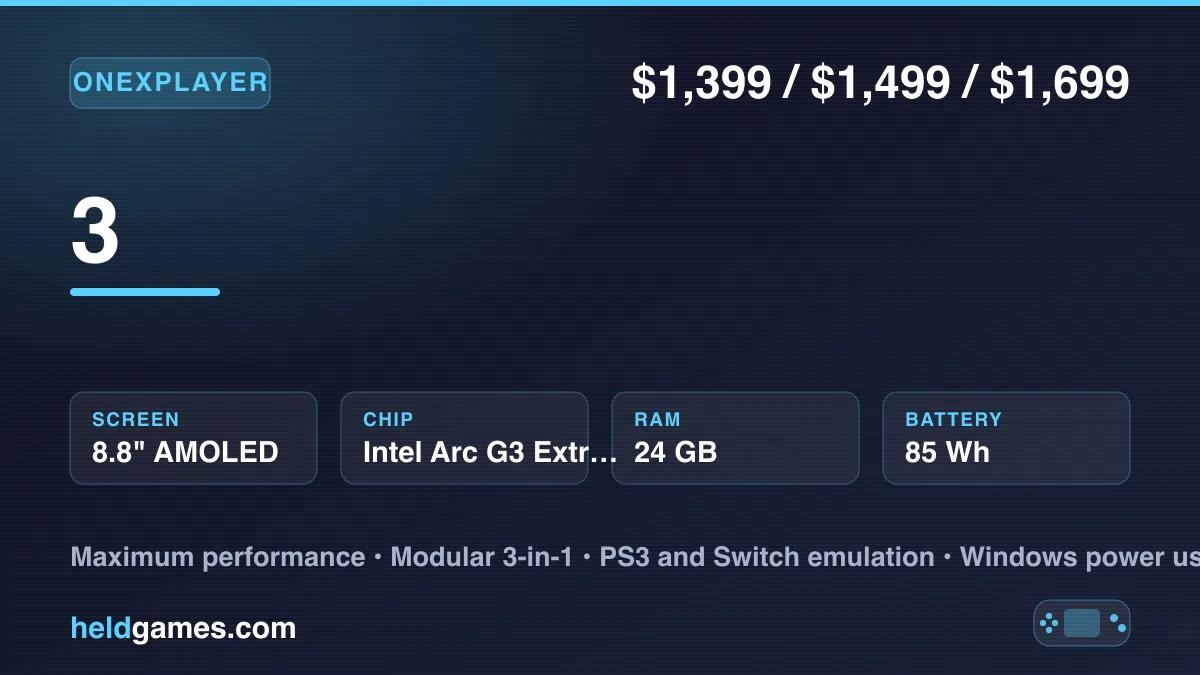
Let us be clear about where the OneXPlayer 3 sits. This is not a couch device for SNES and Game Boy. It starts at $1,399, which is more than a ROG Xbox Ally X and roughly twenty five times the price of an RG35XX. It plays in a different league. What it offers for that money is a genuine first. It is the first shipping handheld built on Intel's Arc G3 Extreme, and it is a modular machine that pulls apart into a handheld, a tablet, and a small Windows laptop.
The pitch is ambition. A big 8.8 inch 144Hz AMOLED screen, up to 32 GB of RAM, an 85Wh battery, and a chip whose Arc B390 graphics independent testing puts around laptop RTX 4050 level. That is real power, enough to run modern PC games at playable framerates and emulate everything through PS3 with headroom. The two asterisks are the price and the platform. This is Intel Arc graphics on full Windows 11, and both of those come with questions we get into below.
✓ Pros
- • First handheld with Intel's Arc G3 Extreme, OneXPlayer claims RTX 4050-class graphics
- • Gorgeous 8.8 inch 1920x1200 AMOLED at 144Hz with HDR
- • Modular 3-in-1: detach the controllers, add the magnetic keyboard, and it becomes a tablet or mini laptop
- • Up to 32 GB of RAM, the most headroom for demanding PS3 and Switch emulation
- • Large 85Wh battery, among the biggest in any handheld
- • Hall-effect sticks in the detachable controllers resist drift by design
- • Full Windows 11 runs every launcher, EmuDeck, and standalone emulators
- • USB4 and a Mini SSD slot make docking and storage upgrades easy
✗ Cons
- • Very expensive, starting at $1,399 and climbing to $1,699
- • Intel Arc GPU driver maturity for emulation still trails AMD, and RPCS3 lists Intel graphics as not recommended
- • Full Windows 11 friction: updates, driver management, and power tuning
- • Big and heavy at around 950g, a two-handed device that needs a bag
- • The 24GB configs use slower LPDDR5X-7467 memory than the 32GB model
- • The modular accessories add cost and more pieces to carry
Specs
Technical Specifications
| Screen | 8.8" AMOLED, 1920×1200, 144Hz VRR, HDR, 100% DCI-P3, up to 1100 nits |
| Processor | Intel Arc G3 Extreme (14-core, 18A Panther Lake), Arc B390 graphics (12 Xe3 cores) |
| RAM | 24GB LPDDR5X-7467 or 32GB LPDDR5X-8533 |
| Storage | 512GB or 1TB NVMe (Mini SSD) + microSD |
| Battery | 85Wh, 35W max power mode |
| Cooling | Vapor chamber (11,203mm²) + aluminum fin array (16,644mm²) |
| OS | Windows 11 |
| Controllers | Detachable, Hall-effect sticks, touchpad |
| Connectivity | Thunderbolt 4 / USB4, USB-A, Mini SSD, microSD, 3.5mm, Wi-Fi 7, Bluetooth 6.0 |
| Weight | ~950g (2.1 lb) |
| Price | $1,399 (24GB/512GB), $1,499 (24GB/1TB), $1,699 (32GB/1TB) |
The Modular Idea
The headline feature is the form factor. The controllers detach from both sides, like a Legion Go or a Switch. On its own the main unit is a tablet with a kickstand. Add the magnetic backlit keyboard and it becomes a small Windows laptop. OneXPlayer calls it a 3-in-1, and for once the marketing describes something real.
This matters more than it sounds. A handheld this powerful is also a capable PC. Being able to prop it up, clip on a keyboard, and answer email or edit a document turns it from a toy into a tool. If you travel and want one device that games and works, the modular design is the strongest argument for the OneXPlayer 3 over a fixed handheld.
The tradeoff is pieces. The keyboard is a separate accessory, the controllers are removable parts, and that is more to pack and more to lose. Modular always trades tidiness for flexibility.
The Chip: Intel Arc G3 Extreme
This is the first handheld to ship with Intel's Arc G3 Extreme, built on the 18A process. It is a 14 core chip, with 2 performance cores, 8 efficient cores, and 4 low power cores, paired with the full Arc B390 graphics and its 12 Xe3 cores. That GPU is the story. Notebookcheck's analysis puts the Arc B390 in the same class as a laptop RTX 4050, trading blows with it across a range of games, which is a level of integrated graphics no handheld has had before.
Against AMD's Ryzen Z2 Extreme, the numbers favor Intel. PassMark scores put the G3 Extreme roughly 25% ahead in multi-threaded CPU work, and Intel's own gaming tests claim up to around 42% higher framerates at a matched 35W. Vendor numbers deserve a grain of salt, but early independent gaming results back up the general picture. On raw performance, this is the fastest handheld chip you can buy right now.
Here is the caution, and it matters for a retro site. Raw performance and emulation are different problems. Intel GPUs have historically lagged AMD for emulators, and RPCS3, the main PS3 emulator, currently lists Intel graphics as not recommended because they lack some of the Vulkan features it needs. PS3 emulation is also very CPU heavy, and the G3 Extreme's strong CPU helps there, but the GPU driver side is the real risk. There is no dedicated emulation testing on this chip yet, so if PS3 or Switch emulation is your main reason to buy, wait for hands-on results rather than assuming the raw power translates.
PC Gaming Performance
Early hands-on numbers show the chip delivers on modern PC games at the screen's native 1200p. Cyberpunk 2077 runs around 60fps at 1200p, Red Dead Redemption 2 clears 70fps at 1200p, and Forza Horizon 6 pushes past 80fps at 1200p. Spider-Man 2 stays playable at 900p with the power mode turned up. These are numbers no previous handheld chip could hold at this resolution, and they line up with the RTX 4050 laptop comparison. For native PC gaming, the OneXPlayer 3 is the fastest handheld on the market.
Display
The 8.8 inch AMOLED is a highlight with no asterisk. At 1920x1200 it is sharp, and AMOLED gives it the deep blacks and vivid color that an LCD handheld cannot match. The 144Hz refresh with VRR is smoother than almost anything else in the category, and HDR with up to 1100 nits of peak brightness makes it usable outdoors. For a premium device, this is the screen you want.
Windows 11 on a Handheld
The OneXPlayer 3 runs full Windows 11, not a console style OS. That is the source of its power and its friction. Every storefront works, including Steam, Epic, and Game Pass, and every emulator installs the way it would on a desktop. EmuDeck runs on Windows and can set up a full emulation library for you.
The cost is maintenance. Windows updates arrive at the worst times, drivers need attention, and getting good battery life means tuning power profiles per game. If you want a device that boots into a clean game menu and just works, this is not it. If you want maximum control and compatibility, Windows is the point.
Battery Life
The 85Wh battery is one of the largest in any handheld, and it feeds a device with a 35W maximum power mode. Early testing shows the range you would expect. Light indie games at around 5W can stretch to roughly 10 hours, AAA titles at 17W land near 3.5 hours, and pushing the chip to its full power mode drops runtime to under 2 hours. That is the same tradeoff every powerful Windows handheld makes. The big battery buys long sessions in retro and 2D games and short ones when you run the chip flat out.
Who Is This For?
The OneXPlayer 3 is for a specific buyer. You want the newest silicon, you want the flexibility of a device that turns into a tablet and a laptop, and the $1,399 and up price is not a dealbreaker. You are comfortable with Windows and willing to babysit drivers to get the best out of it.
If you mostly emulate through PS2 and want the smoothest experience for the least money, a Steam Deck OLED or a Legion Go S on SteamOS makes far more sense. If you want the most proven power for emulation today, the ROG Xbox Ally X with its AMD chip is the safer flagship. Our OneXPlayer 3 vs ROG Ally X comparison and premium Windows handhelds guide map the whole tier. The OneXPlayer 3 is the bleeding edge pick, and the bleeding edge always costs more and carries more risk.
Frequently Asked Questions
Is the OneXPlayer 3 worth $1,399?
Only if you specifically want the modular design or the Intel Arc G3 Extreme. For pure gaming performance per dollar, a ROG Xbox Ally X does most of the same work for far less. You are paying for the three in one concept and for being first on new Intel silicon.
Can the OneXPlayer 3 emulate PS3?
Yes. The Arc B390 graphics land around laptop RTX 4050 level, which clears PS3 emulation in RPCS3 with headroom. Our best handhelds for PS3 emulation guide covers what that actually requires.
Can it emulate Xbox 360?
Yes, through Xenia on Windows, though Xenia remains less mature than RPCS3. Where a native recompiled port exists it will run far better, and our Xbox 360 recompiled games list tracks which games have one.
How is Intel Arc for handheld gaming?
Better than it was, and still the main question mark on this device. Arc drivers have improved a lot, but AMD and NVIDIA have deeper per game optimization histories. Expect the occasional title that needs a driver update before it behaves.
OneXPlayer 3 or ROG Xbox Ally X?
The Ally X is cheaper, lighter, and runs on better established graphics drivers. The OneXPlayer 3 has the bigger 8.8 inch AMOLED, more RAM, a larger battery, and the modular trick. See our OneXPlayer 3 vs ROG Ally X comparison for the full breakdown.
Does it run SteamOS?
It ships with Windows 11. Third party SteamOS installs are a moving target on new hardware, and we would not buy this device expecting it. Our SteamOS on third party handhelds guide covers where that stands.
Final Verdict
The OneXPlayer 3 is one of the most ambitious handhelds ever made. A stunning 144Hz AMOLED screen, a genuinely useful modular design, and Intel's newest chip add up to a device that wants to be your handheld, your tablet, and your laptop at once. It is also the most expensive way to emulate, and it inherits every rough edge of Windows plus the open question of Intel Arc driver maturity.
If you are an enthusiast who wants the newest thing and a do-everything form factor, and you can stomach the price, it is exciting. Most people should wait for independent emulation testing and buy a proven AMD flagship or a SteamOS device for a fraction of the cost.
Related reading
 ReviewReview
 Comparison