
Affiliate disclosure: This review contains affiliate links. As an Amazon Associate, we earn from qualifying purchases at no extra cost to you. Learn more.
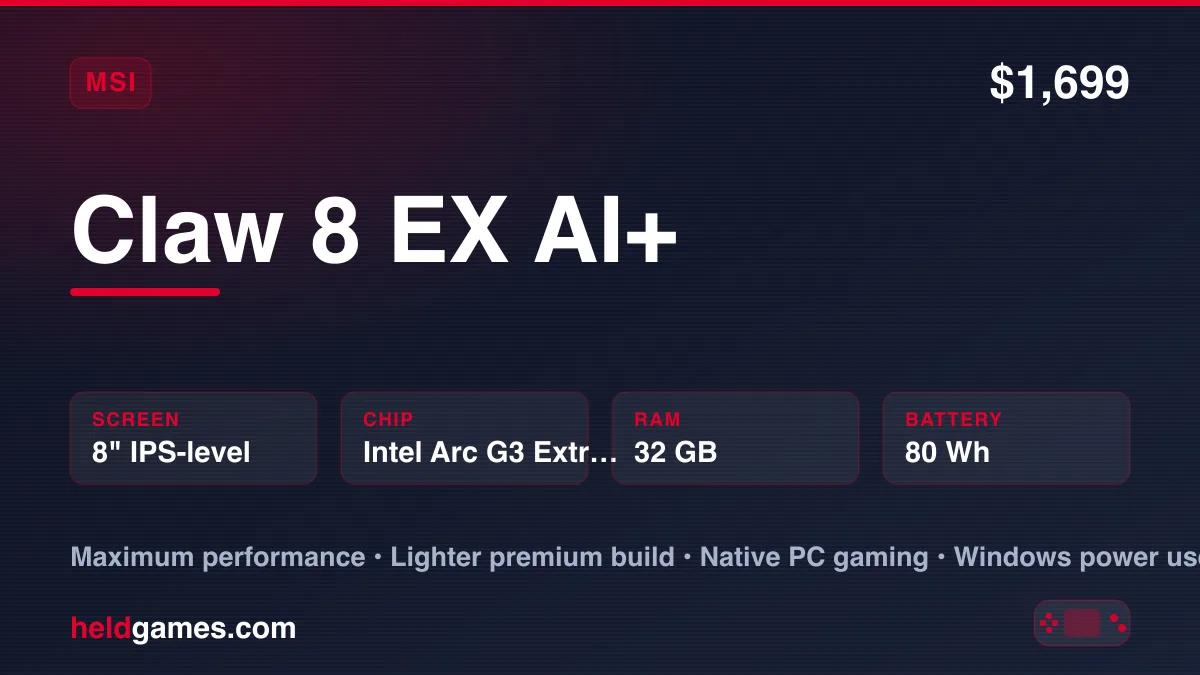
Let us place the MSI Claw 8 EX AI+ before anything else. This is a flagship, not a couch device for SNES and Game Boy. It costs $1,699, which is more than a ROG Xbox Ally X and many times the price of an RG35XX. What it offers for that money is a seat at the front of the pack. It is one of the first handhelds built on Intel's Arc G3 Extreme, the same chip class as the OneXPlayer 3, wrapped in a body that is lighter and easier to hold than that modular rival.
The pitch is power without the compromises of a convertible. A large 8 inch 120Hz screen, 32 GB of RAM, a 1 TB SSD, and an 80Wh battery back a chip that plays modern PC games at native resolution and emulates everything through PS3 with headroom. The two asterisks are the price and the platform. This is Intel Arc graphics on full Windows 11, and both of those come with questions we get into below.
✓ Pros
- • One of the first handhelds on Intel's Arc G3 Extreme, the fastest handheld chip class you can buy
- • Large 8 inch 1920x1200 screen at 120Hz with variable refresh
- • 32 GB of RAM and a 1 TB SSD as standard, plenty for demanding PS3 and Switch emulation
- • Lighter than the OneXPlayer 3 at around 785g, and comfortable for long sessions
- • Hall-effect sticks and triggers resist drift by design
- • Cooler Boost HyperFlow dual-fan cooling keeps the chip fed under load
- • Full Windows 11 runs every launcher, EmuDeck, and standalone emulators
- • Thunderbolt 4 makes docking and storage expansion easy
✗ Cons
- • Very expensive at $1,699
- • Intel Arc GPU driver maturity for emulation still trails AMD, and RPCS3 lists Intel graphics as not recommended
- • IPS-level LCD panel, not the AMOLED you get on the OneXPlayer 3
- • Full Windows 11 friction: updates, driver management, and per-game power tuning
- • Heavy and large for a handheld at around 785g, a two-handed device
- • No modular tablet or laptop mode, unlike the OneXPlayer 3
Specs
Technical Specifications
| Screen | 8" IPS-level, 1920×1200, 48–120Hz VRR, 500 nits, 100% sRGB |
| Processor | Intel Arc G3 Extreme (14-core, Panther Lake, up to 4.7 GHz) |
| Graphics | Intel Arc B390 (12 Xe cores) |
| RAM | 32GB LPDDR5X-8533 |
| Storage | 1TB NVMe (PCIe Gen4) + microSD |
| Battery | 80Wh |
| Cooling | Cooler Boost HyperFlow, dual fans + heat pipes |
| OS | Windows 11 |
| Controls | Hall-effect sticks and triggers |
| Connectivity | Dual Thunderbolt 4 (DP / PD 3.0), microSD, Wi-Fi 7, Bluetooth 6 |
| Weight | 785g |
| Price | $1,699 (32GB/1TB, model CG3EM-024US) |
The Chip: Intel Arc G3 Extreme
The headline is the silicon. The Claw 8 EX AI+ is one of the first handhelds to ship on Intel's Arc G3 Extreme, the same chip class that powers the OneXPlayer 3. Neither device gets to claim it invented this platform. They arrived together, and they represent the leading edge of Intel's push into handhelds.
That chip is the reason to consider this device. Its Arc B390 graphics land in a class no previous handheld has reached, and against AMD's best handheld silicon the raw numbers favor Intel across CPU and GPU work. On native PC gaming, this is as fast as handhelds get right now.
Here is the caution, and it matters for a retro site. Raw performance and emulation are different problems. Intel GPUs have historically lagged AMD for emulators, and RPCS3, the main PS3 emulator, currently lists Intel graphics as not recommended because they lack some of the Vulkan features it needs. PS3 emulation is also very CPU heavy, and the G3 Extreme's strong CPU helps there, but the GPU driver side is the real risk. There is no deep emulation testing on this chip yet, so if PS3 or Switch emulation is your main reason to buy, wait for hands-on results rather than assuming the raw power translates.
PC Gaming Performance
For native PC games at the screen's 1200p resolution, the Arc G3 Extreme delivers. This is the chip class that finally makes 1200p a realistic target on a handheld, where the previous generation topped out lower. Modern AAA games stay playable at native resolution with the power mode turned up, and lighter titles run with room to spare. For running your Steam library on the go, the Claw 8 EX AI+ sits at the top of the market.
Display
The 8 inch panel is large and sharp at 1920x1200, and the 120Hz refresh with variable refresh rate keeps motion smooth. It covers 100% of sRGB and reaches around 500 nits, so it is bright and colorful in normal use. The one honest caveat against its closest rival is the panel type. This is an IPS-level LCD, not AMOLED, so it cannot match the deep blacks and vivid color of the OneXPlayer 3's screen. For most players in most lighting it still looks great, and the size and refresh rate matter more day to day than contrast. If screen quality is your single priority, though, AMOLED wins.
Windows 11 on a Handheld
The Claw 8 EX AI+ runs full Windows 11, not a console style OS. That is the source of its power and its friction. Every storefront works, including Steam, Epic, and Game Pass, and every emulator installs the way it would on a desktop. EmuDeck runs on Windows and can set up a full emulation library for you.
The cost is maintenance. Windows updates arrive at the worst times, drivers need attention, and getting good battery life means tuning power profiles per game. If you want a device that boots into a clean game menu and just works, this is not it. If you want maximum control and compatibility, Windows is the point.
Battery Life
The 80Wh battery is large, and it feeds a chip that can draw a lot of power. Expect the same tradeoff every powerful Windows handheld makes. Light indie and 2D games sip power and stretch to long sessions, mid weight titles land in the low hours, and pushing the chip to its full power mode drops runtime sharply. The big battery buys long sessions in retro and 2D games and short ones when you run the chip flat out.
Who Is This For?
The Claw 8 EX AI+ is for a specific buyer. You want the newest silicon, you want a large fast screen, and you would rather have a lighter one piece handheld than a modular convertible. The $1,699 price is not a dealbreaker, and you are comfortable with Windows and willing to babysit drivers to get the best out of it.
If you mostly emulate through PS2 and want the smoothest experience for the least money, a Steam Deck OLED or a Legion Go S on SteamOS makes far more sense. If you want the most proven power for emulation today, the ROG Xbox Ally X with its AMD chip is the safer flagship. And if you want the same Arc G3 Extreme chip with an AMOLED screen and a modular tablet and laptop mode, the OneXPlayer 3 is the do-everything alternative.
Final Verdict
The MSI Claw 8 EX AI+ is one of the most powerful handhelds you can buy, and it makes a smart argument. It takes the same leading edge Intel chip as the OneXPlayer 3 and puts it in a lighter, more comfortable body without the extra pieces of a modular design. For raw PC gaming on the go it is superb. It is also the most expensive way to emulate, it uses an LCD rather than AMOLED, and it inherits the open question of Intel Arc driver maturity.
If you are an enthusiast who wants the newest thing in a body you can actually hold for hours, and you can stomach the price, it is a compelling pick. Most people should wait for independent emulation testing and buy a proven AMD flagship or a SteamOS device for a fraction of the cost.
Related Reading
Related reading
 ReviewReview
 Comparison