
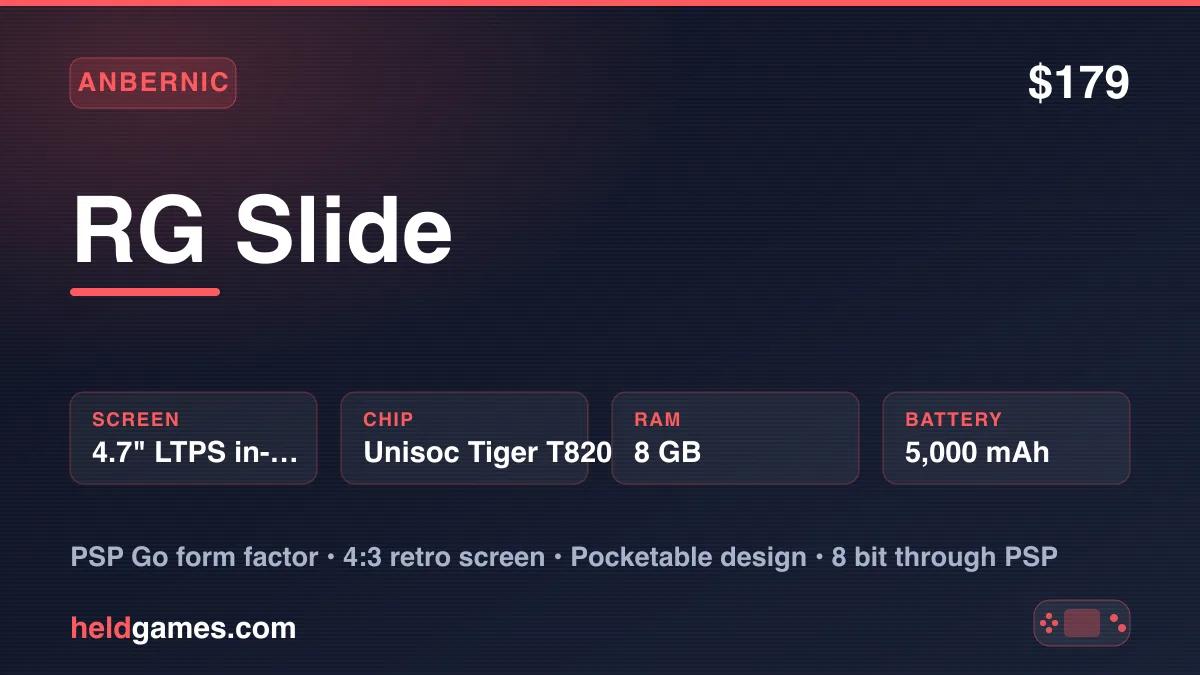
Anbernic ships a lot of handhelds. Most of them are slabs. The RG Slide is the rare one that tries something genuinely different. The screen slides up to reveal the controls underneath, exactly like the old PSP Go. It is a fun, tactile idea, and it makes the device far more pocketable when closed.
Underneath the novelty is a sensible mid tier handheld. The 4.7 inch screen uses a 4:3 LTPS panel, which is a lovely fit for retro systems. The Unisoc T820 chip and 8 GB of RAM put it in the middle of the pack for power. This is not a Retroid Pocket 6 rival. It is a charming device for fans of classic systems who like a clever form factor.
Specs
| Screen | 4.7 inch LTPS in cell, 1280x960, 4:3, up to 120Hz |
| Processor | Unisoc Tiger T820, octa core |
| GPU | Mali G57 quad core at 850MHz |
| RAM | 8 GB LPDDR4X |
| Storage | 128 GB UFS 2.2, microSD expansion |
| Battery | 5000 mAh, 10W charging, roughly 6 hours |
| OS | Android 13 |
| Form factor | Sliding screen over a control deck |
| Weight | About 379 g |
| Connectivity | Dual band Wi Fi, Bluetooth 5.0 |
The Sliding Deck Is the Whole Point
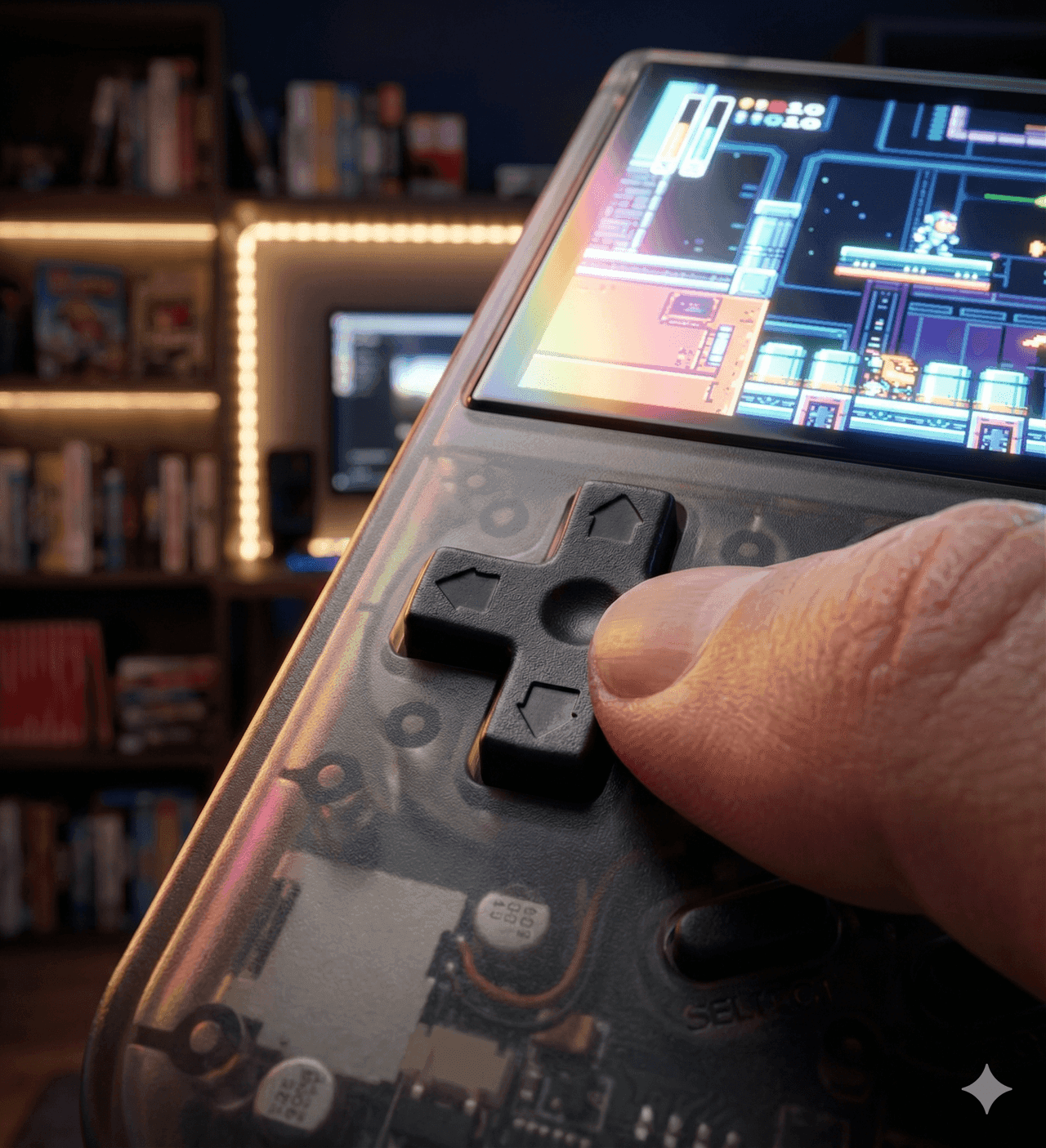
The headline feature is the slide. Closed, the RG Slide is a compact rectangle that drops into a pocket easily. Open it, and the screen lifts up to reveal a full control deck. It is the PSP Go layout, brought back for 2026.
The mechanism feels solid in use. The slide action has a satisfying snap. The trade off is honest. A slider has moving parts. A slab does not. If you want the most rugged possible device, a traditional handheld like the Anbernic RG40XXV is the safer call. If you love the form factor, the slide is a delight.
The 4:3 Screen Is a Smart Choice
Most modern handhelds use 16:9 panels. The RG Slide uses 4:3, and for retro content that is the better shape. NES, SNES, Genesis, PS1, and most arcade games were made for roughly square screens. On a 4:3 panel they fill the display with no pillarbox bars.
The 4.7 inch LTPS screen is sharp at 1280x960 and runs at up to 120Hz. It is an LCD, not an OLED, so deep blacks and contrast trail the AMOLED flagships of 2026. For bright, colorful retro games the panel looks great in daily use.
Emulation Performance
The Unisoc T820 is a capable mid tier chip. Set your expectations there and you will be happy.
- NES, SNES, Genesis, Game Boy through GBA. Full speed, every title, no fuss.
- PS1. Full library, full speed.
- Nintendo 64. Strong. The bulk of the library runs well with the right core.
- Dreamcast. Good. Most of the library plays at full speed via Flycast. See the Flycast Dreamcast setup guide.
- PSP. Good. Many titles run at full speed, with the heaviest games needing tuning. The 4:3 screen does mean pillarboxing for PSP's 16:9 output.
- PS Vita. Possible but limited on this class of chip. The Odin 3 is a far better Vita3K device. See the PS Vita emulation guide.
- PS2 and GameCube. This is the ceiling. A subset of lighter titles is playable with tuning. Do not buy the RG Slide expecting a consistent PS2 or GameCube machine.
If heavy PS2 and GameCube are your priority, step up to a Snapdragon device like the Retroid Pocket 6 or the Anbernic RG557.
Software
The RG Slide runs full Android 13 with the Play Store. Every major Android emulator works. We suggest installing a front end like Daijisho or ES DE for Android on top of the stock launcher, then using the RetroArch setup guide to dial in cores.
The stock Anbernic launcher remains the weakest part of the Anbernic software story. It is functional. Most owners replace it. The good news is that on Android, doing so takes only a few minutes.
Battery and Charging
The 5000 mAh battery delivers roughly six hours of typical retro play. Lighter 8 and 16 bit systems stretch longer. PSP and Dreamcast pull it down. For a device this pocketable, the battery is reasonable.
Who Should Buy the Anbernic RG Slide
Buy the RG Slide if you love the PSP Go sliding form factor; your library is mostly 8 bit through PSP; you want a 4:3 screen for retro systems; you want something genuinely different from another black slab.
Skip the RG Slide if you want a reliable PS2 or GameCube machine (look at the Retroid Pocket 6); you prefer the deep contrast of OLED; you want the simplest, most rugged device with no moving parts.
The RG Slide is not the most powerful handheld of 2026. It might be the most fun to pick up. For the right buyer, that counts for a lot.
Frequently Asked Questions
How much does the Anbernic RG Slide cost?
Around $179. Pricing and configurations are listed on the official Anbernic store.
What can the RG Slide emulate?
Everything from the 8 bit and 16 bit era through PS1, N64, Dreamcast, and most of PSP. PS2 and GameCube are the ceiling, with only lighter titles playable.
Does the RG Slide have an OLED screen?
No. It uses a 4.7 inch 4:3 LTPS LCD at 1280x960. The shape is excellent for retro systems, but contrast trails the AMOLED handhelds.
Is the sliding mechanism durable?
The slide feels solid in hand. Long term durability data is not available at review time, which is the usual trade off for any device with moving parts.
Does the RG Slide run Android?
Yes. It ships with full Android 13 and the Play Store, so any Android emulator or front end works.
Related Reading
The Verdict4.1 / 5
The Anbernic RG Slide is the most interesting form factor Anbernic has shipped in a while. The sliding control deck is genuinely fun, the 4:3 LTPS screen is a perfect match for retro systems, and the price is reasonable. The Unisoc T820 keeps it firmly in the mid tier, so set expectations at PSP, Dreamcast, and N64 rather than heavy PS2 or GameCube. If you love the PSP Go idea and play mostly 8 bit through PSP, the RG Slide is a charming pick.
Related reading
 ReviewReviewReview