
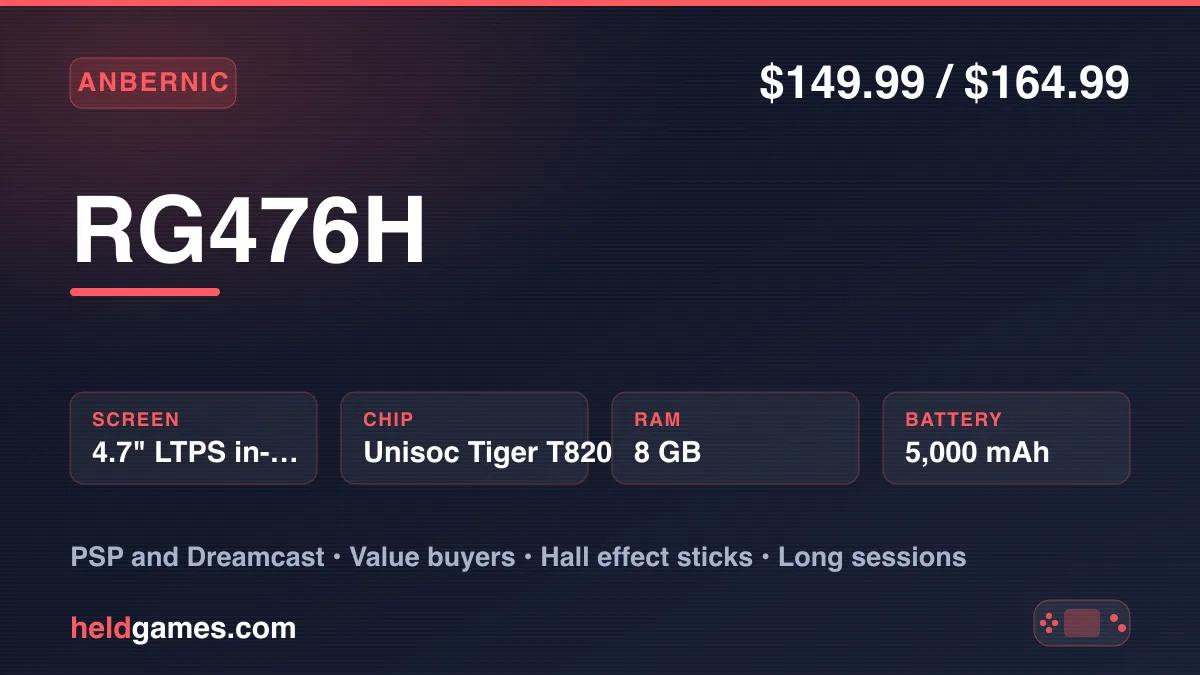
The Anbernic RG476H is easy to overlook. It sits between the budget H700 Linux devices and the flagship Dimensity 8300 models, and it does not have a headline feature to shout about. What it has is a very good screen, a comfortable body, and a price that keeps drifting down.
That combination is more compelling than it sounds. The 4.7 inch 1280x960 panel here is the same size and resolution as the one in the RG477V and the RG477M, devices that cost $60 to $130 more. You are buying most of the viewing experience for a lot less money.
This review is based on published specifications and hands on coverage from retail units. We have not tested one ourselves.
Specs
| Screen | 4.7 inch LTPS in-cell, 1280x960, 4:3, up to 120Hz |
| Processor | Unisoc Tiger T820 (6nm octa-core) |
| GPU | Mali-G57 (quad-core) |
| RAM | 8 GB |
| Storage | 128 GB, microSD expansion |
| Battery | 5,000 mAh, rated around 6 hours |
| OS | Android 13 |
| Controls | 3D Hall effect analog sticks, D-pad, four shoulder buttons |
| Design | Horizontal, glass and plastic shell |
| Street price | $164.99 retail, $149.99 at launch |
Affiliate disclosure: This page contains affiliate links. As an Amazon Associate, we earn from qualifying purchases at no extra cost to you. Learn more.
The Screen Is the Reason to Buy It
Anbernic put a genuinely nice panel in a mid-range device here. The 4.7 inch LTPS in-cell display runs 1280x960 in a true 4:3 ratio and supports refresh rates up to 120Hz.
That resolution does real work. At 1280x960 a lot of retro sources scale cleanly. SNES, GBA, and Game Boy all land on tidy integer multiples, which keeps pixel art crisp instead of smeared. PS1 content looks right. The in-cell construction means the pixels sit close to the glass, so contrast holds up outdoors better than on cheaper laminated panels.
The 4:3 shape carries the usual trade off. Retro systems from NES through PS2 fill the screen. PSP and other 16:9 content gets letterboxed with bars top and bottom. Given the T820's performance profile, though, PSP is a system you will actually spend time with here, so those bars are worth thinking about before you buy.
The Unisoc T820 Ceiling
The T820 is the same chip Anbernic used in the RG Slide and the RG556. It is a capable mid-range part, and it is important to be honest about where it stops.
- NES through PS1: Effortless. Nothing to configure.
- N64: Full speed on the vast majority of the library.
- Dreamcast: Excellent through Flycast.
- PSP: Very good. Most of the library at full speed, some heavy titles wanting settings work.
- Saturn: Playable but fussy, as Saturn always is. Our Saturn emulation guide explains why.
- PS2: Partial. Lighter 2D and mid-tier 3D titles run. Demanding games do not. Do not buy this expecting the PS2 library.
- GameCube: Largely out of reach beyond a handful of light titles.
- Switch: No.
Anbernic's own marketing claims the device handles "most of your PS2 games." Treat that with caution. The T820 can run a meaningful slice of PS2, but "most" oversells it. If PS2 is the reason you are shopping, spend up to a Dimensity 8300 device.
Like the 477 models, the T820 uses a Mali GPU, which means the same driver caveats apply. Emulator optimization tends to target Qualcomm Adreno first, so some titles behave better on a Snapdragon device at similar raw performance.
Build and Comfort
The RG476H is horizontal, which is the right call for a device you will use for long PSP and N64 sessions. Your hands spread out, your fingers rest naturally on the shoulder buttons, and nothing cramps after an hour.
The shell mixes glass and plastic. It is not the CNC aluminum of the RG477M, but nothing here feels cheap for the money.
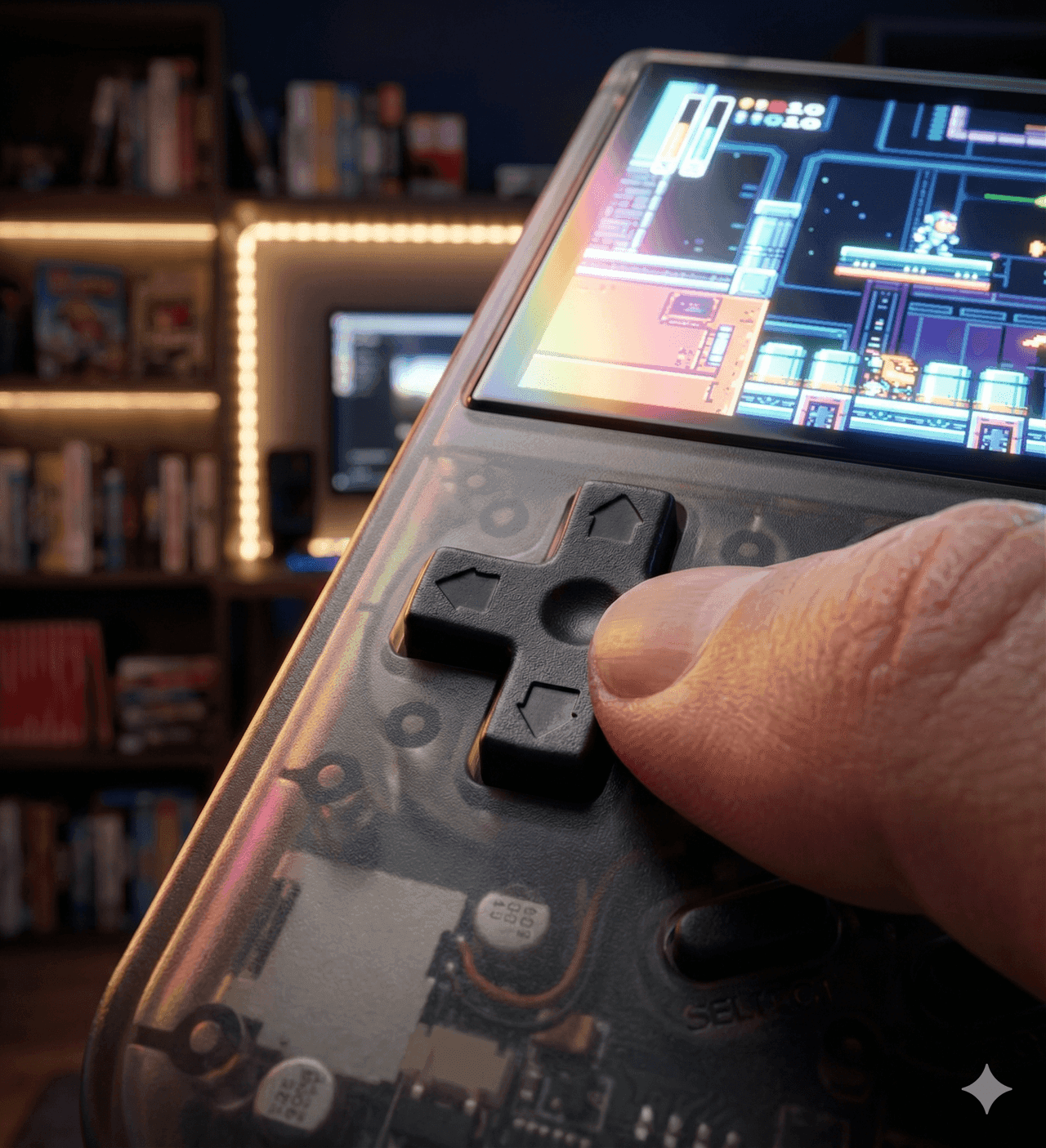
The standout inclusion is 3D Hall effect analog sticks. Hall sticks use magnetic sensors instead of physical contacts, so they do not wear into stick drift over time. Finding them at this price is unusual and it is a real long term value argument. Our stick drift guide covers why this matters.
Battery
The 5,000 mAh cell is rated at roughly six hours. That rating assumes moderate work. Light 8 bit and 16 bit emulation goes considerably longer. Sustained PSP or PS2 pulls it down toward four.
This is a solid result for the size, and it comfortably clears a long flight with lighter systems.
Software
Android 13 with full Google Play access. Install RetroArch, standalone emulators, or a frontend and go. Anbernic preloads emulators with working button maps, so it is usable straight out of the box.
Android 13 is a little dated by mid 2026 but nothing in the emulation stack requires newer. As with every Anbernic Android device, the stock launcher is functional and forgettable. Daijishō or ES-DE makes the whole thing feel like a real console.
Where It Sits
| RG476H | RG477V | Retroid Pocket 5 | |
|---|---|---|---|
| SoC | Unisoc T820 | Dimensity 8300 | Snapdragon 865 |
| GPU | Mali-G57 | Mali-G615 MC6 | Adreno 650 |
| RAM | 8 GB | 8 or 12 GB | 8 GB |
| Screen | 4.7 inch 1280x960 4:3 120Hz | 4.7 inch 1280x960 4:3 120Hz | 5.5 inch AMOLED 16:9 |
| Battery | 5,000 mAh | 5,500 mAh | 5,000 mAh |
| PS2 | Partial | Comfortable | Good |
| Street price | $164.99 | $219 | $219 |
The RG476H's argument is simple. It costs about $55 less than either alternative and gives you the same screen as the RG477V. What you sacrifice is the top of the emulation ladder.
Against the Retroid Pocket 5, the choice is screen shape and GPU. The RP5 has a 16:9 AMOLED and an Adreno GPU with better driver support, which makes it stronger for PSP and Switch attempts. The RG476H has the 4:3 panel that suits retro better, plus Hall sticks and a lower price.
Who Should Buy the RG476H
Buy it if you want the best screen and comfort you can get around $150, your library runs from NES through PSP and Dreamcast, you want Hall effect sticks so drift never becomes your problem, and you are happy treating PS2 as a bonus rather than a promise.
Skip it if you want the PS2 library properly, GameCube or Switch matter to you, PSP dominates your library and the letterboxing would bother you, or you would rather save more and take an RG35XX H at a third of the price.
The RG476H will not excite anyone on a spec sheet. It is just a well judged device at a fair price, and it gets frequently discounted below $150, which makes it one of the better value propositions Anbernic currently sells.
Frequently Asked Questions
How much does the Anbernic RG476H cost?
$164.99 at retail. Pre-orders launched at $149.99, and the device is frequently discounted below that on AliExpress.
Can the Anbernic RG476H run PS2 games?
Partially. Lighter 2D and mid-tier 3D PS2 titles run, but the demanding end of the library does not. Anbernic's claim that it handles "most" PS2 games oversells the Unisoc T820. For dependable PS2, look at a Dimensity 8300 device like the RG477V.
What chip does the RG476H use?
A Unisoc Tiger T820, a 6nm octa-core chip with a quad-core Mali-G57 GPU. It is the same chip found in the Anbernic RG Slide and RG556.
Does the RG476H have Hall effect sticks?
Yes. It ships with 3D Hall effect analog sticks, which use magnetic sensors and do not develop stick drift over time.
How long does the RG476H battery last?
The 5,000 mAh battery is rated at around six hours. Expect longer with 8 bit and 16 bit systems, and closer to four hours with sustained PSP or PS2.
Is the RG476H better than the Retroid Pocket 5?
They target different things. The RG476H costs about $55 less and has a 4:3 screen better suited to retro systems. The Retroid Pocket 5 has a 16:9 AMOLED, a Snapdragon 865 with better emulator driver support, and a higher PS2 ceiling.
Related Reading
The Verdict4.1 / 5
The RG476H is the value play in Anbernic's Android range. You get the same excellent 4.7 inch 1280x960 120Hz panel as the far pricier 477 models, plus 8 GB of RAM, Hall effect sticks, and a comfortable horizontal body, for around $150. The Unisoc T820 sets the ceiling. Everything through PSP and Dreamcast is easy, and a good chunk of PS2 works, but GameCube and Switch are not really on the menu. If your library stops at PS2 and you want the most screen and comfort per dollar, this is a genuinely smart buy.
Related reading
 ReviewReviewReview